


My May 26 article argued that the crisis of Trumpism should not be read merely as a shift in public support or as another ordinary chapter in the competition between Republicans and Democrats. The stakes were deeper: whether the social demand Donald Trump had tapped into — protection, recognition, defense of the national community, and hostility toward elites seen as predatory — could survive the Trump coalition and find a different political vehicle on the left. That demand is increasingly linked to the problem of affordability: the cost of housing, health care, education, mobility, energy, raising children, and old age — in other words, the widening gap between disposable income and the way of life Americans were promised. In May, Graham Platner’s Senate candidacy in Maine appeared to offer an early test of that hypothesis. Four months later, that reading needs revisiting, testing, and correction. Not because the demand has disappeared. Quite the opposite: events between May and August have shown that the demand is greater than the candidate who seemed to embody it. 1
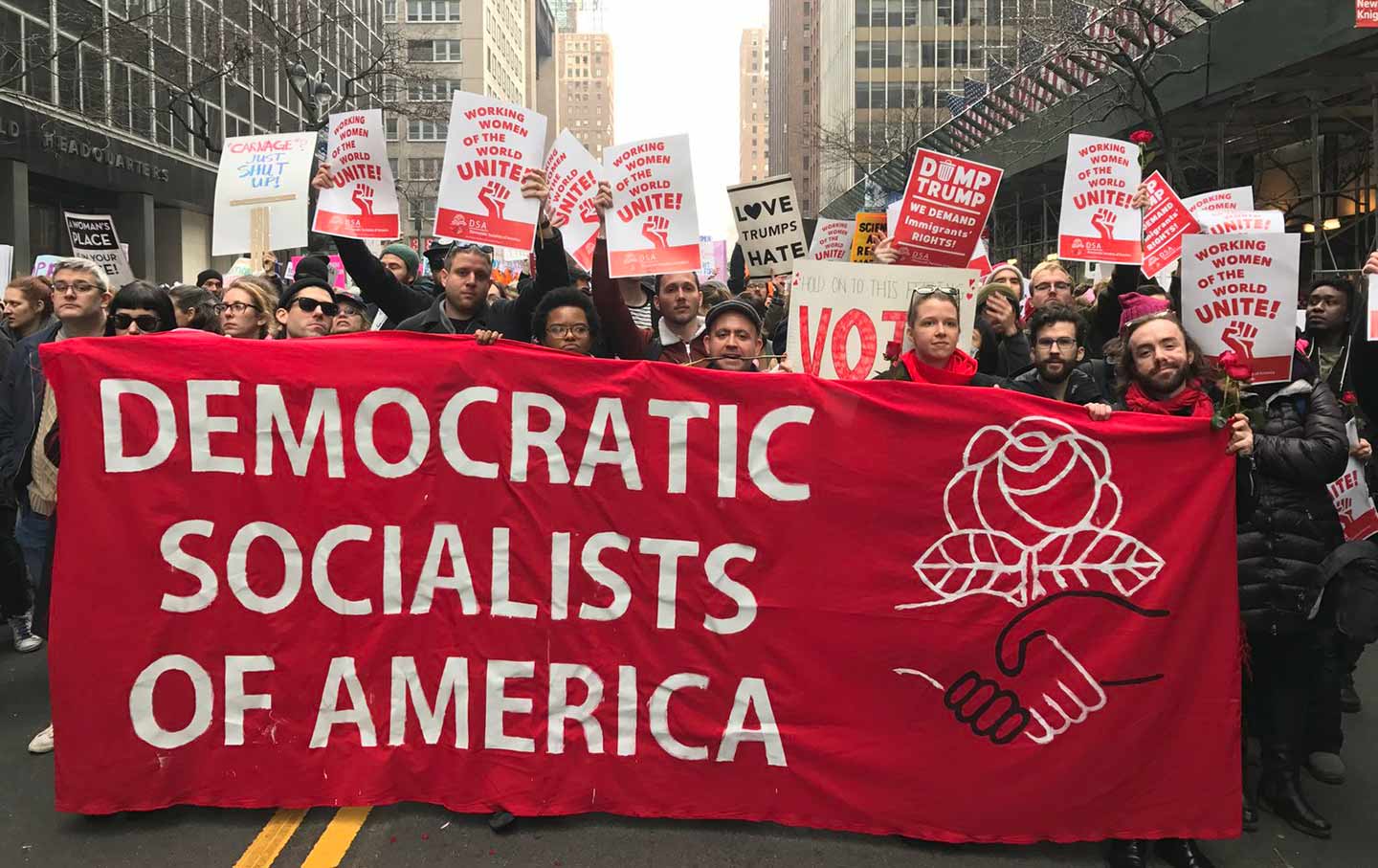
The battle over American populism is now unfolding within the Democratic Party. Social conflict is re-emerging in primaries — the institutional machinery that selects personnel, language, and priorities before any of them must face the general electorate. Between June and August, many incumbents fell there; social Democrats advanced (9 of them won, 17 lost); better-funded moderates were defeated. But that was also where the limits of the progressive surge became visible once “socialist” became a national target.
The Candidate Falls, the Demand Remains
Platner is the first case we must revise in our earlier analysis. In May, his candidacy seemed an unusually plausible synthesis: a military background, manual labor, local roots, criticism of war, anti-billionaire rhetoric, and support for robust social policy. Precisely because he combined in a single political persona what progressives so often lack — social credibility, territorial belonging, and a non-campus aesthetic — his campaign seemed capable of testing how permeable parts of post-MAGA America might be to left-wing populism. The test ended before November. Platner won Maine’s Democratic primary, then withdrew in July after an allegation of sexual assault, which he denied, made continuing the campaign politically untenable. 2
The left cannot treat this as a secondary incident. If it intends to rebuild trust in a society already convinced that every camp protects its own, it cannot ask for moral rules to be suspended simply because the accused belongs to the right cause. That would reproduce the tribalism it condemns on the right. At the same time, Platner’s withdrawal does not erase what his candidacy revealed. Instead, it shows how fragile insurgencies are when they lack their own institutions. When the candidate and the movement become indistinguishable, a crisis involving the candidate can drag down the meaning invested in him. American politics over the past decade has become very good at finding theatrical bodies. It has been much less successful at building containers that can survive their collapse.
Replacing Platner with Troy Jackson changed the test. Jackson lacks Platner’s theatrical novelty. He is a fifth-generation logger, a union man, a former president of the Maine Senate, a longtime ally of Bernie Sanders, and a politician whose career has repeatedly been tested. His profile shifts the question from outsider charisma to the durability of rootedness. The question is no longer whether a new political persona can break through the system. It is whether a labor populism with legislative experience and rural roots can reach a white, independent, older, peripheral electorate in a state where Susan Collins still presents herself as a moderate Republican. The later emergence of a 1988 police report involving Jackson reminded us that even the slow-build model is not immune to biographical vulnerability. But that is precisely what makes the distinction useful. Authenticity is not enough. It has to be verifiable, organizable, and replaceable. 3
The transition from Platner to Jackson reveals two models of political legitimacy. The first is born of rupture: the man who appears to stand outside politics, discovered through the network, able to speak directly to a base that rejects institutions and party machinery. The second is born of accumulation: work, union, territory, local conflict, and the legislature. The first accelerates. The second endures. The emerging American left will likely need both, but it cannot afford to confuse them. Without figures capable of breaking the establishment’s language, no opening appears. Without organizations, rules, and rooted careers, nothing survives the impact.
Social Populism Did Not Begin in 2026
To understand why demand persists, we must separate it from the daily narrative of individual candidates. American populism did not begin with Trump, nor did it begin on the right. The People’s Party of the 1890s organized farmers and workers against the power of railroads, credit, and finance. The Omaha Platform of 1892 demanded greater Democratic control over money, transportation, and essential infrastructure. It was a contradictory movement, constrained by race and territory, but its central axis was not a war against the outsider. It was resistance to economic concentration that could impose political dependence. 4
The New Deal translated part of that intuition into state architecture. Roosevelt did not build a plebiscitary populism. He built an alliance in which unions, Social Security, financial regulation, public works, and labor rights protected democracy from its own oligarchic dissolution. Martin Luther King Jr.’s Poor People’s Campaign later sought to link racial justice to material security. Bernie Sanders restored criticism of billionaires, private healthcare, and debt to the national political vocabulary. The new antimonopoly turn, from Lina Khan to Tim Wu, updated that tradition for an age of platforms, digital concentration, and captured supply chains. 5
The decisive break came when the Democratic Party retained the language of rights but lost the language of material power. Deindustrialization, financialization, globalization, and the shift to market liberalism were presented as inevitable modernization. The loss of industrial work became an adjustment; student debt became an investment; the decline of midsize cities became the price of efficiency; and job insecurity became flexibility. The party continued to include identities and minorities, but it gradually ceased to look like an instrument capable of restraining those who controlled credit, healthcare, housing, work, and infrastructure. Trump entered that space. He did not eliminate the social question; he translated it. Immigrants replaced monopolies as the visible target; the culture war replaced redistribution as the mechanism of belonging; and the leader replaced organization as the locus of trust.
That is why the progressive advances of 2026 are not merely evidence that the left is growing. They are part of a contested effort to reclaim the American populist tradition. The new right uses “the people” as a source of legitimacy for stronger command and for replacing one elite with another — technological, wealthy, religious, and more willing to use the state against the opposing camp. Social populism instead seeks to use popular demand to limit any private aristocracy that controls the material conditions of citizenship: housing, credit, healthcare, work, education, data, platforms, networks, insurance, and campaign finance. The difference is not an anti-establishment tone; both sides share that. The difference is the direction of conflict: downward, against migrants and minorities, or upward, against those who control rents and the infrastructure of everyday life.
June: The Insurgency Moves Beyond Protest
The first visible signal came from New York. On June 23, the slate backed by Mayor Zohran Mamdani won three congressional primaries: Darializa Avila Chevalier defeated Adriano Espaillat; Brad Lander beat Dan Goldman; and Claire Valdez defeated the successor endorsed by retiring Representative Nydia Velázquez. Two sitting members of Congress were unseated, two Democratic socialists became all but certain to win in deeply blue districts, and House Democratic leader Hakeem Jeffries watched the candidates he had supported go down. A municipal victory had become a national school of candidate selection: not simply a progressive mayor, but a network capable of changing congressional primary outcomes. 6
A week later in Denver, Melat Kiros defeated Diana DeGette, a nearly thirty-year incumbent, in Colorado’s 1st District primary. In Washington, Janeese Lewis George won the Democratic nomination for mayor in a city where winning the primary is nearly tantamount to election. In Philadelphia, state legislator and avowed Democratic socialist Chris Rabb defeated better-funded candidates backed by the local establishment. These victories do not yet amount to a national wave, but they form a coherent sequence: social, youth-driven, or locally rooted anti-establishment campaigns — often connected to DSA networks or progressive coalitions — are turning primaries from incumbent ratification into trials of the party apparatus. 7
Their success also reflects local government’s transformation into a theater of national conflict. Housing, rents, transportation, energy costs, public safety, schools, grocery stores, minimum wages, health care, and policing are municipal or state issues before they become ideological symbols. A left that promises to do things — build housing, make transportation affordable, regulate utilities, expand care, and discipline rent-seeking — can present itself as a governing force rather than merely the system’s critical conscience. That marks a break from the period when progressivism often seemed better at naming injustice than at managing complexity.
August: The Frontier Expands and Finds Its Limits
On August 4, the test changed scale. In Michigan, Abdul El-Sayed narrowly defeated Representative Haley Stevens in the Democratic Senate primary, becoming the first progressive of this cycle to win a statewide nomination in a state Trump carried in 2024. A week later in Minnesota, Lieutenant Governor Peggy Flanagan defeated the more moderate Angie Craig in the Senate primary. That same night in Wisconsin, Democratic socialist Francesca Hong lost the Democratic gubernatorial primary to moderate David Crowley by just over three thousand votes. The geography of the insurgency had expanded, but Wisconsin made it impossible to mistake the sequence for a linear march to the left. 8
On August 18, another break came, more instructive because it occurred in Florida rather than in a progressive laboratory. Angie Nixon, a state legislator, labor organizer, and member of the Democratic Socialists of America, defeated Alexander Vindman in the Democratic Senate primary despite a massive fundraising disadvantage. The result confirms that the anti-establishment fracture is no longer confined to blue territory in the Northeast or Midwest. Yet Florida also reveals the sequence’s double face. On the one hand, a socialist candidate can defeat a nationally known military and media figure backed by far more money. On the other, she now enters a general election in a strongly Republican state, with a Hispanic electorate responsive to anti-communist language, making the race immediately more difficult for Democrats. 9
The August tests push the frontier without abolishing it. El-Sayed shows that a progressive can win a statewide contest in a battleground state. Hong’s defeat shows that the same dynamic can halt when voters perceive an electability risk or a too-heavy cultural burden. Flanagan points to a third possibility: ideological sharpness on some issues, combined with established institutional roots, without fully merging into DSA identity. Nixon adds a fourth: an anti-establishment victory in a red state, but with an even clearer general-election problem. The advance therefore does not signal a new socialist majority. It shows that an organized minority can change the personnel and vocabulary of the Democratic field even beyond safe urban districts, while the center retains its ability to resist and the general election retains its disciplinary power.
Primaries as a Machine for Radical Selection
This is where the primary system becomes central to the analysis. The American system does not merely register polarization; it helps select for it. When a district is not competitive, the real election does not take place in November. It takes place in the dominant party’s primary. The decisive voter is no longer the district’s median citizen but the one who is more motivated, more ideological, and more willing to invest time and money in the internal fight. The member of Congress arrives in Washington less as a broker for a mixed constituency than as the representative of a trench.
The mechanism operates on both the right and the left. Republican primaries reward more Trump-aligned candidates: hostile to compromise, dependent on the conservative media ecosystem, and inclined to treat politics as an existential struggle. Democratic primaries create openings for socialists, abolitionists, anti-interventionists, or aggressively redistributive candidates, especially where the risk of losing to a Republican is minimal. The symmetry lies in the mechanism, not in the substance. Universal healthcare is not equivalent to a theory of election fraud; a minimum wage is not equivalent to delegitimizing the constitutional order. Yet both camps learn that political survival depends more on base intensity than on the ability to appeal to the center. 10
Research on congressional primaries confirms this distortion. Primary voters are disproportionately strong partisans; they weigh shared values and promises of change more heavily than experience or the ability to beat the other party. In safe districts, members of Congress know that their main threat comes not from the general election but from an internal challenge. They therefore become responsive to a small political body capable of punishing them, even when that body does not represent the majority of the district. The paradox is that the same system that allows a social left to emerge can reduce its ability to convert those victories into national gains. Primaries reward clarity, belonging, conflict, and difference. General elections require expansion, translation, hierarchy, and the ability to reconcile demands that are not identical. 11
That is why the victories of 2026 must be read together, not simply added up as if they were the same. New York, Denver, Philadelphia, and Washington show the ability to capture party machinery in Democratic territory. Michigan tests conversion in a battleground state. Wisconsin shows a moderate backlash. Minnesota suggests a progressive path that is not fully socialist. Maine measures whether a labor populism rooted in the white periphery can compete against an experienced Republican. Florida intensifies the dilemma: an anti-establishment candidate can win a primary even when the apparatus has the money but may hand Trump and the Republicans the most useful ideological frame for November. This is not a wave map. It draws a struggle over which combination of radicalism, biography, and translatability can survive the passage from primary to general election.
From Socialist Label to Material Protection
The word “socialist” elicits a reaction in the United States that cannot be ignored. For some voters, it evokes authoritarianism, central planning, hostility to property, an urban culture war, and contempt for religion or the national community. For others, especially younger voters, it means what Europeans call social democracy: universal healthcare, unions, public transportation, progressive taxation, affordable housing, monopoly control, and protection from debt. The battle over the label matters, but it does not decide everything. A voter can reject the word and support many of the policies it encompasses; another can embrace the word and reject the discipline required to govern.
A Reuters/Ipsos poll completed on August 3 makes the gap between content and label measurable. Among registered independents, 64% support raising taxes on large corporations and billionaires, and 60% support government health coverage for everyone. Yet 43% say they would be less likely to vote for a candidate who called themselves a Democratic socialist, compared with 22% who would be more likely. The policies can therefore travel farther than the label. The label can stop them from traveling. Trump is building his new anti-communist offensive precisely around that asymmetry. 12
Social populism becomes competitive when it stops demanding a left-wing identity and instead presents protection as an ordinary function of the republic. Affordability remains the point where pressures converge. When the cost of living becomes unaffordable, society loses more than purchasing power. It loses faith that downward mobility can be reversed, that work can still buy dignity, and that an order that continues to generate wealth can justify itself if ordinary life becomes unlivable.
Trump understood that fracture before much of the Democratic field did. He did not invent it. He found it in deindustrialized counties, midsize cities, rural districts, the indebted middle class, workers without college degrees, disillusioned veterans, and small business owners crushed by credit and insurance costs. He gave that distress a border, an enemy, and a stage. The limit of Trumpism in power is the widening gap between the social demand it mobilized and the power bloc that governs it: tech capital, finance, crypto, large fortunes, the ideological new right, and institutions more prepared to use the state to discipline the opposing camp than to reduce the cost of living. The emergence of a more recognizable socialist face now gives the president a second move: turn the social question into an ideological test by grouping universal healthcare, wealth taxes, abolishing ICE, criticism of military spending, and opposition to Israel under a single label — socialism, then communism — that shifts the argument from distribution to national belonging.
Trump Reopens the War on Communism
This is not an improvised reaction to the August victories. According to a Reuters analysis, in the two weeks after New York’s June 23 primaries, Trump invoked communism 81 times. His advisers have tested the relative effectiveness of “communism” and “socialism”: the former mobilizes the Republican base and some Hispanic constituencies in Florida and Texas more effectively, but has less traction with independents and younger voters; the latter may travel more easily in districts where the emotional memory of the Cold War is weaker. On July 4, during celebrations marking the 250th anniversary of the Declaration of Independence, the president had already moved that vocabulary from Cold War memory into domestic political competition. 13
The shift from tactical to presidential framing became explicit on July 20. In the Captive Nations Week proclamation, the White House grouped socialism, communism, and totalitarianism as ideologies that must not take root in the United States. After El-Sayed’s victory, Trump called him a “communist loser”; Republican committees labeled other progressive winners “socialist” or “Midwest Mamdanis.” The socialist face of the Democratic Party thus became a device for political recomposition: rather than debating healthcare, taxes, ICE, Israel, or military spending separately, these issues were fused into a single threat to the American form. 14
The maneuver aims to reverse the midterm terrain. Progressives want November to be a referendum on affordability, wealth concentration, and the state’s effectiveness. Trump wants it to be a referendum on the Democratic Party’s ideological identity and, by extension, on its Americanness. If that frame works, voters can reject policies that individually draw support, even from independents, by rejecting them as a bloc through symbolic association. Nixon’s victory in Florida makes the device even more useful to Republicans: it allows them to link socialism, Cuba, Venezuela, antisemitism, abolishing ICE, and cultural insecurity in a state where anti-communist memory is not archival material but a living component of political identity.
The strategy, however, has limits. The same poll that shows the relative toxicity of the socialist label also shows broad independent support for redistributive and healthcare policies. An offensive that does nothing but shout “communism” may mobilize the Republican base, but it does not solve the cost-of-living problem. If gas, insurance, rent, health premiums, and food remain at the center of daily life, Trump risks making anti-communism look like a rhetorical detour from a material demand. Its effectiveness will therefore depend on whether Republicans can turn ideological fear into a credible explanation of economic anxiety. Without that connection, Cold War language may work as a cry of belonging, not as an answer from government.
The External Cost of Power
The war with Iran has made the geopolitical contradiction more visible. America First promised a hierarchy: fewer resources for wars of transformation, more attention to the domestic base. The return of intervention, higher energy costs, ammunition consumption, and military deaths have reopened the question Trump once answered in simplified but powerful terms: why should the American middle class pay, through higher prices and a more uncertain horizon, for an external order that does not seem to improve its life? In July, Reuters described the moment when the war’s human cost returned to the domestic stage. However, as early as March, conflict-driven energy prices had already become a political problem for Republicans heading into the midterms. 15
The question can be framed in isolationist or strategic terms. Isolationism imagines that the United States can separate itself from the system it built without paying costs in trade routes, currency, alliances, and security. A strategy of selectivity instead recognizes that American power cannot sustain every front at the same intensity and that external commitments must be ranked by vital interests, industrial capacity, and domestic consent. This is where social populism can become geopolitical. Not because it rejects power, but because it asks what social base can sustain power. A republic that cannot make life livable for its own population shortens its strategic patience, turns foreign policy into an intermittent theater of shocks, and weakens the legitimacy of sacrifice.
The same applies to manufacturing. Bringing the factory back cannot be political nostalgia. It requires industrial, energy, education, infrastructure, wage, and labor policies; protection against predatory trade practices; and investment sustained beyond the electoral cycle. If the new right talks about production but accepts the worker’s subordination to a new technological aristocracy, it leaves room for a left that can link industry to citizenship. If the left talks about redistribution but cannot speak about power, supply chains, energy security, and technological command, it hands the right a monopoly on the national imagination. The real contest is not between openness and closure. It is between two understandings of sovereignty: command from above over a frightened society, or the collective capacity to reproduce the material conditions of national life.
From Anti-Establishment Conflict to Governing Capacity
Social democratic victories point to a transformation of the Democratic Party, but they do not guarantee that this transformation will produce a new national coalition. The danger is that the party splits into two apparatuses that cannot understand one another: on one side, the administrative liberalism of the educated professions; on the other, a militant left strong in primaries but vulnerable in general elections. The first speaks the language of competence and institutional defense but struggles to name material suffering without reducing it to a policy brief. The second speaks of conflict and power but risks accumulating symbols, words, and positions that narrow its field before it engages with the country.
To avoid that split, social populism must recognize that identity is not a cognitive error to be corrected. People do not live only within income brackets. They belong to places, families, churches, races, trades, memories, generations, and moral communities. The right has exploited that dimension by turning it into resentment and hierarchy. The left cannot simply deny it. It has to reconnect it to material security. Pride in a trade, the right to remain in one’s county, the dignity of a family that does not live on debt, the ability to have children without financial terror, and the protection of a neighborhood without permanent militarization: this is where belonging and redistribution can stop fighting each other.
That means talking about the border without cruelty and without administrative cosmopolitanism. Immigration is not only a humanitarian duty, nor is it only a threat. It is work, wages, law, demography, security, and the state’s ability to make its sovereignty visible. A social policy that ignores the border gives the right a monopoly on order. A policy that reduces the border to spectacular deportations destroys the moral and labor conditions of cohesion. A Democratic populist approach should connect regulated immigration, labor rights, an enforceable minimum wage, penalties for employers who exploit migrant vulnerability, and a form of citizenship that does not turn the foreign worker into an instrument for undercutting the domestic worker.
It also means discussing security without reducing it to policing or denying its coercive dimension. A safe neighborhood needs public order, but it also needs schools, mental healthcare, housing, jobs, lighting, transportation, public space, and competent administration. Social democratic municipalism can become credible only if it demonstrates it can govern that complexity without retreating into the purity of opposition. That is what New York, Denver, Washington, Philadelphia, and other progressive administrations will be judged on: not the moral coherence of their platforms, but whether they can deliver housing, services, security, and sustainable budgets without being captured by rent-seeking interests or the apparatus itself.
Finally, it means speaking to MAGA voters without demanding a prior moral confession. Some will never move. Others will remain attached to the civil religion of revenge or migrate toward a more disciplined, technological, illiberal post-Trump right. Others will abstain. But a share of voters — especially younger people, workers without college degrees, indebted small property owners, veterans, suburban families, and residents of deindustrialized peripheries — can listen to a language that does not ask them to repudiate their biographies before discussing housing, wages, healthcare, and war. That is not a moral task. It is a task of political translation.
The Danger of Winning the Trenches
The 2026 primaries therefore hold both promise and danger. The promise is that the Democratic apparatus no longer monopolizes selection. Organized campaigns, volunteers, small donors, and material language can overcome money, seniority, endorsements, and local control. The danger is mistaking victory in the trenches for conquest of the field. A safe primary rewards the candidate who sharpens internal differences. A competitive general election rewards the candidate who can turn that difference into a broader synthesis. The first requires mobilization. The second requires conversion. The first creates identity. The second must create legitimacy.
The Mamdani camp has one clear advantage: it recognizes that affordability is more powerful than a platform built on separate categories. Rent, transportation, food, and wages cut across race, origin, and generation. They can build a multiracial coalition without reducing it to an arithmetic sum of constituencies. Yet every victory increases the weight of issues that sit off to the side of that core. Positions on Israel, policing, immigration, schools, gender identity, foreign policy, and institutional radicalism may strengthen a base while giving Trump the rhetorical bridge he needs to collapse everything into the word “communism.” The point is not to censor conflict. It is to rank it.
The lesson is not that the left should moderate itself until it becomes indistinguishable from the establishment. It is that it has to decide what sits at the center of its coalition. Every movement that aspires to govern holds positions on identity, ethics, and international affairs; not all can occupy the center of the program at once. If affordability is the center, every other issue has to be translated into that language or placed in a comprehensible hierarchy. Universal healthcare is protection. Affordable housing is concrete freedom. Wages are dignity. Unions are democratic power. Antitrust defends the market against capture. Strategic selectivity preserves power without hollowing out society. If that hierarchy disappears, insurgency becomes an ideological inventory.
Platner’s fall makes that discipline even more necessary. The charismatic candidate invites a movement to suspend hierarchy because he seems able to hold everything together through his own body. When that body falls, the container’s weakness is exposed. A more mature organization has to show that it can select candidates, vet biographies, protect victims, defend rules, and keep speaking to the working class without turning every personal crisis into a trauma for the movement. Form comes before the leader. Otherwise, social populism ends up imitating Trumpism’s fundamental vice: dependence on the person who claims to embody the people.
November as a Test of Conversion
The November elections will not tell us whether the United States has become socialist. They will tell us whether the Democratic insurgency can turn primary victories into coalition-building capacity. After August, the test has specific names and geographies: El-Sayed in Michigan, Flanagan in Minnesota, Jackson in Maine, Nixon in Florida, Crowley in Wisconsin as the moderate limit, Mamdani-aligned networks in the cities, and local races where the left must move from disruption to administration. Each case will measure a different mix of radicalism, electability, and governing capacity.
Michigan will be the clearest laboratory for the national clash. El-Sayed brings to the industrial and postindustrial heart of the Midwest a progressive platform, a critique of foreign policy, and an identity that Republicans will try to cast as a cultural threat. If he can speak about healthcare, prices, jobs, autos, energy, and war in a language that cannot be reduced to political testimony, he can broaden the meaning of Democratic populism. If he remains trapped by his label, he will become the face Trump wants.
Maine will test labor populism. Jackson will have to show that radical social positions can coexist with a rural, union, pragmatic vocabulary. It will not be enough for him to stand to Collins’s left; he has to appear more rooted, more useful, and more credible to voters seeking protection rather than revolution. Florida will be the hardest test for the socialist label. Nixon has already shown that money alone cannot lock down a primary. She now has to show that an anti-establishment victory is not the same as a foreordained defeat in a state where anti-communism is the political mother tongue of a decisive share of the electorate. That is where the thesis of a movement from right-wing to left-wing populism will face its most severe stress test.
The battle for the Democratic Party, then, is not a choice between center and left as fixed categories. It is about rebuilding a channel of translation. The party lost part of the working class because it managed globalization without acknowledging its losses, spoke about rights without rebuilding social power, and defended institutions many voters saw as belonging to someone else. The new left can correct that failure only if it does not replace one jargon with another. The language of class must become a national language, not a militant subculture.
The final question is whether votes can shift from right-wing to left-wing populism. Today, the answer is more complicated. Platner is no longer the candidate who might have embodied that shift. Yet the victories of the past few months show that social demand exists, the Democratic establishment is vulnerable, and many voters distinguish redistributive policies from the socialist label. The possibility has not disappeared; it has shifted from an individual biography to an organizational form. It does not depend on one man. It depends on whether a party current can become a national coalition.
For now, the left is advancing mainly in primaries — the mechanism that selects activists before they encounter the country. That advance is real but ambiguous. It can restore the language of social conflict to democracy; it can also lock the left inside geographies it already controls. It can break the power of money; it can produce candidates who are too easy to isolate. It can turn affordability into a new national grammar; it can allow Trump to rename that grammar communism. The difference will depend on the ability to rank, translate, govern, and endure.
After Platner, the question is no longer who might lead this populism. It is whether American social populism can become a form capable of surviving its candidates, governing internal conflict, selecting without idolizing, expanding without emptying itself out, and holding together housing and the border, healthcare and security, wages and country, and anti-oligarchy and power. If it can, November will not yet be its triumph, but it may be the first test of its conversion from insurgency into politics. If it fails, Trump will not need to solve the social question. He will only need to give it the enemy’s name.
Notes
1. M. Scattarreggia, “From Right-Wing Populism to Left-Wing Populism. Is a Vote Shift Possible in November in the United States?”, Substack, May 2, 2026.
2. Reuters, “Maine Democrat Platner says he will reflect on Senate campaign, denies report of sex assault,” July 6, 2026; Reuters, “Bernie Sanders urges Platner to quit Maine Senate race as Democrats vie to succeed him,” July 7, 2026; Associated Press, “Graham Platner to speak at labor rally, one of his first public events since ending Maine campaign,” August 13, 2026.
3. Reuters, “Maine Democrats pick Troy Jackson to replace Platner in US Senate race,” July 25-26, 2026; PBS NewsHour, “How Troy Jackson went from Maine logger to Democratic nominee for Senate against Susan Collins,” August 8, 2026; New York Post, “Maine Dem Senate pick Troy Jackson attacked romantic rival, ‘pushed around girlfriend Lana Pelletier in 1988: police report,’” August 13, 2026.
4. People’s Party, “Omaha Platform,” July 4, 1892; T. Frank, The People, No: A Brief History of Anti-Populism, New York, Metropolitan Books, 2020.
5. F. Perkins, The Roosevelt I Knew, New York, Viking Press, 1946; M.L. King Jr., Where Do We Go from Here: Chaos or Community?, Boston, Beacon Press, 1967; T. Wu, The Curse of Bigness: Antitrust in the New Gilded Age, New York, Columbia Global Reports, 2018; L.M. Khan, “Amazon’s Antitrust Paradox,” Yale Law Journal, vol. 126, 2017.
6. A. Izaguirre and S. Peoples, “Mamdani Slate Sweeps Democratic Primaries in New York, Ousts Two Incumbents from Congress,” Associated Press, June 23, 2026; Washington Post, “Mamdani-backed candidates sweep Democratic primaries in New York,” June 24, 2026.
7. J. Bedayn, “Democratic Socialist Melat Kiros Defeats Longtime U.S. House Incumbent in Colorado,” Associated Press, June 30, 2026; G. Fields and M. Brown, “Janeese Lewis George Wins the Democratic Primary for Mayor of Washington, D.C.,” Associated Press, June 18, 2026; M. Levy, “Progressives Land a Big Win in a Philadelphia House Primary,” Associated Press, June 2026.
8. Reuters, “After bitter primary, El-Sayed seeks to unite Democrats in Michigan Senate race,” August 5-6, 2026; Reuters, “Four things we learned from primaries in Wisconsin, Minnesota and South Carolina,” August 12, 2026; PBS NewsHour, “Peggy Flanagan wins Senate primary in Minnesota, notching another victory for progressive Democrats,” August 12, 2026.
9. Reuters, “In upset, Florida democratic socialist Nixon wins Democratic Senate primary,” August 18, 2026; The Guardian, “Democratic socialist Angie Nixon scores surprise win in Florida US Senate primary,” August 18, 2026; Financial Times, “Democratic socialist unexpectedly wins Florida primary,” August 19, 2026.
10. M. Li, P. Miller, and M. Buchholz, “How Gerrymandering Tilts the 2024 Race for the House,” Brennan Center for Justice, September 24, 2024.
11. Brookings Institution, “The 2018 Primaries Project: The Ideology of Primary Voters,” October 23, 2018; E.C. Kamarck and J. Wallner, “Anticipating Trouble: Congressional Primaries and Incumbent Behavior,” Brookings Institution/R Street Institute, October 2018; A.B. Hall, “What Happens When Extremists Win Primaries?”, American Political Science Review, vol. 109, no. 1, 2015, pp. 18-42.
12. J. Ax and J. Lange, “Some US progressive goals win support of independent voters, Reuters/Ipsos poll finds,” Reuters, August 7, 2026; Ipsos, “Democratic Party holds edge over GOP on cost of living,” August 5, 2026.
13. Reuters, “Trump invokes communism 81 times in two weeks as aides test midterms message,” July 8, 2026; Reuters, “Trump extols America, rails at communism in US 250th celebration,” July 4, 2026.
14. The White House, “Captive Nations Week, 2026,” July 20, 2026; Time, “Trump Labels Abdul El-Sayed a Hateful ‘Communist,’” August 6, 2026; Reuters, “Republicans seize on Michigan progressives’ wins, but party is split on socialism message,” August 8, 2026.
15. Reuters, “The week the costs of the Iran war came home,” July 23, 2026; Reuters, “Rising gas prices from Iran war imperil Trump’s Republican majority in Congress,” March 10, 2026; Reuters, “Oil prices drop 7% to three-week low after Trump cancels attack on Iran,” August 3, 2026.





Leave a Reply