

'/%3E%3Cpath%20fill='%23b2b2b2'%20d='M241%20382q0%2016%2017%2026%2017%2011%2042%2011t42-11q16-11%2017-26V269H241'/%3E%3Cpath%20fill='%239f7e00'%20d='M241%20379q0%2014%208%2023%209%209%2021%209%2014%200%2021-9%209-9%209-23V269h-59'/%3E%3Cpath%20d='M241%20339v-70h59v110q0%2014-9%2023l-6%205v-68h-15v72q-8%200-14-4v-68zm59%2040c0%2022%2015%2032%2029%2032%2021%200%2030-18%2030-32v-40h-59'/%3E%3Cpath%20fill='%239f7e00'%20d='M266%20277v5h2v12h-3v-5h2v-5h-9v5h2v5h-4v9h3v18h-5v10h34v-10h-5v-18h3v-9h-4v-5h2v-5h-9v5h2v5h-3v-12h2v-5zm42%20101q0%2010%206%2017%206%206%2015%207%2010-1%2016-7%206-7%206-17v-29h-43'/%3E%3Ccircle%20fill='%230044ad'%20cx='329.5'%20cy='372'%20r='6'/%3E%3Cellipse%20fill='%230044ad'%20cx='300'%20cy='340'%20rx='16'%20ry='21'/%3E%3C/svg%3E)
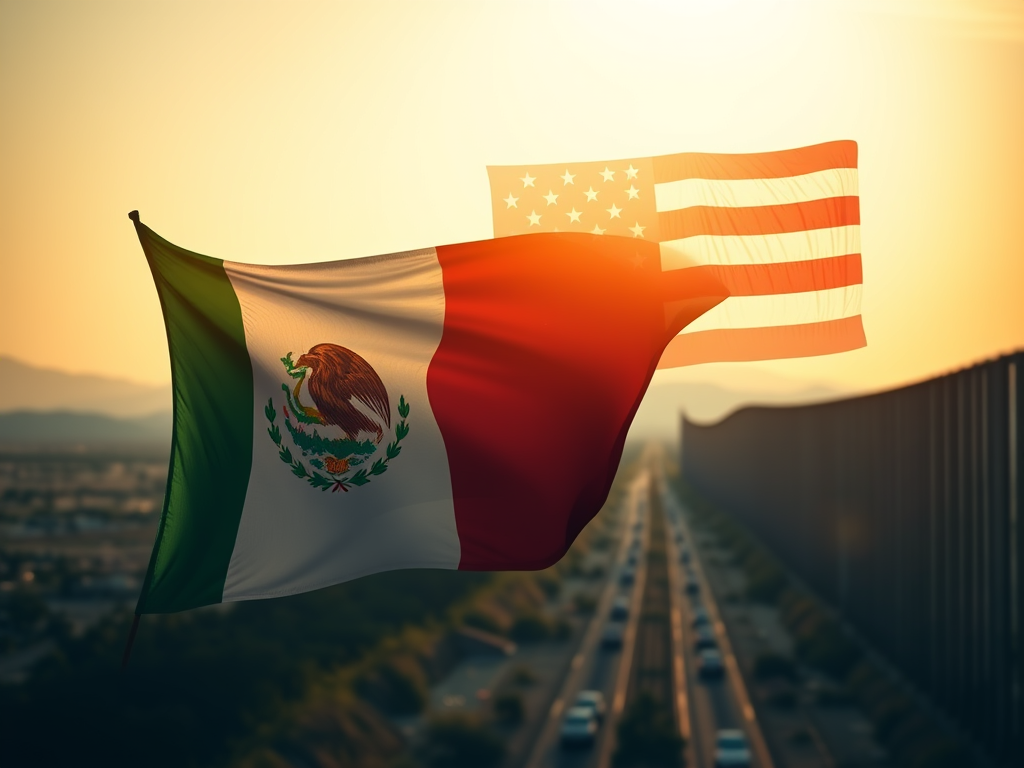
From Territorial Humiliation to Assertion as a Regional Power
The history of Mexico–United States relations is marked by a series of asymmetries, wounds, and readjustments. Few pairs of states clearly illustrate the tension between proximity and distrust, reliance and pride. Since the mid-19th century, Mexico has lived in the shadow of the northern giant, yet from that very shadow, it has also cultivated a sense of mission and resistance that now enables it to position itself as a regional power with its own ambitions. What started as a history of defeats and losses has, over time, become a relationship of strategic interdependence that is reshaping the continent’s balance. From Territorial Mutilation to National Awakening
The 1846–1848 war marked the first major split between the two nations. Following the U.S. invasion and the Treaty of Guadalupe Hidalgo, Mexico lost more than half of its land: California, Texas, Arizona, New Mexico, Nevada, and Utah. That loss was not just a military defeat but a deep cultural wound. In Mexican consciousness, the idea of loss became a foundational trauma, fueling the drive for a national identity rooted in resistance to Anglo-Saxon expansion.
This “pedagogy of defeat,” however, ultimately became one of the driving forces of Mexican nationalism. The twentieth century was largely an effort to restore dignity and sovereignty: the 1910 Revolution redefined the social contract; oil was nationalized in 1938, and the government acted as the protector of the national interest against foreign capital. In response to the U.S.’s focus on the market and competition, Mexico developed a narrative centered on community and social justice that continues to influence its political discourse today.
Century of Dependence and the Porous Border
With the rise of the United States as a global superpower after 1945, Mexico took an ambivalent stance: it integrated economically into the hemispheric system led by Washington while maintaining a degree of independence in its foreign policy. The border — which in the 19th century symbolized loss — became in the 20th century a vital route: millions of Mexican workers crossed north in search of jobs, and remittances started to become a crucial source of foreign currency.
Globalization intensified that symbiosis. The North American Free Trade Agreement (NAFTA), signed in 1994, strengthened productive integration: Mexico became the United States’ “extended factory,” focusing on manufacturing and assembly. However, this dependence came at a cost. Economic liberalization increased internal inequality and empowered the cartels, who found the border to be an ideal place for smuggling and drug trafficking. Washington, for its part, never stopped viewing the south with suspicion: irregular immigration, drug trafficking, and organized violence often served as reasons to pressure the Mexican government. Behind the rhetoric of cooperation, a persistent view of an unstable neighbor — necessary but dangerous — persisted.
The Chicanos: The Human Mirror of a Living Border
In this context, the more than forty million people of Mexican origin living in the United States — known as the Chicanos — represent the most complex and symbolic link in the bilateral relationship. They are not just migrants; they carry a hybrid identity that challenges the very concept of the border itself. While some fully integrate into the U.S. system, others maintain a cultural and emotional connection to Mexico.
The difference between integration and assimilation is crucial here. Integration involves participating in economic and social life without sacrificing one’s identity; assimilation, on the other hand, suggests a complete merging into the dominant culture. Washington favors the latter, while Mexico, even without a clear geopolitical plan, views this diaspora as a source of influence. In a possible situation of tension, Chicanos could act as an identitarian “Trojan horse”: a community that, from within, reminds the United States of its own imperial history and its unresolved border issues.
Mexico as an Emerging Regional Power
The current landscape shows a shift in power dynamics. With a young population of over 130 million, industrial growth driven by nearshoring, and a strategically favorable geographic location, Mexico is emerging as a regional powerhouse. Its economy has become more diverse, its middle class has expanded, and its role in the North American supply chain has become crucial. Unlike in the past, Mexico can now negotiate from a position of demographic strength and a need for mutual benefit: the United States is aging and requires labor and industrial proximity; Mexico provides both. The challenge is to turn that interdependence into strategic influence rather than subordination.
Nevertheless, the shadow of transnational criminality still darkens that goal. Washington accuses Mexico City of being complacent with the cartels and even of allowing fentanyl trafficking to be used as a pressure tool: “What China does with TikTok,” some U.S. analysts say, “Mexico does with fentanyl.” Underlying that accusation is the fear of a secret alliance between Beijing and CDMX to weaken the United States through addiction and social dependence. Although this view borders on paranoia, it reflects a decline of trust and an ideological competition.
Structural Convergences and Divergences
Both countries share interests in regional stability, border control, and economic cooperation. Without Mexico, the U.S. southern border would be unmanageable; without the United States, the Mexican economy would lose its main market. However, they differ in their views on order: Washington advocates for controlled openness under its dominance, while Mexico seeks flexibility and symbolic sovereignty. In terms of national identity, the United States educates its citizens about the universal mission of freedom and competition; Mexico, on the other hand, emphasizes the resilience and dignity of its people in the face of external power. One nation views itself as destined for manifest destiny; the other as resilient and proud. This difference creates both conflict and potential for balance.
Conclusion: The Return of the South
Mexico in the twenty-first century is no longer the defeated country of the nineteenth. It has learned to turn its proximity to the United States into a source of power rather than just a source of humiliation. Its challenge now is to maintain internal unity, control violence, and develop a future that isn’t dependent on the North’s influence.
History does not repeat itself, but it rhymes: if in the past Washington advanced on Mexico with cannons, today Mexico advances on the United States with people, culture, and manufacturing. The border that once symbolized loss can, paradoxically, become the equilibrium point of a new North American order, one in which the South, at last, has its voice and can play its geopolitical cards.



Leave a Reply