

'/%3E%3Cpath%20fill='%23b2b2b2'%20d='M241%20382q0%2016%2017%2026%2017%2011%2042%2011t42-11q16-11%2017-26V269H241'/%3E%3Cpath%20fill='%239f7e00'%20d='M241%20379q0%2014%208%2023%209%209%2021%209%2014%200%2021-9%209-9%209-23V269h-59'/%3E%3Cpath%20d='M241%20339v-70h59v110q0%2014-9%2023l-6%205v-68h-15v72q-8%200-14-4v-68zm59%2040c0%2022%2015%2032%2029%2032%2021%200%2030-18%2030-32v-40h-59'/%3E%3Cpath%20fill='%239f7e00'%20d='M266%20277v5h2v12h-3v-5h2v-5h-9v5h2v5h-4v9h3v18h-5v10h34v-10h-5v-18h3v-9h-4v-5h2v-5h-9v5h2v5h-3v-12h2v-5zm42%20101q0%2010%206%2017%206%206%2015%207%2010-1%2016-7%206-7%206-17v-29h-43'/%3E%3Ccircle%20fill='%230044ad'%20cx='329.5'%20cy='372'%20r='6'/%3E%3Cellipse%20fill='%230044ad'%20cx='300'%20cy='340'%20rx='16'%20ry='21'/%3E%3C/svg%3E)
The “Mearsheimer case”: when the lobby becomes speakable—and when it becomes dangerous
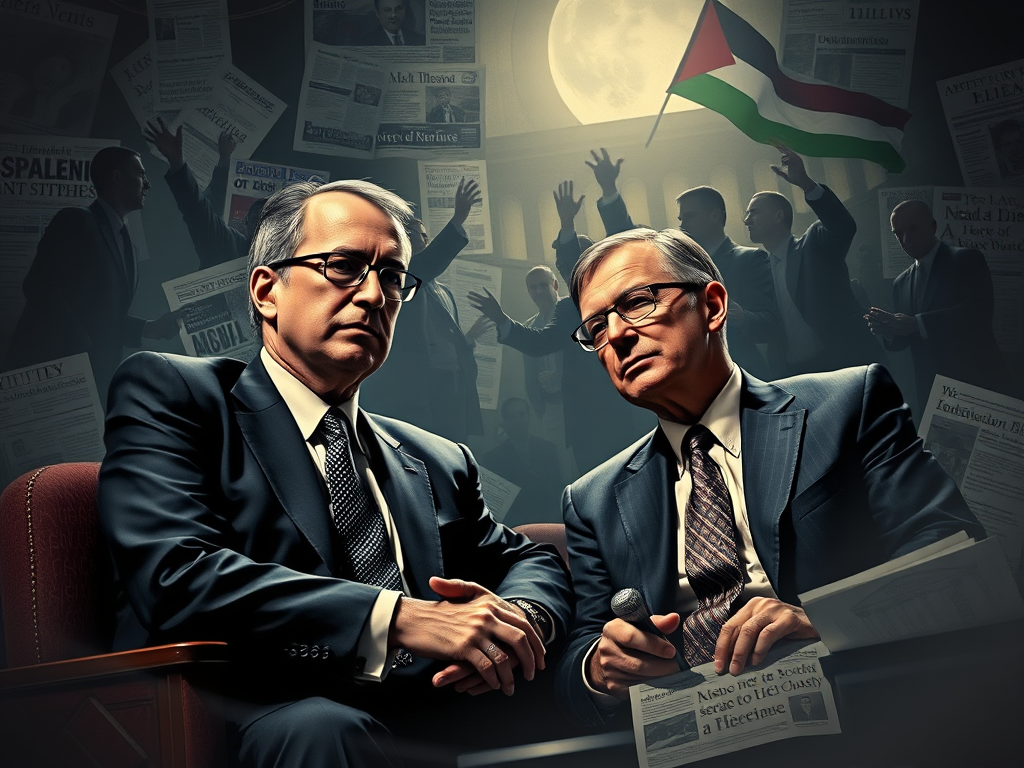
If there is a narrative turning point in the history of the “pro-Israel lobby” in the United States — a moment when a previously whispered topic enters public debate with a proper name — that point is 2006. John J. Mearsheimer and Stephen M. Walt do not come from militant activism but from the core of academia, from political science. They study realism, power, national interests, and the logic of alliances. Precisely for that reason, when they publish The Israel Lobby and U.S. Foreign Policy (first as an essay and working paper, then as a book), they are not merely “criticizing Israel”: they are advancing an interpretive hypothesis about how America makes decisions. In a country where the alliance with Israel has been, for decades, a bipartisan article of faith, this begins to look like profanation.1
The spark is twofold. On the one hand, the thesis: U.S. support for Israel – in their view – cannot be explained solely by “cold” strategic reasons but also by the influence of a constellation of groups and individuals capable of shaping Congress, the executive branch, and the media. On the other hand, the lexicon: “Israel lobby.” Two words that, in American memory, touch an exposed nerve because they risk resembling — if only through cultural echo — the antisemitic conspiracy narratives of the past.
That is where the case explodes. The reaction is not a normal academic exchange: it is a war of frames. For critics, the danger is that “lobby” becomes a shortcut, attributing to a hidden power what is instead the product of political choices, state responsibility, strategic interests, and national political culture. Alan Dershowitz, for instance, attacks the framework head-on, presenting it as a rebranding of “conspiracy” for a new era: not a critique of specific policies but a dangerous narrative structure akin to older myths.2
For Mearsheimer and Walt, by contrast, the point is almost the opposite: if lobbies exist in the United States (energy, pharmaceuticals, weapons, finance), why should the pro-Israel network be untouchable or unsayable? They insist on a detail that serves as a conceptual defense: not “plot,” but coalition; not a single command center, but a loose coalition of organizations and supporters, with no “headquarters” and no monolithic chain of command. This matters because it draws a line between analyzing lobbying and indulging conspiratorial imaginaries.3
The dispute, however, does not stay within university departments. For a few weeks, Harvard Kennedy School is pulled into the media crosshairs: newspapers and talk shows treat the paper as if it were “Harvard’s position.” The institution responds with a symbolic move: it removes the logo from the online version and strengthens the disclaimer, emphasizing that the work reflects the authors’ views. The episode is instructive because it shows how, on this topic, the battle is also about legitimacy: who gets to speak, with what seal of authority, and at what reputational cost.4
From that moment on, the “Mearsheimer case” has three lasting effects on public discourse.
The first is the normalization of the lexicon. After 2006–2007, saying “Israel lobby” is no longer automatically relegated to the margins: it enters, albeit cautiously and often with defensive prefaces, even mainstream venues. Not because the thesis is universally accepted (it is not), but because the threshold for what can be said shifts: the question is no longer “does it exist or not?” but “how much does it matter, how does it operate, and where does analysis end and prejudice begin?” That boundary becomes the real battleground.
The second effect is epistemic polarization: the same sentence can be read as an empirical description or as an insinuation. Here, sociologically, the issue is not only Israel: it is the crisis of “trust” in elites and in the institutions that produce knowledge. In an environment saturated with suspicion, complex explanations (institutions, interests, ideologies, history) lose ground to the short one: “someone controls.” The Mearsheimer case accelerates this dynamic by offering a powerful — and for many, intuitive — story; it forces opponents to respond on moral terrain, often before analytic terrain.
The third effect is the increasingly tight entanglement of antisemitism and criticism of Israel in contemporary American debate. On one side, longstanding defense and advocacy organizations argue that certain forms of anti-Zionism function today as vectors of antisemitism; on the other, intellectuals and activists object that this conflation risks shrinking the space for legitimate political critique. This short-circuit, latent in 2006, explodes in the 2020s amid wars in Gaza, campus tensions, and battles over definitions. On this, too, Mearsheimer becomes unavoidable: not because he “won” the dispute, but because he made it irreversible.
The paradox of the “Mearsheimer case” is therefore geopolitical and sociological at once: a work born to read foreign policy through national interests ends up becoming an internal war over discursive legitimacy, moral definitions, and the line between analysis and stigma. It is the moment when the lobby becomes, more than an actor, a symbol: for some, the symbol of a real and underestimated influence; for others, the symbol of an old American temptation — finding a scapegoat —repackaged in contemporary language.
Actors and biographies within the ecosystem: ADL, AJC, Conference of Presidents, CUFI, AIPAC, and UDP as a network of networks
To truly weave the lobby into the narrative, one must stop treating it as an abstract entity and instead see it as an ecosystem: different institutions, missions, and styles, yet able to converge on certain priorities: military aid, Iran, antisemitism, anti-BDS (Boycott, Divestment, Sanctions) legislation, Israel’s security, and the defense of the bilateral bond. Here, individuals matter; the lobby in America is also a biography.
Imagine the scene as a map of distributed power. In New York, the Conference of Presidents is the “clearinghouse”: a coordinating and representative body that presents itself as the aggregated voice of dozens of organizations and explicitly claims internal pluralism (“views do not necessarily reflect every member”). It is an elegant way to say: unity without uniformity.5
At the operational helm is William C. Daroff, a “community diplomacy” figure: years in Washington with the Jewish Federations, then, starting in 2020, CEO of the Conference of Presidents. His job is to engage with government and allies, manage crises, and build common fronts when the community is divided.6
And above that structure, since June 1, 2025, is Betsy Berns Korn, Chair: an entrepreneur and activist, but above all a bridge figure between worlds. Her résumé already spells “ecosystem”: former national president of AIPAC (2020–2023), then Chair of AIPAC’s board (2023–2025), and now Chair of the Conference of Presidents. In her, the network becomes a person: a node linking Washington (AIPAC) and New York (Conference of Presidents) to the philanthropic-institutional infrastructure of the American Jewish world.7
In Washington, AIPAC (American Israel Public Affairs Committee) is the best-known actor because it operates on the classic terrain of federal lobbying and, in recent years, on the electoral terrain as well. Here, biography becomes organization: Elliot Brandt, now CEO, is an AIPAC “internal product,” with nearly thirty years in regional offices and at headquarters, culminating in succession to Howard Kohr (formalized in 2024 and then made effective through the handover).8
Alongside him sit the triad of board officers who embody the institution’s governance: Michael Tuchin, President of AIPAC; Korn, Board Chair; and Bernie Kaminetsky, President-Elect; names that also appear in AIPAC’s official communications announcing leadership and strategy.
But the decisive metamorphosis in the public narrative is the committee’s other “soul”: AIPAC is no longer only about “influence” over laws and resolutions; it also shapes political careers. Here enters the United Democracy Project (UDP), an affiliated super PAC that works to elect candidates seen as strong supporters of the U.S.–Israel relationship. FEC (Federal Election Commission) data makes its operations traceable.9
In 2024, this dimension surged into media storytelling: pro-Israel groups and super PACs invested heavily in highly visible Democratic primaries. Reuters recounts the internal pressure within the Democratic Party and the emergence of campaigns such as “Reject AIPAC,” including fundraising and spending figures from the electoral cycle.10
This is where the ecosystem stops looking like a lobby and, to many, begins to look like a disciplining machine: not only persuasion but also selection. And it is precisely this step — from policy to career — that makes the question so polarizing.
Then there is another organization, less lobbying in the strict sense and more “moral authority”: the Anti-Defamation League (ADL). Jonathan Greenblatt does not come from a diplomatic pipeline but from a hybrid profile: entrepreneurship, corporate life, the White House (the social innovation office under Obama), and then ADL from 2015. It is a leadership profile typical of contemporary America: managerialism, politics, and advocacy.
After October 7 and the campus crises, ADL has emphasized the legal and operational dimensions:11 Reuters reports on the launch of a nationwide pro bono legal support network against antisemitism, signaling a shift from “monitor and denounce” to “intervene and litigate.”12
In the definitional battles, Greenblatt is also one of the faces of the thesis “anti-Zionism is antisemitism,” a stance that — whatever one thinks of its merits — produces an internal geopolitical effect: it redraws the line between legitimate critique and stigma, and thus the very possibility of dissent in public space without being placed in the domain of hate.13
The American Jewish Committee (AJC) is a different species again: more “public diplomacy” and international relations than congressional lobbying in the strict sense. Ted Deutch, CEO since 2022 after more than a decade in Congress, embodies that transition: from elected politics to institutional advocacy. It is a biography that signals a method: speaking legislators’ language because one has inhabited it from within.14
Finally, there is the world that Mearsheimer and Walt identified in 2006 as a decisive component of the coalition: Christian Zionists. Here, the figure is John Hagee, founder and National Chairman of Christians United for Israel (CUFI). His biography (televangelist, pastor in San Antonio, a network of believers and donors) explains part of the American paradox: the alliance with Israel is not only geostrategy or a “Jewish lobby,” but also political theology, evangelical identity, and mass mobilization. CUFI claims enormous membership and functions as a popularity multiplier, especially in conservative environments.
Put these figures on the same stage, and the ecosystem appears for what it is: a network of networks. The Conference seeks consensus and unity; AIPAC turns geopolitical priorities into legislative and electoral pressure; UDP translates symbolic conflict into primary investments; ADL polices the boundary between critique and hate and builds legal instruments; AJC operates as civil diplomacy; and CUFI brings mass, faith, and an identity narrative.15
And this is where the “Mearsheimer case” returns as a useful narrative lens. Nearly twenty years later, what once looked like a debate about a single thesis (“the lobby distorts policy”) now appears more like a conflict over the functioning of American democracy itself: how much lobbying is normal physiology, how much is hegemony; where advocacy ends, and discipline begins; where fighting antisemitism ends, and governing dissent begins. The real shift produced by Mearsheimer was not “proving” a thesis once and for all, but moving the conversation onto terrain from which there is no return: who decides foreign policy, with what instruments, and at what internal cost.
NOTES
- J.J. Mearsheimer, S.M. Walt, “The Israel Lobby”, «London Review of Books», March 23, 2006; Id., “The Israel Lobby and U.S. Foreign Policy”, KSG Faculty Research Working Paper Series RWP06-011, Harvard Kennedy School, March 2006; Id., The Israel Lobby and U.S. Foreign Policy, Farrar, Straus and Giroux, New York 2007.
- A. Dershowitz, “Debunking the Newest—and Oldest—Jewish Conspiracy”, 2006 (reply to Mearsheimer and Walt); see also the reconstruction of the debate and academic reactions in “The Israel Lobby”, «Harvard Magazine», June 2006.
- J.J. Mearsheimer, S.M. Walt, “The War over Israel’s Lobby”, roundtable, «Foreign Policy», July/August 2006 (especially on the notion of “loose coalition” and the theme of “controlling the debate”); Id., The Israel Lobby and U.S. Foreign Policy, cit., Introduction and ch. 1.
- “Kennedy School disavows paper by two professors”, «The Harvard Crimson», March 2006 (logo removal and institutional disavowal note); “The Israel Lobby”, «Harvard Magazine», June 2006.
- Conference of Presidents of Major American Jewish Organizations, “Who We Are / About” (mission, membership, and coordinating function); see also institutional notes on the “unity without uniformity” principle in the organization’s public communications.
- Conference of Presidents, “Leadership / William C. Daroff” (profile and CEO role); Jewish Federations of North America, communication on William C. Daroff’s appointment as CEO (2019) and the start of his tenure in 2020.
- Conference of Presidents, press releases: “Harriet P. Schleifer elected for a second term as Chair… Betsy Berns Korn approved as Chair-Elect” (May 2024) and “Betsy Berns Korn Assumes Role as Chair of the Conference of Presidents” (June 4, 2025).
- AIPAC, “The next AIPAC CEO, Elliot Brandt” (June 4, 2024); Times of Israel, “AIPAC names Elliot Brandt as successor to veteran chief Howard Kohr” (June 5, 2024).
- Federal Election Commission (FEC), committee profiles: American Israel Public Affairs Committee Political Action Committee (C00797670) and United Democracy Project (“UDP”) (C00799031); FactCheck.org, “United Democracy Project”, September 26, 2024; UnitedDemocracyProject.org, “About”.
- Associated Press, “More than 20 progressive groups form a coalition to counter pro-Israel groups…” (February 2024); «The Guardian», “Race to unseat ‘squad’ member Jamaal Bowman becomes most expensive House primary ever” (June 2024) (on the role of independent expenditures and pro-Israel committees).
- Anti-Defamation League (ADL), Audit of Antisemitic Incidents 2024, published April 22, 2025 (historical series since 1979; 2024 data and trends).
- Reuters, “Law firms, Anti-Defamation League launch legal group to counter antisemitism”, October 29, 2025; Gibson Dunn, “ADL and Gibson Dunn Launch Nationwide Pro-Bono Legal Support Network…”, October 2025.
- International Holocaust Remembrance Alliance (IHRA), Working Definition of Antisemitism (adopted 2016) and explanatory materials; U.S. Department of State, “Defining Antisemitism”; Executive Order 13899, “Executive Order on Combating Anti-Semitism”, December 11, 2019 (explicit reference to the IHRA definition).
- American Jewish Committee (AJC), “American Jewish Committee Announces Appointment of Congressman Ted Deutch as Next Chief Executive Officer”, February 28, 2022; AJC, “Press Release: Ted Deutch Is New American Jewish Committee CEO”, October 3, 2022; profile: AJC, “Ted Deutch (bio)”.
- Christians United for Israel (CUFI), “Our Leadership” (John Hagee: founder and National Chairman); Associated Press, “Why conservative American evangelicals are among Israel’s strongest supporters”, 2025 (on the political weight of Christian Zionists and CUFI’s role); PBS, Bill Moyers Journal, profile “Christians United for Israel (CUFI)”, 2007.
ESSENTIAL BIBLIOGRAPHY
J.J. Mearsheimer, S.M. Walt, The Israel Lobby and U.S. Foreign Policy, Farrar, Straus and Giroux, New York 2007.
J.J. Mearsheimer, “The Israel Lobby”, «London Review of Books», March 23, 2006.
A. Dershowitz, The Case for Israel, Wiley, Hoboken 2003.
A. Dershowitz, “Debunking the Newest—and Oldest—Jewish Conspiracy”, 2006.
Anti-Defamation League, Audit of Antisemitic Incidents 2024, ADL, 2025.
AIPAC, institutional resources and communications (leadership; PAC; AIEF).
Conference of Presidents of Major American Jewish Organizations, institutional materials and press releases (leadership; mission; chair succession).
American Jewish Committee, press releases and institutional profiles (leadership; policy briefs).
Christians United for Israel, institutional materials (leadership; membership; CUFI on Campus).
Federal Election Commission, committee data and profiles (AIPAC PAC; United Democracy Project).
E. Schattschneider, The Semisovereign People, Holt, Rinehart and Winston, New York 1960 (for the theory of political conflict and agenda-setting).
M. Olson, The Logic of Collective Action, Harvard University Press, Cambridge (MA) 1965 (for the theory of interest organization).


Leave a Reply