


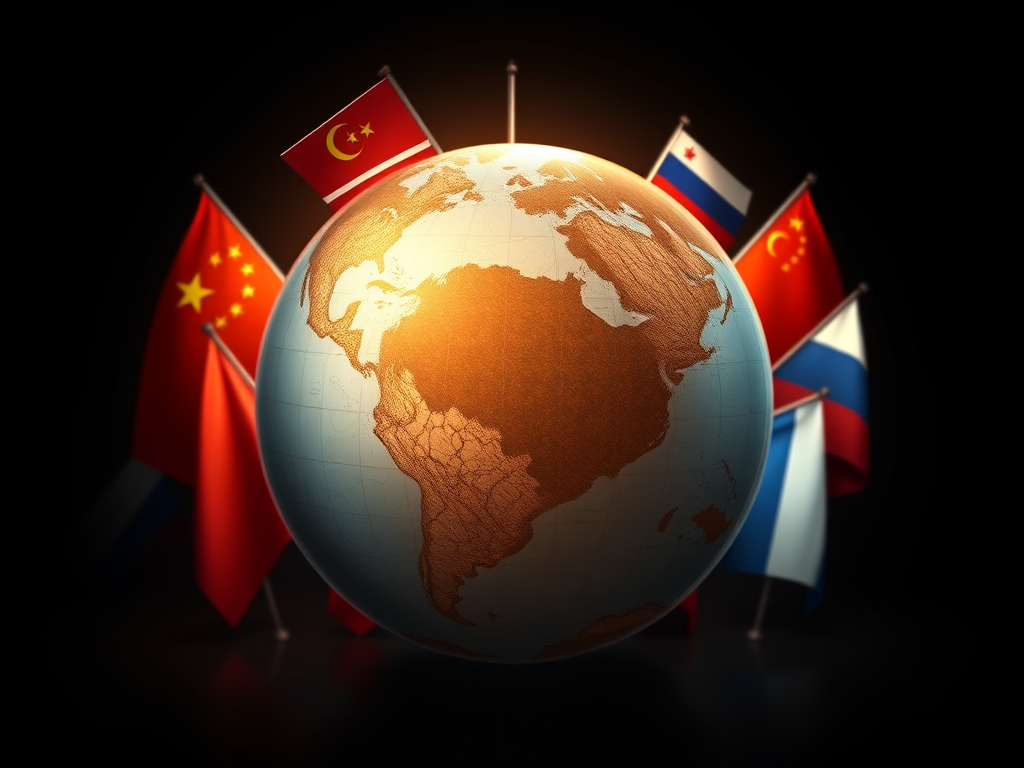
A Geopolitical Essay
PART IV – TODAY
The Crisis of the Hegemon and the Return to a Concert of Powers
The hegemonic shift we are currently witnessing does not resemble a sudden fall. Instead, it is a gradual, hidden process: a slow, quiet erosion of America’s ability to shape and give meaning to the global order. What is fading — even before the concrete power sources, such as industrial strength, naval dominance, and financial influence — is the psychological drive that once made Washington see its role as leading the world as both natural and inevitable. It is the weariness of an empire. The United States still stands as the world’s top power, but it no longer acts like a universalist hegemon: every decision is filtered through a transactional mindset, and every commitment is carefully weighed against immediate costs and benefits.
This shift, initially subtle, has become more noticeable to both rivals and allies. In Moscow, Beijing, Tehran, Ankara, and Jerusalem, the view is growing that Washington is no longer willing to enforce credible red lines, or that even if it did, domestic support for them would be fragile. It is this loss of credibility, more than military retrenchment itself, that signals the end of the so-called Pax Americana. The international system thus enters a phase of unstable balance, reminiscent in some ways of the nineteenth-century Concert of Powers: a system without a true central authority, where decisions are made through constant negotiation and shifting alliances. However, unlike the nineteenth century, today’s economic, technological, and informational interdependencies accelerate crises and amplify their systemic impacts, creating an environment of ongoing uncertainty.
Internal Polarization and Identity Fracture
On the domestic front, the America that emerged from the 2008 financial crisis was a wounded nation. The recession exposed the fragility of a growth model built on debt and financialization, breaking the belief that each generation would enjoy a better life than the last. In the deindustrialized Rust Belt, factories closed, wages remained flat, and entire communities lost their economic foundation. Globalization — once promoted as a means to create shared prosperity — increasingly appeared to be a rigged game that favored cosmopolitan elites and powerful tech hubs, while the rest of the country bore the brunt of the adjustment.
The fracture started as an economic issue but quickly turned into a cultural divide. It was no longer just about income and jobs; it became about differing visions of the nation and its future. One side represented an urban, multiethnic, progressive America that saw global openness as an opportunity for growth and exchange. The other side was a rural, religious, white America that viewed openness as a threat and called for a return to a traditional, cohesive identity. These two visions no longer merely coexisted; they clashed more and more, making every political issue — from abortion rights to taxes, from public education to environmental policy — an existential battleground.
Digital polarization has only widened the divide. Social networks, fueled by algorithms that favor outrage and extreme views, form echo chambers where each side sees the other as a threat to the nation’s survival. Even institutions are drawn into the conflict: Congress is hampered by mutual vetoes, the Supreme Court becomes an ideological battleground, and the media abandon any pretense of neutrality to side with one faction or another.
This climate of ongoing conflict directly impacts America’s international stance. A divided society is less willing to accept sacrifices for distant objectives. The prolonged wars in Afghanistan and Iraq — costing thousands of lives and trillions of dollars — remain symbols of strategic failure in the public’s mind. As public opinion grows tired of funding global security, there is a shift toward a more selective foreign policy: fewer open-ended missions, fewer commitments to nation-building or regime change, and a stronger emphasis on domestic borders. Consequently, the idea of the “global sheriff” is replaced by one of protection, self-reliance, and prioritizing internal affairs.
Trump and the “America First” Turn
Donald Trump does not represent an accident of history but rather the logical result of the economic and social changes of the last thirty years. His political rise was driven by widespread dissatisfaction with globalist elites, resentment among marginalized groups, and deep mistrust of federal institutions; mistrust he himself actively worsened. His 2016 victory reflected a systemic fracture rooted in earlier decades: the outsourcing of industry in the 1990s and 2000s, the increasing inequalities after 2008, and the feeling that the post-9/11 wars drained resources without improving national security.
Under Trump, the very language of the presidency changed significantly. Multilateral summits stopped being places for compromise and instead became platforms for asserting national power and influence. Alliances were seen as short-term agreements, based on paying a “fair share.” Diplomatic language was replaced with direct, confrontational speech more common in business negotiations. America First grew beyond a campaign slogan to become a core principle of foreign and economic policy, emphasizing sovereignty and protecting domestic workers.
Symbolically, decisions to withdraw from the TPP, the Paris Climate Accord, UNESCO, and the WHO did not mean a complete abandonment of global leadership, but instead sent a clear message: America would no longer provide global public goods at no cost. This marked the beginning of a policy of “selective disengagement,” or retrenchment, an effort to reduce the costs of global involvement without fully forfeiting leadership influence.
Domestically, the Trump administration concentrated power by issuing executive orders that bypassed Congress, restructuring federal agencies, and appointing conservative judges to reshape the judiciary for decades. Relations with the media and universities became openly confrontational, with both being portrayed as rhetorical enemies and accused of promoting a progressive ideology hostile to “deep America.”
Measures like the travel ban, increased deportations, and using the Alien Enemies Act to suspend protections for certain groups of migrants changed America’s global image. The United States was no longer the “universal nation” that welcomed and integrated people, but a republic focused on defending its sovereignty with resolve. The aim was no longer to expand the American model but to protect the domestic political system from perceived external threats. This shift had lasting effects on how the U.S. was viewed, moving it from a symbol of universal progress to a nation that defends its specific interests.
Trump and the “America First” Turn
The foreign policy goal in this context is clear: reduce global outreach and focus more on the Western Hemisphere and internal security issues. The renewal of the USMCA (formerly NAFTA) is viewed as a way to protect North American manufacturing; Canada and Mexico become essential parts of a “continental fortress” plan aimed at securing supply chains. In Central and South America, Washington aims to counter China’s growing influence, marked by infrastructure investments and agreements to access strategic resources like lithium, copper, and rare earths. Venezuela becomes a testing ground for a mix of sanctions, diplomatic isolation, and economic pressure. However, the continent is no longer America’s backyard: Brazil and Mexico pursue more independent foreign policies, often staying neutral between Washington and Beijing, which forces the U.S. into ongoing negotiations to maintain influence.
Toward Europe, the White House demands tangible contributions to collective security, much like an empire expects from its clientes. Threats of withdrawal from NATO cease to be mere rhetoric and instead become leverage to push partners into higher military spending. The effect is a real psychological shock: European capitals realize that American protection is no longer unconditional. This dynamic sparks a long-overdue debate on European strategic autonomy, which remains unfinished but becomes increasingly urgent.
In the Ukrainian context, Washington sees that Russia no longer poses an existential threat to the West: if, after years of war, it has been unable to conquer the entire Donbas, it is unlikely to threaten Warsaw or Berlin. This encourages the idea of a compromise, a halt to the conflict that would let resources be shifted toward the Indo-Pacific front.
In the Middle East, the United States continues to guarantee Israel’s security and safeguard energy routes but grants Jerusalem broad leeway, even when Israeli actions risk pulling Washington into unwanted escalations or going against its own national interests. It is a form of functional yet risky delegation, one that sends the world an unclear message: America would rather accept a political cost than once again act as the direct protector of regional stability.
In Asia, Obama’s announced pivot has developed into a strategy of technological containment: fewer bases and long-term commitments, but increased investments in precision deterrence, cyber defense, and control of critical supply chains. Taiwan remains the red line, but the goal is to ensure its security without engaging in a protracted war that would be unsustainable for American industrial logistics.
Industrial and Social Constraints: The Limits of American Power
America’s new strategic stance also arises from a clear-eyed assessment of reality. War-game scenarios conducted by think tanks and the Pentagon itself show that U.S. stockpiles of conventional munitions would be used up within weeks in a high-intensity conflict, that the American shipbuilding industry is too slow to replace losses in a potential confrontation with a major power, and that the defense industrial base is fractured and reliant on foreign suppliers for essential components. U.S. war logistics — once built for a world where “Made in USA” ruled global production — are now susceptible to supply-chain disruptions.
This fragility is heightened by global integration: high-end semiconductors, rare earths for electronics, and pharmaceutical active ingredients primarily come from countries that are either hostile or neutral toward the United States. A simultaneous war against a major power would strain not only America’s military but also its entire economy, clearly showing how much more interconnected — and therefore more vulnerable — the superpower is today compared to 1941.
Added to this is a social constraint: after two decades of conflict, American public opinion firmly rejects the idea of unlimited sacrifices to defend distant countries or support regimes voters see as ungrateful. The memory of coffins returning from Iraq and Afghanistan remains vivid, as does the human toll of the COVID-19 pandemic, which strengthened the call for domestic priorities. In this environment, using military force has become politically costly: every intervention now needs to be justified by direct security concerns and clear benefits for the average citizen.
From Primacy to Concertation: The Return to a World of Powers
Taken together, these constraints have led to a structural shift in the role of the United States: from architect of the global order to permanent negotiator, from unconditional guarantor to primus inter pares. Washington still holds powerful tools — conventional military dominance, dollar supremacy, technological edge — but they are now used more selectively, based on cost-benefit analyses.
The void left by the hegemon has not remained unfilled. Moscow seeks to claim it by reaffirming its sphere of influence and launching its war of aggression against Ukraine in 2022. Beijing increases pressure on Taiwan and develops institutional alternatives such as the Belt and Road Initiative and the Asian Infrastructure Investment Bank. Tehran expands its influence from the Gulf to the Levant, while Ankara and Riyadh act as independent regional powers, capable of negotiating across multiple centers of authority. Even Israel, a historic strategic ally, increasingly operates as an independent player, making unilateral decisions that could pull Washington into unwanted wars.
It’s not the American withdrawal that causes these shifts, but rather the perception of a United States less willing to use force to maintain the status quo. In other words, what is disappearing is hegemony as systemic deterrence: rival powers feel free to test the limits of the system and to change the rules of the game.
The West’s Broken Promises
At this point in the essay, it’s helpful to consider what remains of the order established in 1945. The concept of the West has always been more than just a geographic area; it represented a community united by shared values, lifestyles, and collective goals that were broadly similar, though somewhat different depending on each nation’s background. It was a universe that could be summarized by the three ideals promoted by the French Revolution of 1789: liberté, égalité, fraternité. This universe was meant to include the entire world under the illusion that everyone would adopt our value system, our way of life, and our collective goals. Today, the enthusiasm for these three major promises of the West has shifted to deep disappointment over their failure, a change that helps explain many of the current trends we see.
The promise of liberty, rights, and democracy has been only partly fulfilled: only about one-fifth of the world’s population fully enjoys protected civil and political rights, and the percentage of citizens living in liberal democracies has been decreasing for nearly twenty years. In many countries, including some in the EU, there are signs of an illiberal shift, a reduction in civic space, and assaults on judicial independence. Meanwhile, authoritarian regimes — from China to Russia — are gaining popularity, presenting themselves as more efficient and stable, especially during crises. China’s economic growth since the Cold War’s end has been extraordinary: GDP has grown fourteenfold, poverty has fallen significantly, life expectancy has increased, and higher education has expanded. This success provides the Global South with a strong alternative to Western democratic universalism.
The second promise — that of equality, prosperity, and broadly shared well-being — has been broken by the rise of inequality. While it’s true that global GDP has increased by more than 150% since 1991 and hundreds of millions of people have escaped extreme poverty, the West’s share of global production has fallen from 64% to 40%, and wealth is increasingly in the hands of a small elite. The Gini index has gone up in almost all developed economies; in the U.S., inequality has reached levels similar to those of the late nineteenth-century Gilded Age. This demographic and economic decline, along with imbalance, has shattered social consensus and fueled populism and nationalism.
The third promise — that of fraternity, peace, and stability — has been broken by the increase in conflicts. Since the end of World War II, much of the effort by Western states, led by the U.S., has focused on creating an international institutional framework that could facilitate conflict resolution and promote peace. However, since 1991, wars have not decreased; they have doubled, and civilian casualties remain high. Additionally, the false belief that economic interdependence would make war impossible has clashed with the reality of a world where supply chains are used as tools of coercion, a phenomenon Henry Farrell and Abraham Newman aptly call “weaponized interdependence.”
Crisis of Telos and Conflicts
The failure of these three promises has caused an existential shift: the West has lost its telos, its sense of purpose toward a better future. The myth of progress has been replaced by a narrative of protection. Security becomes the main priority; barriers — physical at borders, digital to prevent foreign interference, and regulatory to protect strategic industries — once again serve as key tools of governance. Demography amplifies this sense of vulnerability: the white American population is projected to become a minority by 2050, fueling identity-based fears and slogans like “They will not replace us!”, which are echoed both in street rallies and across social media. The dominant view among Western white middle classes is that sooner or later, someone will take “our” place and claim “our” prosperity. This is the story of the decline of a world once rooted in economic, technological, and military dominance.
In a planet increasingly unsettled by chaos, with an uncertain future and a delegitimized ruling class, the psychological dimension takes precedence over the material and political rationality. From this arise new myths: Make America Great Again, Russian imperial nationalism, China’s expansionist dream, and Israel’s messianic aggressiveness, made explicit in the name of its military operation against Iran — “Rising Lion” —, which echoes a biblical verse celebrating the mythical strength of Israel’s victorious people. This marks the most radical shift in the collective imagination of the West. It is the main reason why emotional impulses have shaped new political directions and phenomena such as Brexit, the rise of Trump, and the mission of Greater Israel. This triggers a wave of nationalist-populist, anti-elite, and anti-global movements across the entire West, starting with the hegemon’s own territory.
The story we’ve been tracing now shifts in scale. Multipolar order — or more precisely, global disorder — emerges on the battlefield: in Ukraine, where NATO’s cohesion and the reality of the Russian threat are tested; in Gaza and the wider region, where American decisions are limited by an independent-acting ally; in the South China Sea, where China’s resolve will challenge deterrence. The shift from unipolarity to a chorus of powers — to a G-Zero world — is therefore not just an academic concept: it’s a battlefield.
Leave a Reply