

'/%3E%3Cpath%20fill='%23b2b2b2'%20d='M241%20382q0%2016%2017%2026%2017%2011%2042%2011t42-11q16-11%2017-26V269H241'/%3E%3Cpath%20fill='%239f7e00'%20d='M241%20379q0%2014%208%2023%209%209%2021%209%2014%200%2021-9%209-9%209-23V269h-59'/%3E%3Cpath%20d='M241%20339v-70h59v110q0%2014-9%2023l-6%205v-68h-15v72q-8%200-14-4v-68zm59%2040c0%2022%2015%2032%2029%2032%2021%200%2030-18%2030-32v-40h-59'/%3E%3Cpath%20fill='%239f7e00'%20d='M266%20277v5h2v12h-3v-5h2v-5h-9v5h2v5h-4v9h3v18h-5v10h34v-10h-5v-18h3v-9h-4v-5h2v-5h-9v5h2v5h-3v-12h2v-5zm42%20101q0%2010%206%2017%206%206%2015%207%2010-1%2016-7%206-7%206-17v-29h-43'/%3E%3Ccircle%20fill='%230044ad'%20cx='329.5'%20cy='372'%20r='6'/%3E%3Cellipse%20fill='%230044ad'%20cx='300'%20cy='340'%20rx='16'%20ry='21'/%3E%3C/svg%3E)
A Geopolitical Essay
INTRODUCTION
Geopolitics as an analytical lens
What follows is an essay in geopolitics. In this discipline, the first rule is analytical empathy: to step into the perspective of all actors involved and grasp their worldview, strategies, and tactical choices. In most cases, the principal actors are nation-states and peoples; only rarely are they non-state entities, and even then, they are usually structured collectives with real capacity for projection. Geopolitics analyzes power dynamics and, where possible, sketches future scenarios; it does not sit in judgment because it operates outside the realm of moral considerations. In this lens, there are no “good guys” and “bad guys”: there are interests, perceived threats, and constraints to decipher.
This approach stems from the fact that personalities and ideologies — while not irrelevant — weigh less than national interests and the geographic, historical, ethnic, and human factors that influence them. It is the weave of elements that generates leaders like Trump, Xi Jinping, or Putin — figures who embody the historical moment of their respective countries. Their personalities and visions influence tactical decisions, but the larger designs — the grand strategy — are traced by structural imperatives that the most clear-sighted leaders recognize and interpret.
What geopolitics cares about are the stakes — material and symbolic — and the means available: physical, economic, and technological resources, but also psychological resources such as collective determination. Human factors are fundamental: national cohesion, the level of endemic violence, the propensity for conflict, the capacity to withstand sacrifice, demographic structure, attitudes toward the foreigner, familiarity with the sea and with space. To these we must add identity factors: imperial legacies, national missions, a shared language, civic pedagogy, lifestyle, collective soul, and common culture. From the combination of all these elements, the actors’ logic of action emerges.
The decline of the American empire and the global hegemonic transition
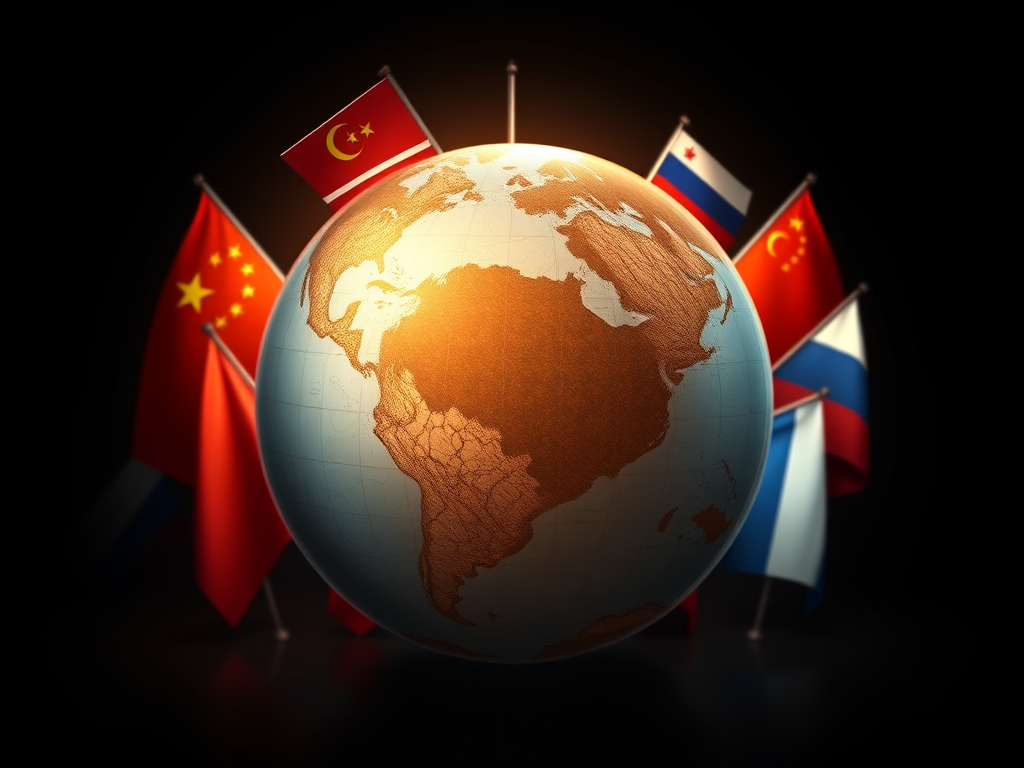
This essay examines the decline of the American empire and the transition to global hegemony. In recent years, the notion has gained traction that the global hegemony of the United States is undergoing progressive erosion and that the international system is entering a phase of hegemonic transition. In other words, the “American empire” — understood as the political, economic, and military predominance exercised by Washington since the end of World War II — shows signs of relative weakening vis-à-vis a growing number of rising actors. The ongoing conflicts — from proxy wars in Eastern Europe and the Middle East to tensions across the Pacific — are symptoms of this transition. The United States remains the dominant superpower; yet, no other actor today appears capable of replacing it, hence the prospect of a historically long period of instability and systemic competition. The slogan “Make America Great Again,” the banner of Trumpism, reflects the domestic perception of a decline that needs to be reversed.
It is crucial, however, to note that US primacy, although attenuated, remains a reality. In terms of conventional power, the United States maintains military superiority and global projection capacity, thanks to an extensive network of bases, alliances, and security partnerships. Financially, the dollar’s hegemony — periodically questioned by attempts at de-dollarization — remains solid: the US currency still accounts for the large majority share of global foreign-exchange reserves and international transactions. Even American soft power, although more contested than in the past, continues to exert a cultural, scientific, and technological influence capable of shaping global patterns of consumption, innovation, and communication.
This leads to a central point: American decline is relative, not absolute. We are not witnessing a sudden collapse, but rather a gradual shift in balances and an erosion of the capacity to steer the world order, exacerbated by deep-seated domestic fault lines. Washington still possesses formidable instruments of power, yet it has lost part of its propulsive energy and international credibility, due to a sequence of strategic errors — from the post‑9/11 “forever wars” to the contentious management of globalization and the internal fractures it helped provoke — and to the rise of challengers adept at exploiting the fissures of the liberal order.
The result is the advance of a “G‑Zero” world, in which the absence of a recognized hegemon enlarges the space for uncertainty, disorder, and competition over spheres of influence. It is the dawn of a more fluid, fragmented, and unstable order in which geopolitics returns as the indispensable lens for interpreting global dynamics.
PART I — THE DAY BEFORE YESTERDAY
The world order in the bipolar system (1945–1991)
Between 1945 and 1949, in a world devastated by war, a new international architecture emerged. The United States, rising from the conflict with an intact economy and unmatched industrial capacity, found itself in a position of global superiority without precedent. Europe lay in ruins, Asia was undergoing postwar realignment, and the USSR —victorious yet battered — stood as the rival pole. In this context, a multilateral order sought to hold together economic reconstruction and strategic containment: at Yalta and Potsdam the victors traced spheres of influence and set the principles of a fragile balance; in 1945 the UN was founded; in 1947 the Marshall Plan financed Europe’s recovery; in 1949 NATO institutionalized Western collective defense, with the stated aim of stability and the implicit goal of containing Soviet expansion.
The world that emerged was bipolar but profoundly asymmetric. The Soviet Union maintained a military, territorial, and ideological empire, dominating Eastern Europe, influencing governments in Asia, Africa, and Latin America, and presenting itself as a revolutionary alternative to capitalism. The United States built an empire that was also military, but above all, one of networks: finance, trade, technology, popular culture, and an alliance system that bound Western Europe and the Pacific to America’s security perimeter.
Europe became the core of the confrontation. Divided by the Iron Curtain, it lived two opposing destinies: in the West, the ECSC (1951) and the EEC (1957) launched integration under Washington’s security umbrella; in the East, the Warsaw Pact (1955) coordinated the Soviet bloc while Moscow crushed uprisings in Berlin (1953), Budapest (1956), and Prague (1968). The Cold War never escalated into a direct clash between the superpowers but into a sequence of crises and proxy wars that marked each decade. In the 1950s, the Korean War (1950–1953) turned containment into armed conflict. In the 1960s, the Cuban Missile Crisis (1962) brought the world to the brink of nuclear holocaust, codifying mutual deterrence under MAD (Mutually Assured Destruction). In the 1970s, the Vietnam War (1955–1975) tested American resilience while the USSR consolidated positions in Asia and Africa, leveraging its “colonial virginity.” The détente of Nixon and Kissinger did not erase rivalry; it regulated it: SALT I (1972) and the Helsinki Final Act (1975) set limits to the arms race and recognized European borders, introducing human rights as a pressure lever on the Eastern bloc.
In parallel, other regions became decisive arenas. In the Middle East, the Suez crisis (1956) marked the sunset of British and French influence and the consolidation of America’s role; the Arab–Israeli wars of 1967 and 1973 — with Washington siding with Israel and Moscow backing Arab states — turned the Levant into a laboratory of indirect confrontation. In Latin America, the United States supported coups to constrain communist expansion (Chile 1973, as well as operations in Guatemala and Nicaragua) while the USSR financed revolutionary movements. In Africa, Angola, Mozambique, and Ethiopia became theaters of proxy conflict.
In the 1980s, under Ronald Reagan, a military and ideological counteroffensive took shape: the Strategic Defense Initiative (SDI) – the so‑called “Star Wars”- support for the mujahideen in Afghanistan, and for anti‑communist movements in Latin America and Eastern Europe (such as Solidarność in Poland) further strained the USSR. The Afghan war (1979–1989) became a quagmire for the Red Army, accelerating Soviet decline. The planned economy could not keep pace with Western technological advancements; the gap widened, stagnation set in, and military spending drained Moscow’s resources.
The end of the bipolar system did not come with a decisive battle, but rather through internal exhaustion: Gorbachev’s reforms — glasnost and perestroika — opened spaces of freedom that soon became ungovernable. The peaceful revolutions of 1989 toppled Eastern European regimes, Germany reunified, and the USSR dissolved without a shot in 1991. The West triumphed without tanks: the Cold War ended like a silent collapse, opening the way to a unipolar order that, for a moment, seemed destined to last.
The first phase of globalization: architecture and narrative (1945–1991)
Globalization was the lever through which Americans built their empire. In its first phase, it was primarily a systemic project of geopolitical engineering, with its load-bearing structure comprising the international institutions and organizations promoted by the United States from 1945 onward. At Bretton Woods, the International Monetary Fund and the World Bank were created to stabilize exchange rates, finance reconstruction, and prevent balance‑of‑payments crises. The United Nations provided the political‑legal framework for an international community, enshrining the principle that disputes should be resolved multilaterally rather than by force. The GATT, a precursor to the WTO, initiated progressive trade liberalization and laid the groundwork for an integrated global market.
Alliances and dedicated organizations guaranteed security: NATO (1949) became the pillar of Western collective defense, while bilateral treaties with Japan, South Korea, and Australia extended America’s protective umbrella into the Pacific. Regional institutions also strengthened: the ECSC and the EEC initiated European integration; in Asia, 1967 marked the founding of ASEAN (comprising Indonesia, Malaysia, the Philippines, Singapore, and Thailand).
Alongside these apex bodies, a dense lattice of specialized agencies developed, reflecting a multi‑level vision of governance. FAO and WHO treated hunger and pandemics as shared problems; UNESCO promoted cultural and educational cooperation; Interpol coordinated the fight against transnational crime. In this ecosystem, each sector — health, education, commerce, finance — found an institutional venue in which to negotiate rules and standards.
Sociologically, the system produced a common language and a pedagogy of cooperation: officials, experts, and diplomats learned to work in international networks, share data and statistics, and think in global terms. Governance thus became a process for socializing global elites, who internalized values of coordination, compromise, and respect for international law.
The geopolitical effect was twofold. It pacified relations among Western powers, turning them into permanent allies, and it gave the United States instruments to legitimize its primacy. American leadership appeared less as an imposed dominion and more as the guarantee of a rules‑based system from which all could benefit. The balance between military and financial power on the one hand, and shared institutions and norms on the other, made the “American Century” possible.
This first globalizing architecture had a value that went beyond technical function: it was the cultural and normative frame that enabled the circulation of goods, capital, and ideas on a planetary scale, transforming the planet into a governable space. That institutional network — built to guarantee stability and growth — would become the platform for the next acceleration of globalization in the 1990s, when, with the fall of the Berlin Wall, no systemic rival remained to contest its legitimacy.
The first phase of globalization: narrative and soft power (1945–1991)
The institutional architecture of the first globalization was never a neutral exercise. It was accompanied by a narrative that conferred political and moral meaning on the new order and legitimated American hegemony by presenting the rules written in Washington — and in the multilateral venues it shaped — as universal. Four pillars sustained it and spoke to both elites and global public opinion: international security, free trade, the rule of law, and human rights.
Global security was the foundation. The United States presented itself as a guarantor of international order, providing nuclear deterrence and conventional protection through alliances that spanned from the Atlantic to the Pacific. NATO was the backbone of European defense; bilateral pacts with Japan, South Korea, and Australia created a Pacific belt. Interventions such as the Korean War (1950–53) and the Berlin airlift (1948–49), as well as later patrol operations in the Taiwan Strait and the Persian Gulf, reinforced the implicit message: the stability of markets and the free circulation of goods and capital were possible only under the US umbrella.
Free trade was the second pillar. Through GATT and subsequently the WTO, the United States promoted tariff reductions, thereby supporting the expansion of world trade and the emergence of global value chains. The Kennedy Round (1967) and the Uruguay Round (1986–1994) were decisive steps in a liberalization presented as a positive-sum game, characterized by greater efficiency, lower prices for consumers, and convergence between advanced and emerging economies. Behind the optimism lay the awareness that benefits were uneven: American multinationals consolidated dominant positions, while adjustment costs — including unemployment and the shutdown of mature sectors — fell on local communities.
The third pillar was the rule of law in international affairs, which converted American power into normative power. Treaties such as the Nuclear Non-Proliferation Treaty (1968) and trade conventions, as well as transnational arbitration, have provided a predictable framework for business and dispute resolution. The United States styled itself as custodian of the rules‑based order, yet also exercised influence through unilateral instruments: the Foreign Corrupt Practices Act (1977) and the financial sanctions administered by the OFAC (Office of Foreign Assets Control, US Treasury) had extraterritorial effects, effectively imposing American standards on firms and banks around the world.
Finally, the fourth pillar was the value dimension. The expansion of liberal democracy and the defense of human rights were framed as humanity’s natural destination. The Atlantic Charter (1941) and the Universal Declaration of Human Rights (1948) were foundational references. Programs supporting the “third wave of democratization,” efforts to secure free elections in Latin America and Eastern Europe, and pressure against apartheid or Southern Cone dictatorships all testified to a political‑moral projection that nonetheless coexisted with hard‑power logic, inviting accusations of double standards: the same United States that promoted human rights could back authoritarian allies when deemed strategic, as with Saudi Arabia or Pinochet’s Chile.
This narrative was amplified by an unprecedented soft power capable of molding global imagination. American culture became the vehicle through which the order was internalized and made desirable. Coca‑Cola and McDonald’s were not merely products but symbols of modernity and standardized abundance. Levi’s and Converse dressed generations, turning clothing into a global language of freedom and rebellion. Hollywood was the great myth-making workshop: from patriotic epics to romantic comedies, from war films to Westerns, it told the story of a dynamic, technological, and victorious America. Jazz and then rock ’n’ roll carried the rhythm of a young society to the radios of Paris, Berlin, and even Moscow; literature — from Hemingway to Steinbeck, from Faulkner to Kerouac — staged a country on the move, made of endless roads and moral tests.
Symbolic geography also fueled attraction: New York, with its skyscrapers and Wall Street, was seen as the heart of global capitalism; California was regarded as the laboratory of innovation, from the emerging Silicon Valley to San Francisco’s counterculture. The “American Dream” — the idea that anyone can build a better life through work and initiative — became a planetary narrative, propagated by films, advertising, the photographs of Life magazine, and songs that promised social mobility and confidence in the future. This was not a mere adornment of power but its most seductive face: it normalized hegemony by presenting it as a horizon of freedom and progress. The first globalization did not impose itself solely through treaties and alliances, but also through the spread of jeans, music, cars, and cinema.
Economy and global finance in the bipolar system (1945–1991)
Postwar economic globalization emerged in a divided world, but under undisputed American hegemony. Between 1944 and 1945, the conferences of Bretton Woods and San Francisco designed the institutions of a new world economic order. The IMF and the World Bank were created to stabilize exchange rates, prevent balance‑of‑payments crises, and finance reconstruction. The Bretton Woods system anchored currencies to gold via the US dollar, which was convertible at $35 per ounce and backed by Fort Knox reserves. The greenback established itself as a “safe asset” and a universal medium of exchange.
The United States used its economic power as a strategic instrument. The Marshall Plan (1947) was not just financial aid, but a lever of influence: it financed Europe’s reconstruction, reactivated export markets for American industry, and tightly bound Western European economies to the Western orbit. In parallel, Washington led the creation of the GATT (1947), the first multilateral trade liberalization initiative, initiating cycles of tariff reductions.
During these decades, the US economy was the world’s locomotive, accounting for roughly 40% of global GDP, driving technological innovation, and hosting the world’s major stock exchanges. The American financial system — Wall Street, the major investment banks, and the rating agencies — became the beating heart of global finance. Capital liberalization was still limited, but cross-border flows began to grow, as American dollars and technology financed the reconstruction of Japan and the “Four Asian Tigers” (Hong Kong, Singapore, South Korea, and Taiwan), laying the foundations for East Asia’s subsequent industrialization.
The bipolar economic order featured a planetary division of labor, with the Western bloc producing and trading in a relatively open market. At the same time, the Soviet COMECON planned intra-bloc exchanges at political prices, isolated from the dollar circuit. That separation prevented proper world integration until the end of the Cold War.
The 1970s crisis marked a turning point: in 1971, Nixon suspended dollar–gold convertibility, inaugurating the era of fiat currency. The dollar retained its reserve‑currency role thanks to the “petrodollar” arrangement with Saudi Arabia, which denominated oil trades in dollars and sustained structural demand for the currency. Meanwhile, financial liberalization gained momentum, as Eurodollar markets emerged and banks’ capacity to lend and recycle capital across borders expanded.
Industrially, the United States still lived its manufacturing apogee: Detroit was the world’s auto capital, Pittsburgh its steel capital, and Silicon Valley was at the dawn of the microelectronic revolution. However, the first cracks appeared in the 1980s: Japanese and German competition eroded market shares, the US trade deficit became chronic, and public debt increased. Deindustrialization began to take hold, while services and finance grew as shares of GDP.
By the end of the bipolar era, the global economic system was poised for unprecedented expansion: Asian economies had emerged as new production centers, world trade had tripled from 1950 levels, and the dollar remained the system’s fulcrum. With the collapse of the USSR, ideological barriers to globalization also fell; market capitalism was poised to become the universal grammar of the world economy.d from 1950 levels, and the dollar remained the system’s fulcrum. With the USSR’s collapse, ideological barriers to globalization fell as well: market capitalism was poised to become the universal grammar of the world economy.



Leave a Reply