


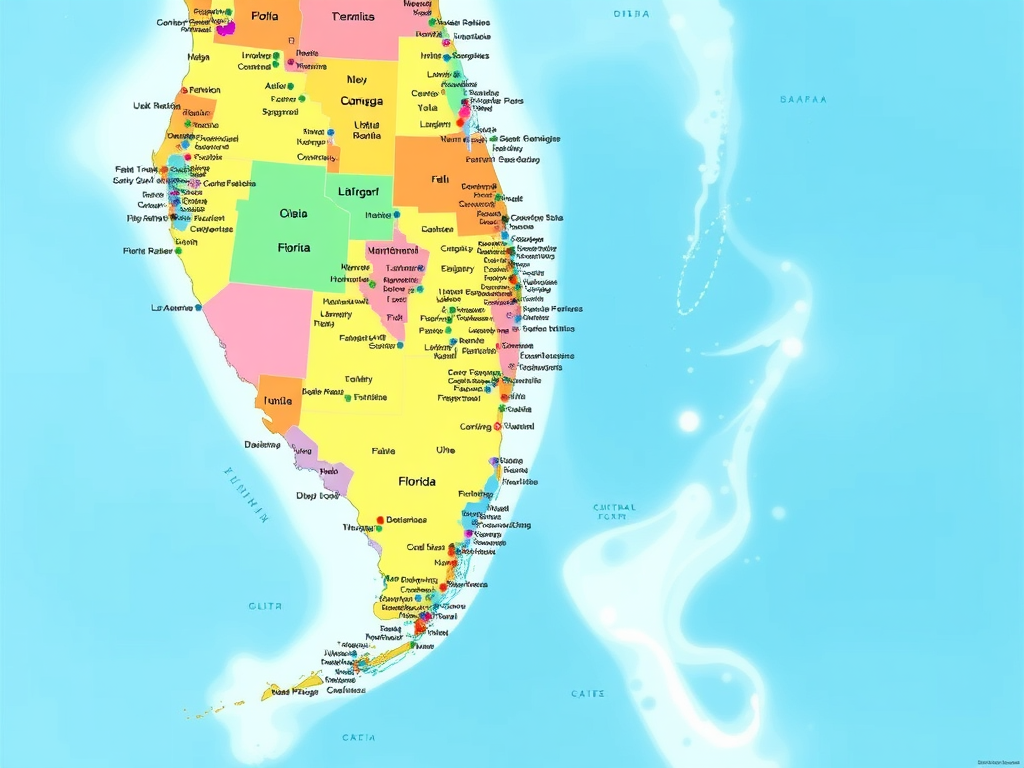
Florida as a Laboratory
Florida today is one of the most fertile arenas for observing how political and cultural fault lines – the so-called cleavages – shape the internal dynamics of the United States. The concept, elaborated by Seymour Martin Lipset and Stein Rokkan in the 1960s, refers to deep and persistent divisions within society that, over time, give rise to stable political identities and to parties that become their representatives.[1] In the U.S. context, traditional cleavages (center–periphery, capital–labor, urban–rural, secular–religious) have taken particularly accentuated forms in Florida, making the state a microcosm of national polarization.
Studying Florida means examining a “belt of fractures” where multiple milieux intersect: Latin American exile communities with a strong anti-communist ethos; rural white populations tied to evangelical traditions; affluent retirees and professionals in the southeast; cosmopolitan youth in university centers; new domestic migrants from the Northeast and California. Each milieu translates into distinct political orientations, creating a territorial mosaic in which voting behavior and civic identity vary dramatically from county to county.
This fractured geography is not coincidental: it stems from the state’s frontier history, its role as a hinge between the continental United States and Latin America, and a demographic acceleration that has profoundly transformed society in the last thirty years. Florida, which in 1970 had just over six million inhabitants, now surpasses twenty-two million: an expansion that has brought with it cultural conflicts, economic tensions, and new forms of political polarization.
The Urban–Rural Cleavage: Metropolitan Coasts vs. the Interior
The most visible cleavage is that between the coastal metropolitan areas and the rural interior. Major metropolitan counties – Miami-Dade, Broward, Orange (Orlando), Hillsborough (Tampa), Palm Beach – present a cosmopolitan, multiethnic socio-demographic profile, with high levels of education and advanced economic sectors. Here, the dominant milieu is progressive: civil rights, cultural diversity, and environmental sustainability prevail. Universities (University of Miami, UCF in Orlando, USF in Tampa) act as intellectual catalysts, reinforcing liberal identity.
By contrast, the Panhandle and the interior counties of the North and Center (Baker, Suwannee, Dixie, Levy, Marion, Lake) represent a rural, agricultural, and often evangelical milieu. In these areas, the urban–rural cleavage assumes the form of a cultural confrontation: to the pluralist and inclusive demands of the metropolises, these areas oppose values of order, religion, patriotism, and distrust of the federal government.
The Panhandle in particular – culturally closer to Alabama and Georgia than to the rest of Florida – constitutes a distinct political subculture, with a heavily Republican electorate permeable to national-populist rhetoric and militant mobilization. It is here that the Trumpian milieu finds its deepest roots, characterized by a white, evangelical, and traditionalist identity.
Ethnic and Migratory Cleavages: Latino Plurality and Internal Conflicts
Another crucial fault line in Florida concerns ethnicity and diverse migratory trajectories. The Latino population, which makes up more than a quarter of the state’s inhabitants, does not form a compact electoral bloc: it is distributed across heterogeneous milieux, often in open conflict with one another, revealing the complexity of “Latino” as a political construct.
Cuban Americans
The Cuban American milieu, concentrated above all in Miami-Dade, has historically represented one of the most cohesive and politically influential exile communities. Shaped by direct memories of the Castro revolution, it has forged a strongly anti-socialist identity, transmitted across generations through families, churches, and civic organizations. The resulting cleavage is twofold: on the one hand, against the U.S. left, perceived as indulgent toward Latin American regimes; on the other, toward other Latino groups, accused of not sharing the same ethos of “freedom struggle.”[2]
Venezuelans and Nicaraguans
During the 2000s and 2010s, a new diasporic milieu emerged, composed of Venezuelans and Nicaraguans fleeing chavista and sandinista regimes. Concentrated in the Miami area and the state’s southeast, these groups imported strongly anti-authoritarian narratives and found a natural ally in the Republican Party. This cleavage is relatively recent but politically significant: it has reinforced the GOP’s ability to address a Hispanic public not merely as a progressive minority, but as the vanguard of the struggle against Latin American socialism.[3]
Puerto Ricans
In contrast stands the Puerto Rican milieu, concentrated mainly in Central Florida (Orlando, Kissimmee, Osceola County). Migrating largely in the last thirty years, often because of the island’s economic and natural crises (Hurricane Maria, the debt crisis), they express more progressive orientations, close to the Democratic Party. The cleavage here lies within the Latino identity itself: while Cubans and Venezuelans consolidate the conservative front, Puerto Ricans contest it by proposing an agenda centered on welfare, civil rights, and social integration.
Colombians and “Moderate” South Americans
Another milieu is constituted by Colombians and other South American communities (Argentines, Peruvians, Ecuadorians), present especially in Broward and Palm Beach. These groups tend to occupy a more nuanced position, oscillating between moderate conservatism rooted in family and religious values and pragmatic progressivism on economic and migratory issues. They embody a “middle cleavage,” often decisive in local contests.
Latino Fragmentation as a Geopolitical Microcosm
In sum, Latino voting in Florida is not monolithic but stratified into diasporic milieux that reflect different historical experiences and political traumas. From a geopolitical standpoint, this means Florida becomes a laboratory of electoral transposition of Latin American fractures: the conflict between socialism and anti-communism, between authoritarianism and democracy, is reproduced at Florida’s ballot boxes. This ethnic–migratory cleavage intersects with other factors – class, religion, generation – producing an extremely complex electoral topography.
Socioeconomic and Generational Cleavages: Retirees, Wealth Elites, and New Generations
Another layer of fracture in Florida’s political geography relates to economic inequalities and generational differences, which shape distinct sociopolitical milieux.
Wealth Elite Counties
Counties such as Palm Beach, Collier (Naples), and Sarasota embody a patrimonial conservative milieu. These areas are home largely to affluent retirees from the Northeast and Midwest, attracted by favorable taxation, climate, and the prestige of gated communities. This social group, often of Anglo-Saxon origin and with high economic resources, defends a soft conservatism yet uncompromising on fiscal matters: low taxation, deregulation, and protection of private property. The cleavage here is not cultural but economic: the wealth elite differentiates itself from urban and rural working classes not through religion or ethnicity, but through accumulated capital and lifestyle.
Midwestern and Northeastern Retirees
A specific segment is represented by middle-class retirees migrating from the Midwest and Northeast. This milieu, significantly present in counties along the west coast (from Pasco to Charlotte), tends to reinforce the Republican base: elderly voters, generally white, religious, and socially conservative, who see Florida as both a fiscal and cultural refuge. They represent a generational cleavage opposing urban and university youth, with sharp differences on civil rights, climate, and foreign policy.
Hybrid Suburban Areas
The situation is more complex in suburban areas such as Hillsborough (Tampa) and Pinellas (St. Petersburg). Here, multiple milieux intersect affluent residential neighborhoods oriented toward pragmatic conservatism, alongside central urban zones with youth, minorities, and working classes more inclined toward progressivism. The socioeconomic cleavage thus overlaps with the generational one, producing “hybrid” and highly competitive political spaces. Not by chance, Tampa Bay has historically been one of the most contested areas in state elections.
Youth, Education, and New Political Subcultures
New generations in Florida represent a progressive milieu that, while numerically smaller, is strengthening thanks to universities and urban concentrations. Youth in Alachua (Gainesville) and Leon (Tallahassee) embody this generational cleavage: bearers of ecological, feminist, and inclusivist demands, often in rupture with parents and grandparents living in surrounding rural areas. Higher education acts here as a polarizing factor, with significant geopolitical effects: universities and research centers become progressive enclaves within a state context dominated by conservatism.
Religious Cleavage: Evangelicals, Catholics, and Seculars in Competition
One of Florida’s deepest cleavages is religious in nature, reflecting the classical fracture between secular and confessional milieux. Unlike other Southern states, where evangelical dominance is overwhelming, Florida presents a more fragmented map: alongside regions dominated by conservative Protestant communities, there are urban and metropolitan areas where Catholic, Jewish, or secular identities prevail.[4]
The Evangelical Milieu of the Panhandle and the Interior
The Panhandle and much of the central-northern interior (counties such as Escambia, Okaloosa, Walton, Marion, Lake) form the stronghold of the evangelical milieu. Here, Baptist, Pentecostal, and evangelical churches function not only as religious spaces but also as centers of political socialization. The religious cleavage translates into radical conservative positions on abortion, marriage, sex education, and gender identity. In these areas, religion becomes the central element of political culture: voting Republican is perceived as a moral and communal duty.
Latino Catholics and Ideological Hybridization
In the southern metropolitan areas – particularly Miami-Dade and Broward – the religious milieu is characterized by the strong presence of Latin American Catholics (Cubans, Colombians, Nicaraguans). Here, the cleavage is not between religion and secularism but within Catholicism itself: traditionalist communities supporting the GOP for its anti-socialist and pro-family stances, versus younger Catholics interpreting faith through the lens of social justice. This produces both intergenerational and intrareligious cleavages, weakening the linearity of confessional belonging.
Jewish Communities and Urban Secularization
Jewish communities, concentrated especially in Palm Beach, Broward, and Miami, play a unique role. Politically divided, they oscillate between traditional support for the Democratic Party (for urban progressivism and social policies) and alignment with the Republican Party on foreign policy, particularly regarding support for Israel. Meanwhile, Florida’s major urban centers have witnessed a process of secularization, with a secular, youthful, multicultural milieu opposing evangelical and traditionalist agendas.
An Internal Geopolitical Fracture
The religious cleavage in Florida is thus not merely theological but geopolitical: it defines divergent electoral maps, shapes relations among ethnic communities, and reinforces cultural polarization. In the Panhandle, evangelical Christianity serves as a communal glue legitimizing radical right policies; in Miami, Latin Catholicism generates ambivalent and competitive identities; in Palm Beach, Judaism combines with cosmopolitanism and economic pragmatism. The result is a mosaic where the religious factor multiplies and intertwines with existing cleavages (ethnic, socioeconomic, generational), making Florida a microcosm of America’s culture wars.
Environmental and Economic Cleavage: Tourism, Agriculture, and Climate Change
Alongside historical and consolidated fractures, Florida today experiences a new cleavage, less institutionalized but potentially explosive: the one opposing economic interest tied to tourism and agriculture, on the one hand, and social and cultural pressures linked to climate change, sustainability, and natural disasters, on the other.
Tourism as Economic Engine and Structural Vulnerability
Florida largely lives off tourism, with regions such as Orlando (Disney, Universal Studios), Miami Beach, and Key West depending on a steady flow of national and international visitors. This tourism milieu is pragmatically oriented toward political stability and economic growth and is thus often resistant to cultural extremisms that could compromise the state’s international image. Yet tourism is also extremely vulnerable to climatic factors: hurricanes, rising sea levels, and record temperatures. Hence, an internal cleavage emerges between entrepreneurs who call for mitigation measures and infrastructural investments, and conservatives who reject environmental policies perceived as “liberal” or as obstacles to immediate profit.
Agriculture and the Rural Milieu
Another fundamental economic component is agriculture, concentrated especially in the interior and central counties. Citrus, sugar, and vegetable cultivation form part of Florida’s historic identity, and the agricultural milieu maintains a conservative and Republican orientation. However, climate change is already profoundly altering this sector: more frequent droughts, devastating hurricanes, crop diseases. This generates tensions between farmers demanding state or federal intervention and radical Republicans promoting deregulation and reduced public spending. In this sense, the environmental cleavage also divides the conservative camp itself.
Young Environmentalists and Coastal Cities
On the opposite front, in university and metropolitan cities (Gainesville, Tallahassee, Miami, Tampa), young people and environmental organizations constitute a progressive milieu that sees climate change as an existential threat. Campaigns for coastal resilience, green infrastructure, energy transition, and climate justice are gaining increasing traction among those under 35. Here, the cleavage is also generational: older voters, often skeptical of climate change, versus youth who view the environmental crisis as key to redefining the state’s political priorities.
Natural Disasters as Political Catalysts
Hurricanes, increasingly frequent and destructive, act as catalysts in making this cleavage visible.[5] Every natural disaster produces moments of solidarity but also political conflict: demands for federal aid, debates over public insurance, tensions between real estate investors and environmentalists. In this sense, Florida represents an internal geopolitical laboratory: the state most exposed to climate change effects simultaneously becomes the epicenter of national disputes over environment, economy, and social resilience.[6]
Florida as a Geopolitical Microcosm of American Fractures
Florida’s political map shows how a state can encapsulate within itself all the fractures running through contemporary America. Urban–rural cleavages, opposing Miami and Orlando to the Panhandle, mirror the national dichotomy between cosmopolitan cities and traditionalist countrysides. Ethnic and migratory cleavages, with Latino plurality divided between conservative Cuban Americans and progressive Puerto Ricans, reproduce Latin American political conflicts on U.S. soil. Socioeconomic and generational cleavages, with affluent retirees and wealth elites opposed to educated yet precarious youth, mirror the broader national economic polarization. The religious cleavage between radical evangelicals and secularized cities reaffirms the fracture between faith and secularism. Finally, the environmental–economic cleavage highlights how tensions over climate change and natural disaster management are becoming new axes of political conflict.
All these cleavages, intertwining, produce a political mosaic where each Florida county appears as a “world unto itself.” Miami-Dade represents the intersection between Latino diaspora and urban cosmopolitanism; the Panhandle, the deep, evangelical, and national-populist America; Palm Beach and Naples embody the patrimonial milieu of white conservative elites; Orlando and Tampa function as suburban laboratories where diverse political subcultures coexist in tension. Florida, more than other states, is the synthesis of fractures that do not neutralize each other but coexist in a precarious equilibrium.
From a geopolitical perspective, this makes Florida a true microcosm of America’s culture wars. Its geographical position makes it a gateway to Latin America, and its exile communities transform external conflicts into domestic battles. Its economy, based on tourism and agriculture, makes it vulnerable to global climatic factors. Its demography, shaped by waves of internal and external migration, exposes it to continuous shocks of identity and values.
Three future scenarios can be outlined. Initially, Florida consolidates its role as a national Republican model: cultural, educational, and fiscal policies tested in the state spread to other conservative-led states, transforming the GOP into a party defined by the Floridian paradigm.[11] In the second, internal fractures radicalize to the point of producing permanent institutional conflict: progressive metropolitan cities pitted against conservative rural counties, clashing over immigration, civil rights, and education. In the third, intensifying climatic and demographic crises turn Florida into an epicenter of social instability: devastating hurricanes, ethnic tensions, insurance and real estate crises could push the state into a spiral of unmanageable polarization.
Whichever scenario unfolds, Florida remains central to the trajectory of the United States. If California symbolized progressivism and innovation for decades, Florida today symbolizes conservative reaction and identity fragmentation. It is not simply a swing state but an internal geopolitical laboratory where the forces shaping America’s destiny are tested, clash, and radicalize. In this sense, to understand Florida’s fractures is to understand the geography of power and conflict in 21st-century America.
Notes
[1] Seymour Martin Lipset and Stein Rokkan, Party Systems and Voter Alignments: Cross-National Perspectives (New York: Free Press, 1967).
[2] Alejandro Portes and Alex Stepick, City on the Edge: The Transformation of Miami (Berkeley: University of California Press, 1993); Louis A. Pérez Jr., Cuba and the United States: Ties of Singular Intimacy (Athens: University of Georgia Press, 2019).
[3] Eduardo A. Gamarra, “Latino Political Realignment in South Florida: Beyond the Cuban Model,” Latin American Politics and Society 64, no. 2 (2022): 45–67.
[4] Pew Research Center, “Religious Landscape Study: Florida,” 2014–2015.
[5] NOAA National Hurricane Center, Tropical Cyclone Report: Annual Summaries, 2023–2024 (Miami, FL: NOAA).
[6] Intergovernmental Panel on Climate Change (IPCC), Sixth Assessment Report (AR6): Summary for Policymakers (Geneva: IPCC, 2021).
Bibliography
- Continetti, Matthew. The Right: The Hundred-Year War for American Conservatism. New York: Basic Books, 2022.
- Gamarra, Eduardo A. “Latino Political Realignment in South Florida: Beyond the Cuban Model.” Latin American Politics and Society 64, no. 2 (2022): 45–67.
- Huntington, Samuel P. Who Are We? The Challenges to America’s National Identity. New York: Simon & Schuster, 2004.
- Intergovernmental Panel on Climate Change (IPCC). Sixth Assessment Report (AR6): Summary for Policymakers. Geneva: IPCC, 2021.
- Lipset, Seymour Martin, and Stein Rokkan. Party Systems and Voter Alignments: Cross-National Perspectives. New York: Free Press, 1967.
- Mudde, Cas. The Far Right Today. Cambridge: Polity Press, 2019.
- NOAA National Hurricane Center. Tropical Cyclone Report: Annual Summaries, 2023–2024. Miami, FL: NOAA.
- Pérez Jr., Louis A. Cuba and the United States: Ties of Singular Intimacy. Athens: University of Georgia Press, 2019.
- Portes, Alejandro, and Alex Stepick. City on the Edge: The Transformation of Miami. Berkeley: University of California Press, 1993.
- Pew Research Center. “Religious Landscape Study: Florida.” 2014–2015. https://www.pewresearch.org/religion/.
- Smiley, David. “Miami Wants to Be the Crypto Capital. Can It Survive the Crash?” Miami Herald, June 2022.
- Urbinati, Nadia. Me the People: How Populism Transforms Democracy. Cambridge, MA: Harvard University Press, 2019.


Leave a Reply