


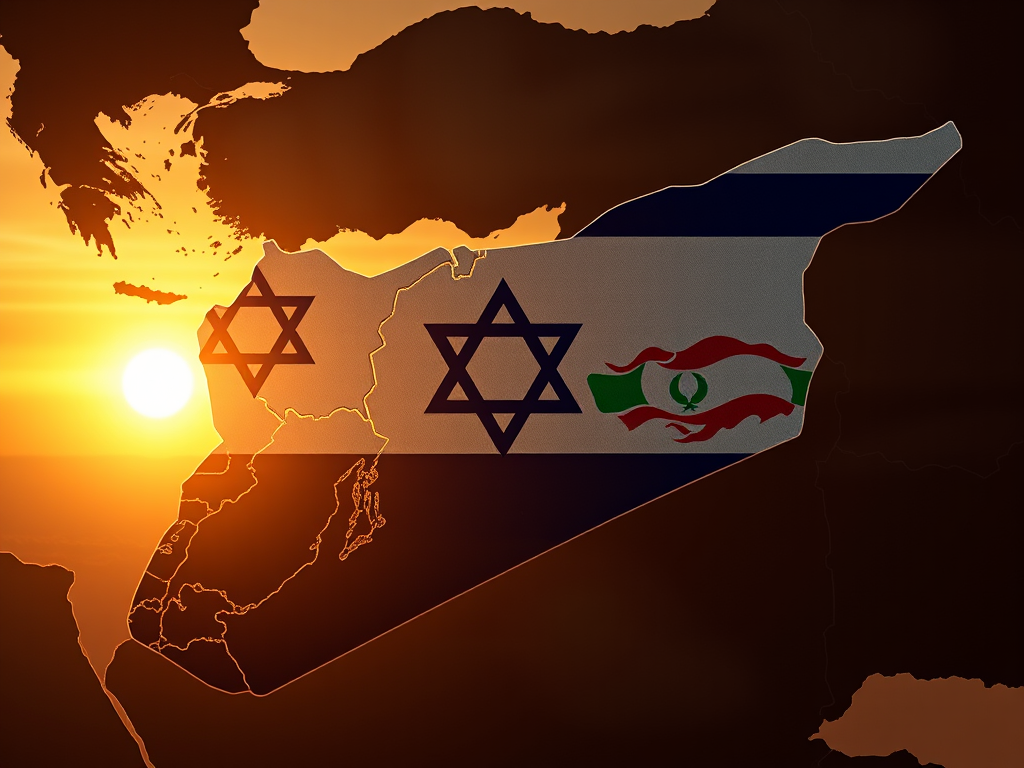
A policy exhumed from the past that aims to fracture the Sunni Arab front and strengthen Israel’s regional position
After Assad: Israel and the return to the doctrine of minorities
With the definitive fall of Bashar al-Assad’s regime in Syria, Israel’s foreign minister, Gideon Saar, was clear: Israel must embrace its condition as a permanent minority in the Middle East and, as such, weave strategic alliances with other minorities in the region. This is not a new idea but a historical doctrine that today resurfaces with renewed force: the “alliance of minorities” as a tool to disarticulate the power of Sunni majorities and protect the interests of the Jewish state.
Historical roots of a strategy
The doctrine of alliances with minorities has its roots in the Ottoman era, when non-Muslim and non-Sunni communities were systematically marginalized. In the twentieth century, this logic gave rise to episodic collaborations among Jews, Maronites, Druze, Kurds, and Alawites. In the 1950s, David Ben-Gurion institutionalized it as one of the four pillars of Israel’s security, alongside alliance with the great powers, mass Jewish immigration, and nuclear deterrence.
For decades, Israel sought peripheral partners in non-Arab countries such as Turkey, Iran, or Ethiopia. However, the success of the Islamic Revolution in Iran (1979), the founding of Hezbollah by the Pasdaran, and Israel’s disastrous invasion of Lebanon in 1982 — culminating in the Sabra and Shatila massacre — undermined this strategy. Israel’s withdrawal from southern Lebanon in 2000 marked its formal abandonment.
Minorities as a strategic shield
Despite the failures, Israel maintained ties with specific communities, particularly the Syrian Druze and the Iraqi Kurds. Since the 1960s, the Mossad has operated in Iraqi Kurdistan, providing arms and training to the Peshmerga. After the fall of Saddam Hussein in 2003, those relations intensified. Today, various reports attest to a permanent Mossad presence in Erbil.
As for the Druze, Israel has never concealed its closeness. Many of them serve in the Israel Defense Forces and are fully integrated into society. In 2025, following the collapse of the Syrian regime, Netanyahu publicly extended a hand to the Druze of Sweida province, calling them “brothers” and promising protection from possible reprisals by the new Syrian government, accused of Islamism and extremism.
Disaggregating Syria to protect Israel
The return to this doctrine reflects a precise strategic reading: preventing the new Syrian government — presumably supported by Turkey, Qatar, and the Muslim Brotherhood — from establishing an Islamist enclave on the Golan. Hence, Israel’s support for a Druze federation in southern Syria, conceived as a buffer against Damascus, and the strengthening of Kurdish autonomy in the northeast.
Israeli troops already control southern Syria, including Mount Hermon, a strategic position located just 18 km from the capital. From there, Israel has line-of-sight over southern Syria, Lebanon, the Beqaa Valley, the West Bank, Jordan, and even the Iraqi border. This presence limits Hezbollah’s ability to reorganize and sends an unequivocal deterrent message.
Buffer zones and negotiating equilibrium
Israel’s offensive also aims to redefine the terms of a future peace with Syria. By occupying the south of the country, Israel effectively neutralizes any Syrian claims to the Golan Heights and seeks to extend the demilitarized zone to all of southern Syria. At the same time, Netanyahu promotes a narrative grounded in the protection of minorities, which serves as a cover for the real objective: to create autonomous sectarian entities capable of fragmenting Sunni Arab power.
Separatism as a tool of legitimation
For Israel, a homogeneous Arab Middle East represents an existential threat. Consequently, the strategy seeks to foster the political and social diversification of the region, strengthening non-state actors and weakening nation-states. The more fragmented the regional environment, the greater the legitimacy of the Jewish state’s existence in its geopolitical imaginary.
Netanyahu also intends to prevent a new Sunni regime in Damascus from supporting Hamas or facilitating the transit of weapons to the West Bank, as has occurred in the past. The Israeli military presence along the border strip thus strengthens the security of southern Syria and controls overflows directed toward the Palestinian territories.
A risky gamble
This strategy carries high risks. The sudden fall of the Alawite regime, after more than half a century of authoritarian rule, has revealed the fragility of sectarian alliances. History itself offers precedents: the coalitions of Maronites and Shiites with the Crusaders in the Middle Ages ended tragically with the arrival of the Mamluks. Alliances among minorities are, by definition, unstable and short-lived.
Israeli policy thus risks generating resentment in broad Arab sectors, fueling new waves of radicalization. Syria’s transition is uncertain, and the fracturing of its political-social fabric could spread to other vulnerable states such as Lebanon, Iraq, and even Jordan.
A new chessboard in evolution
The fall of Assad has not inaugurated peace but rather a radical redefinition of the regional conflict. Israel is rearming, Turkey is advancing, Iran is retreating, Saudi Arabia is maneuvering, and the United States is pulling back cautiously. Meanwhile, the Balkanization of Syria offers strategic opportunities for some and existential threats for others.
On this new chessboard, Israel is playing a complex game, retrieving old formulas to confront unprecedented challenges. Only time will tell whether this bet on minorities will prove a brilliant geopolitical intuition or, rather, the repetition of past errors.





Leave a Reply