

'/%3E%3Cpath%20fill='%23b2b2b2'%20d='M241%20382q0%2016%2017%2026%2017%2011%2042%2011t42-11q16-11%2017-26V269H241'/%3E%3Cpath%20fill='%239f7e00'%20d='M241%20379q0%2014%208%2023%209%209%2021%209%2014%200%2021-9%209-9%209-23V269h-59'/%3E%3Cpath%20d='M241%20339v-70h59v110q0%2014-9%2023l-6%205v-68h-15v72q-8%200-14-4v-68zm59%2040c0%2022%2015%2032%2029%2032%2021%200%2030-18%2030-32v-40h-59'/%3E%3Cpath%20fill='%239f7e00'%20d='M266%20277v5h2v12h-3v-5h2v-5h-9v5h2v5h-4v9h3v18h-5v10h34v-10h-5v-18h3v-9h-4v-5h2v-5h-9v5h2v5h-3v-12h2v-5zm42%20101q0%2010%206%2017%206%206%2015%207%2010-1%2016-7%206-7%206-17v-29h-43'/%3E%3Ccircle%20fill='%230044ad'%20cx='329.5'%20cy='372'%20r='6'/%3E%3Cellipse%20fill='%230044ad'%20cx='300'%20cy='340'%20rx='16'%20ry='21'/%3E%3C/svg%3E)
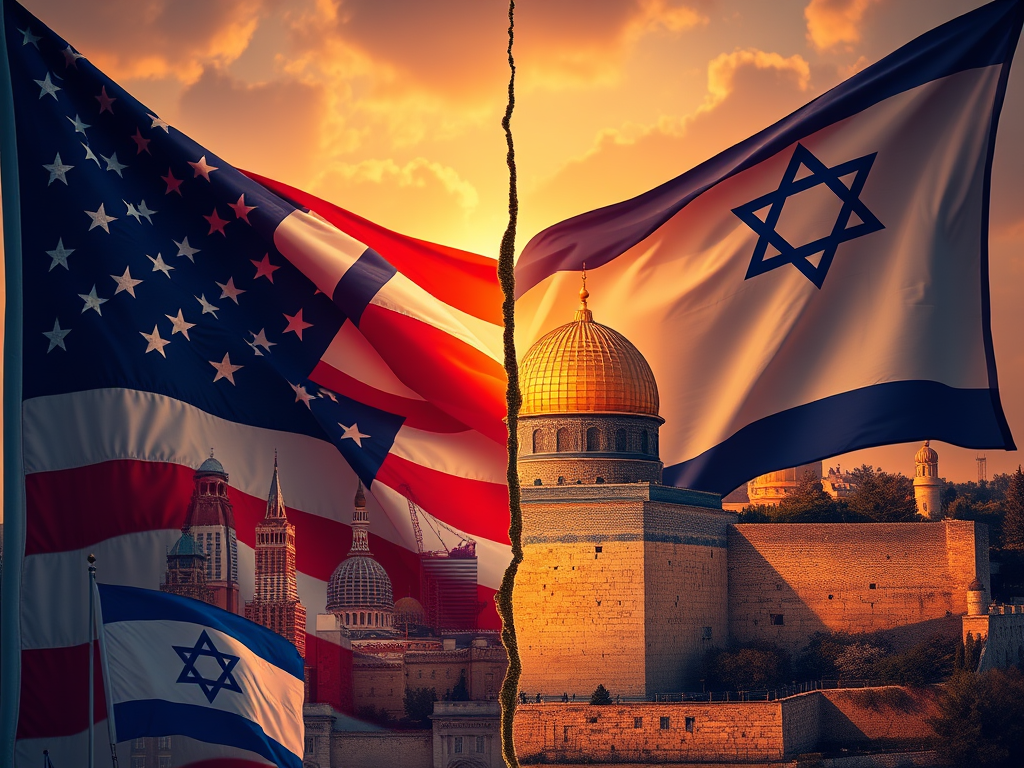
Prologue: The Superpower Without Glue. (Written on January 20, 2026, and published in Limes 2026/2).
In the United States, what is missing is not power but form. On the eve of January 20, 2026 — the first anniversary of the second Trump administration’s inauguration — the question is no longer whether America is “stronger” but whether it is cohesive. Cohesion is not a moral concept: it is a geopolitical variable. A fragmented society can still produce innovation, cyclical growth, and even electoral victories, but it struggles to sustain strategic continuity because it lacks a common language to translate interests into priorities and priorities into durable policies. The crisis has become both horizontal (loss of mutual trust among citizens) and vertical (discrediting of the state), fueled by diffuse anxiety and affective tribalization.1
America today faces a paradox that recurs throughout the history of empires: the apparatus remains immense, but internal energy dissipates. Politics is no longer perceived as a mechanism for resolving conflicts; it is the arena of conflict itself. This shift — rooted in a long trajectory of delegitimation, from Watergate to January 6, through geopolitical shocks and economic crises — is both the premise of Trumpism and its accelerator.
In this framework, Israel becomes a privileged lens because it condenses three dimensions that now overlap and contaminate one another into a single object: foreign policy as internal civil war; culture war as domestic foreign policy; and crisis of representation as permanent suspicion toward every “system” decision. When a superpower begins using external dossiers to measure internal moral belonging, strategy has already become identity. And when strategy becomes identity, the governing coalition can win but struggles to govern.2
The thesis that emerges from this analysis is that the United States, under Trump, is undergoing social regression: politics is returning to functioning as tribal belonging rather than mediation, and tribalization — accelerated by Trump’s rise on the political scene and then normalized by social media — grows precisely as the White House promises “order.” The consequence is not only domestic instability: it is the loss of the capacity to craft a coherent foreign policy and long-term domestic policies, because every choice satisfies one tribe and betrays another. And today, Israel is a cohesion test for all American tribes.
1. From 1948 to “Civil Religion”: Israel as America’s Moral Infrastructure
To understand why Israel has become so divisive, one must remember that for decades it was the opposite: a glue. From 1948 onward, Israel gradually entered the American symbolic pantheon, not only as an ally but also as an example: survival after the Shoah, democracy in a hostile environment, and an advanced frontier of the West in a Middle East that America sometimes read as an energy chessboard, sometimes as political theology, and sometimes as a battlefield against the USSR and later against radical Islamism.3
The point is not to romanticize that history but to grasp its sociological function. In a country whose identity has always been built on “mission,” Israel becomes part of that mission: an external object saturated with internal meaning. And here the structure that now explodes takes shape: Israel is not only a dossier; it is a projection.
The alliance with the United States appears to be a nearly symbiotic element of Israel’s trajectory, part of its security architecture and, at the same time, a pillar of its regional freedom of action. But that very symbiosis produces an inevitable effect: if Israel evolves toward a more assertive posture, or a “hybrid” posture between security and hubris, it drags along reputational costs and entanglement risks for Washington.
For a long time, America absorbed those costs without turning them into an internal conflict because consensus was high and the American order remained credible to its own citizens. Today, by contrast, American society is in a phase of the psychopolitics of anxiety: a country tired of itself, where every insecurity seeks a culprit and every external expenditure becomes a symbolic provocation. In this condition, Israel — once a glue — becomes a detonator.4
2. Israel’s Present as a Shock to the American System: Gaza, Hubris, and a Generational Rupture
If the Gaza war and Israel’s broader regional posture are a lens, it is because they function as a “total event” in the Durkheimian sense: they do not remain within their perimeter but instead rewrite moral boundaries elsewhere.5 Gaza cannot be reduced to an operation against Hamas; it is the latest episode in a long process: Israel’s search for a regional order compatible with survival and prosperity, which tends to include demographic, spatial, and fragmentation objectives for neighboring states, as well as the maintenance of strategic dependence on the United States.
This reading has an immediate effect on American politics: it makes plausible, for growing segments of public opinion, the idea that Israel is no longer simply “a besieged ally” but an actor capable of pulling America into dynamics that intensify global competition and further erode internal legitimacy.
Here, the empirical data help clarify: in recent years — and with acceleration in 2024–2025 — support for Israel and its military actions has sharply polarized by party and, above all, by age. In July 2025, Gallup records a drop in support for Israel’s military action in Gaza and an abyssal split between Republicans and Democrats.6 Brookings, reading those trends, underscores the generational fracture: approval among 18–34-year-olds has collapsed to very low levels compared with those over 55. On October 3, 2025, Pew shows deterioration in perceptions even toward “Israelis,” not only toward the Israeli government, with weakening compared to early 2024 data and a sharp split between Republicans and Democrats.7
These numbers should not be read as a moral judgment: they are a symptom of a mutation in the American imaginary. The same alliance is expressed in different languages by different tribes: for some, it is the defense of the West and deterrence against Iran and jihadism; for others, it is colonialism and rights violations; for still others, it is fiscal cost and war entanglement. Israel thus becomes a litmus test for a society that no longer shares the criteria for judging legitimacy and force.
3. Israel and the Trumpian Revolution: The Dossier That Unites and Divides the New Right
Trumpism was born as a promise to rebuild America around domestic priorities: border, work, energy, order, and “cleaning up Washington.” But the coalition that sustains that promise is broad and inherently contradictory. The fracture does not hinge on whether America should be strong but on how and for whom: contract diplomacy versus the order coalition; tariffs and geo-economics versus multilateral architectures; cost containment and reduction of overstretch versus muscular deterrence.
Israel enters here as a wedge because it cuts across all components of the Trumpian right. There is a religious and Zionist Christian right — especially evangelical — for which Israel is almost integral to American identity: a spiritual and geopolitical frontier. There is a Republican establishment traditionally pro-Israel that views the Jewish state as a multiplier of regional deterrence and a techno-military partner. There is an “America First” populism that oscillates: it supports Israel as a symbol of the West but fears being dragged into endless wars and, above all, detests anything resembling “priorities for others.” There is a tech right that reads Israel through two opposing lenses: on one side, security and anti-Iran positioning; on the other, irritation at “moral” interference and the reputational discipline imposed by the gatekeepers of traditional conservative values.8
Within the Trumpian coalition, Israel serves as both symbolic glue and a source of disintegration. This is central: the Trumpian revolution is powerful as a mobilization but fragile as governance because the identity energy that sustains it is not unified by a common project; it is unified by a common enemy and a promise of restoration. When the moment comes to choose — how much priority to give Israel, at what price, and on what conditions — the common enemy is no longer enough.
It is significant, for example, that in 2025–2026, polls show divisions even within the young Republican electorate over “unconditional” funding for Israel, alongside a preference for domestic economic priorities. It does not matter here whether that source is mainstream or “militant”: what matters is that the signal aligns with other trends and that, within the GOP, the automatic link between conservative identity and unconditional support for Israel is no longer guaranteed among the young.9
4. The Spectrum of Positions: Israel from Unconditional Ally to Strategic Risk
There is an “unconditional ally” position that treats Israel as an extension of “us”: by definition, what Israel does is defend the West and, therefore, America. It is a position that tends to minimize reputational costs and to cast every criticism as a sign of moral hostility.
There is a “conditional ally” position — often realist — that recognizes the centrality of the relationship but insists on American national interests, entanglement costs, and the need for discipline: Israel is an ally as long as it does not force Washington to pay excessive prices in credibility, security, resources, and global competition. This is the position that appears to be a possible long-term American evolution if automatic convergence is eroded by polarization and generational change.
There is then an “Israel as liability” position — present on both the left and in segments of the right — that views the alliance as a structural risk to American interests: war entanglement, reputational damage in the Global South, difficulty building coalitions against China, and “capture” of foreign policy by lobbies and electoral incentives. Here, Israel overlaps with delegitimation: the debate is no longer only about whether a policy is right or effective but whether it is authentically “American”.10
These positions intersect the isolationism/interventionism fault line in a non-linear way. One can be “interventionist” and anti-Israel entanglement (because one prefers the pivot to Asia and deterrence against China), or “isolationist” and pro-Israel (because one reads Israel as a “Western frontier” that must be armed to avoid direct intervention). The map is more complex than traditional alignments.11
This complexity is precisely evidence for the thesis: when a society no longer shares a hierarchy of threats and duties, foreign policy becomes a permanent referendum on identity.
5. Culture War: Antisemitism, Anti-Israelism, and “the West”
If foreign policy on Israel divides, the culture war on Israel fragments even further, because it plays on the most volatile terrain: identity and moral boundaries.
It helps to map the spectrum from those who flaunt antisemitic sentiments to those who profess anti-Zionist or anti-Israeli sentiments to those who consider Israel an integral part of the West. But a clarification is necessary: confusion among these positions fuels social regression.
Antisemitism is a form of hatred and essentialization of Jews as a group: historically, it produces conspiratorial and dehumanizing narratives and, today, finds new digital vehicles. Anti-Israelism can take the form of legitimate criticism of government policy; anti-Zionism can reach the delegitimation of the state’s very existence; and it can slide toward antisemitism when it reproduces collectivizing tropes (“the Jews”) or denies Jews what it recognizes in other peoples (the right to security and sovereignty). But it does not automatically coincide with antisemitism: conflating the two is a form of gatekeeping that constricts critical space and fuels tribal reactions.
That boundary has become one of the main theaters of struggle for hegemony within the American right. Tucker Carlson’s now-famous interview with Nick Fuentes should be read as a stress test: can the new right absorb a figure deemed radioactive, and do the gatekeepers — think tanks, donors, elected officials, pro-Israel organizations — still retain the power to exclude?12
Israel is central because antisemitism is no longer merely “moral deviance”: it has become an instrument of internal power. For institutional conservatives, Fuentes is toxic and disqualifying; for media populism, accusations of antisemitism can be dismissed as instrumental stigma; for the Groyper far right, antisemitism is a theoretical and emotional shortcut, a power map that simplifies the world and offers therapeutic relief from psychopolitical anxiety.
This produces a domestic geopolitical effect: it raises the coordination costs of the Trumpian coalition. A coalition can win with a loose network; governing requires discipline. Every public crisis over antisemitism and Israel consumes political capital in damage control and reduces the room for coherent policy.
Florida serves as an amplifier: not because Groypers are “Floridians,” but because Florida is an operational and symbolic hub of Trumpism. Mar-a-Lago is where populist rebellion and elite coordination converge, and where the battle over moral boundaries enters electoral calculations. Here, with a large Jewish community, the culture war becomes a matter of power logistics.13
6. Men, Youth, Whites, and Christians: Anti-Zionism as the Glue of Radicalization
An important element in understanding the growth of anti-Israel sentiment is the study of youth radicalization — today especially relevant among white Christian males — and of how anti-Zionism functions as glue. The key is that these movements are not only “ideas” but also lifestyles, aesthetics, hierarchies, and rituals: subcultures that sell belonging.14
Groypers are emblematic precisely because they combine three elements that now often converge on the radicalized right: digital politics (group chats and para-social intimacy), a hunger for hierarchy and order, and a stylized masculinity that interprets liberal modernity as decadence. In this context, hostility toward Christian Zionism becomes a recurring fault line: attacking Christian Zionism means attacking one of the moral pillars of mainstream conservatism and, consequently, the gatekeepers.
But radicalization does not arise solely from Israel. Israel becomes a powerful symbol within a broader psychopolitical landscape of anxiety: loneliness, status precarity, loss of social capital, gender conflict, and a perception of impotence that seeks an enemy. I previously defined this dynamic as Durkheimian anomie15 and affective tribalization: when shared rules and community are missing, political identity becomes therapy, and hatred becomes a way to feel “strong.”16
In the Middle East war, the image of Gaza, the rift between pro-Palestinian and pro-Israeli factions, and the use of absolute terms — “genocide,” “terrorism,” “colonialism,” “barbarism” — create an environment in which moderate language seems like cowardice. Youth radicalization feeds precisely on this: the promise of total moral clarity.
And this is an element of disintegration within the Trumpian coalition for a simple reason: the coalition simultaneously includes a religious pro-Israel right, a pro-Israel establishment, and radical subcultures that use antisemitism and trend anti-Zionism as proof of anti-gatekeeper authenticity. Holding these tribes together over time requires a capacity for mediation that Trumpism — given its plebiscitary and charismatic nature — struggles to provide.
7. Delegitimation: The Pro-Israel Lobby, the Jewish Lobby, and the Crisis of Representation
Here we reach the most delicate and, at the same time, the most explosive point: the lobby — more than an actor — becomes a symbol of delegitimization.
The “pro-Israel lobby” is a constellation of organizations, networks, and groups that promote close U.S.-Israel collaboration. It is not monolithic and includes non-Jewish actors (evangelicals, security sectors, donors, think tanks). The “Jewish lobby,” if used as an analytic category rather than a slogan, concerns the actions of Jewish-American organizations on issues of antisemitism, civil rights, community security, and representation. These two often conflict and do not always coincide, and treating them as a single block is a dangerous shortcut.17
But from the standpoint of mass political psychology, technical distinctions matter less than perception. In a country where trust has collapsed and citizens feel they do not count, the mere existence of actors who can buy access, influence primaries, and discipline elected officials is taken as proof that democracy is “rigged.”
This is where the “Mearsheimer case”18 becomes a historical turning point in public discourse. When Mearsheimer and Walt19 introduce the term “Israel lobby” into the academic and media mainstream, they are not only proposing a thesis; they are shifting the threshold of what can be said. The result is a conflict not only analytical but also moral: refutation versus accusation of dangerous tropes, and therefore a battle over who defines the boundaries of legitimate criticism. This boundary work — within the dynamics of gatekeeping — is an ingredient of social regression: when discussion becomes impossible without turning the other into a moral suspect, politics becomes a symbolic civil war.
Recently, the electoral dimension of lobbying has become more visible. The American Israel Public Affairs Committee (AIPAC) has formalized its entry into the electoral arena through instruments such as a Political Action Committee (PAC), and the United Democracy Project, an affiliated super PAC, reflects this shift. In the 2024 cycle, spending and campaigns in Democratic primaries — especially against progressive figures perceived as critical of Israel — became a national reference point: ABC, OpenSecrets, and others reconstructed the weight of pro-Israel groups in challenges to members of the “Pro-Pal Squad.” In 2025, The Washington Post returned to the Cori Bush case and to the role of pro-Israel spending as a source of fracture within the Democratic Party.20
This does not demonstrate “control”; it demonstrates incentive power. But in a phase of delegitimation, incentives are perceived as betrayal: the elected official does not represent but responds to an external funding and reward structure.
The geopolitical point, however, is broader: delegitimation does not originate solely with Israel. Other factors intertwine with distrust of representation: kleptocracy, elitism, and the outsized power of techno-vassals who can buy access and influence policy. Israel and its lobbies are a media case because they are “visible” and “moral,” but the substance is the same: democracy as an access market. When democracy is perceived as a market, the political community ceases to be a people and becomes a clientele.
8. Resentment: “Cleaning Up Washington.” A Revolution That Also Smells Like Continuity
Part of the Trumpian promise was cathartic: “drain the swamp,” clean up Washington, and break the power of bureaucracies and elites. But this aspect of the Trumpian revolution generates disappointment because it produces continuity in new forms: elites change, but elitism does not disappear; the circuit changes, but money does not disappear; the rhetoric changes, but dependence on big donors does not disappear.
In this framework, the pro-Israel lobby acts as a resentment accelerator for two reasons. First, it is one of the few influential infrastructures perceived as truly capable of operating across both parties, and therefore appears as “the system.” Second, on Israel there has been long bipartisan continuity, and in a phase when the public demands rupture, continuity is perceived as evidence of “capture”.
When a revolution promises purification but politics continues to operate within access circuits, resentment seeks an object. Israel becomes that object because it is emotionally powerful, media-saturated, and morally absolute. This is a classic mechanism of social regression: economic and institutional frustration translates into identity conflict because the latter offers immediate gratification.
9. Affordability, Welfare, and Debt: The Symbolic Cost of Israel’s Wars and the Real Cost of Trust
We arrive at perhaps the most important theme, because it is what elections are won on: affordability, welfare, and inequality. Here, rigor is needed: aid to Israel, in macro-fiscal terms, is not the main cause of inflation or debt. But it would be an analytical mistake to stop at the macro level. Trumpism was not born from a budget table; it was born from a perception of decline and betrayal. And in perception, what matters is the contrast between domestic needs and external spending.
It is true that there are stabilized frames and numbers: the 2019–2028 MOU provides $3.8 billion per year in military aid to Israel (largely via Foreign Military Financing).21 But in the 2024–2025 cycle, amid Middle East wars and the need for munitions and systems, the American public debate turned this figure into a symbol: “we send money and weapons abroad, while people here can’t make it to the end of the month.”
On this terrain, a politically toxic dynamic takes hold: even a voter who is not anti-Israel can become anti-system if they perceive that America cannot translate power into well-being. In a phase in which the American Dream is experienced as a memory or a privilege, foreign spending becomes intolerable as a symbolic gesture.
This is not only true on the left. An interesting signal — consistent with the thesis of internal disintegration within the new right — is that recent polling shows young Republicans increasingly favoring domestic economic priorities over “unconditional” funding for Israel. Whether this is a consolidated trend or a momentary signal is not yet clear, but the datum is already meaningful: it indicates that conservative identity no longer automatically guarantees a spending hierarchy.22
As this friction grows, Israel becomes a source of disintegration within the Trumpian coalition, because it conflicts with two founding promises of Trumpism: domestic economic protection and the end of “endless wars.” It is one of the points at which the revolution risks devouring itself.
10. The Theater of Actors: The Pro-Israel Ecosystem
To make the “Israel lens” concrete, the network must be embodied as an ecosystem of figures rather than as an abstract entity.
AIPAC, now led by Elliot Brandt as CEO (succession announced in 2024), represents the classic form of influence: access, congressional discipline, and systematic work to keep the U.S.-Israel relationship bipartisan. But the ecosystem also includes electoral instruments, such as the United Democracy Project, which has demonstrated the capacity to influence primaries and, therefore, careers.23
The Conference of Presidents, with Betsy Berns Korn as Chair since June 2025 and William Daroff as CEO, serves as a coordination hub: an architecture of “unity without uniformity” that unites diverse organizations and sensibilities within a Jewish-American community that is anything but monolithic.24
The Anti-Defamation League (ADL) and the American Jewish Committee (AJC) perform other functions: they address antisemitism, reputation, and civic diplomacy. During the Gaza period and campus demonstrations, their actions inevitably become part of the culture war: not only the defense of the community but also a conflict over the boundary between legitimate criticism and hatred, with immediate spillovers into domestic politics. Here, American discourse becomes hypersensitive and often hysterical. And hysteria is always a sign of social fragility.25
The point is not to ascribe intentions; it is to show how, in a delegitimized democracy, the mere existence of organizations capable of coordinating, speaking with elites, and imposing costs is perceived as proof that the citizen-voter does not count. And it is on this perception — rather than on memoranda — that social regression is built.
11. Foreign Policy as Civil War: Israel Within the NSS 2025 Turn
Here, the Israel lens must intertwine with the comparison between NSS 2022 and NSS 2025. The core of the comparison is that 2022 proposes a theory of international coordination based on rules, coalitions, and predictability; 2025 proposes a contract diplomacy based on conditionality, burden-sharing, burden-shifting, and “dossier-by-dossier” management.26
The question, then, is whether a “contract-based” foreign policy can hold if the internal society is tribal. In theory, yes: contracts seem perfect for a country that no longer believes in missions. But in practice, there is a problem: contract diplomacy requires something tribal America has lost, a shared definition of what counts as a “good deal” and which costs are acceptable. If, for one tribe, Israel is a moral duty, every conditionality looks like betrayal; if, for another tribe, Israel is a liability, every support looks like betrayal. Contract diplomacy does not reduce coordination costs; it transfers them inside the house.
Foreign policy turns into civil war because American factions use external dossiers to fight over internal legitimacy. Israel is the perfect example: it is not just one dossier among others; it is a dossier that decides who is “American” and who is “sold out,” who is “Western” and who is an “internal enemy,” and who defends order and who betrays it.
12. Social Regression as a Geopolitical Variable: From Affective Polarization to Strategic Incapacity. Israel’s Role
At this point, the thesis of this essay can be considered valid: the United States is sliding from a conflictual democracy into one in which conflict becomes identity and, in extreme cases, violence. Affective polarization — the hatred of the other camp — turns politics into mutual delegitimation, which in turn produces chronic instability. The result is social regression.
The geopolitical consequences are immediate: a divided power, spending political capital to manage internal crises, reduces its capacity to compete with China and Russia, and loses credibility as a guarantor of order. But there is an even more important effect: vulnerability to misinformation and “influence” campaigns grows because the information ecosystem is already polarized. In other words, internal tribalization becomes a multiplier of others’ hybrid warfare.
Israel intensifies this mechanism because it is one of the dossiers most susceptible to internal weaponization: powerful images, absolute language, religious identities, visible lobbies, moral accusations. It is perfect material for a society already in anomie.
13. Israel Does Not Cause America’s Fracture; It Reveals It
Israel, however, is not the cause of American social regression. It would be an analytical mistake to claim so. Israel is a lens that makes visible what is already manifest: the loss of a shared center. For decades, the United States could maintain consensus on Israel because it had social capital, trust, and a shared idea of global leadership. Today, that capital is eroding: two out of three Americans no longer believe the system can solve the country’s problems, and a significant share even considers violence “maybe necessary” to get the nation back on track.27
In this environment, any dossier that touches on identity and power becomes explosive. Israel does so more than most because it connects, in a single node, religion, civilization, lobbies, war, morality, and perceived cost.
14. The First Anniversary of the Trumpian Revolution as a Threshold
On the eve of January 20, 2026, the Trumpian revolution appears two-faced. On the one hand, it presents itself as the political form of a society that prioritizes domestic concerns and seeks a break with a universalism perceived as elitist. On the other hand, it accelerates social regression by governing through a grammar of belonging and “enemy,” and by mobilizing a coalition too heterogeneous to be disciplined without producing schisms.
Israel, today, is the lens that exposes exactly this: the Trumpian coalition contains tribes that no longer share either the hierarchy of threats or the hierarchy of duties. When that hierarchy is missing, power moves in jolts, foreign policy becomes a permanent internal referendum, and domestic policies fracture as they must appease groups in conflict. The superpower remains enormous but loses continuity. And a power without continuity is vulnerable.
15. How Israel Can Disintegrate or Recompose the Trumpian Coalition and What It Means for American Power
If we take as confirmed — post-analysis — that social regression and the acceleration of tribalization are underway, then the possible scenarios should not be read as simple “electoral outcomes” but as forms of cohesion. Foreign policy is no longer separable from the nation’s internal form: in 2022, cohesion was the premise of leadership; in 2025, cohesion becomes the substance of national security and the justification for selection.
Scenario 1 – Authoritarian compartmentalization: the coalition holds, but by tightening boundaries
In this scenario, the Trump administration manages to keep the new right together without resolving the Israel fracture, while preventing it from becoming existential. How? Through a strategy typical of transactional hegemony, Israel is treated as a dossier and a “contract” rather than a mission. Support is provided when convenient, conditions are set to placate populists, part of the cost is delegated to regional allies, and attention is shifted to the Western Hemisphere and the internal enemy.
The coalition holds, but at the price of worsening psychopolitics: to maintain unity, pressure on dissent intensifies, the need to discipline the media and subcultures grows, and gatekeeping on antisemitism intensifies as reputational costs become unmanageable. The “Fuentes question” is exactly this: a recurring test of disciplinary capacity.
The geopolitical result is that Washington becomes more intermittent and contractual; accordingly, allies and rivals learn to hedge.
Scenario 2 – Intra-right rupture: the Israel fault line splits Trumpism in two
Here, the diagnosis — “Israel as an element of disintegration in the Trumpian coalition” — is fully borne out. The right splits into two blocs: an institutional and religious pro-Israel right that views Israel as the West’s frontier and a moral obligation; and a national-populist, post-liberal right in “accountant mode” that demands zero cost and no entanglement and uses the issue to accuse the establishment of betrayal.
At the edges of the new American right’s galaxy, radical subcultures attempt to monetize the fracture: not because they hold a coherent line, but because they understand that Israel is a perfect lever to turn dissent into delegitimation. It is the shift of antisionism and antisemitism into boundary work tools, no longer merely ideological content.
Internal outcome: more violent primaries, unstable local coalitions, and the growth of politics as excommunication. External outcome: an inability to sustain a coherent long-term strategy, because every Middle East crisis returns home as a culture war and every decision produces “traitors.”
Scenario 3 – Cross-cutting realignment: anti-interventionism unites pieces of right and left, but builds no order
This is the most “Mearsheimerian” scenario in form: parts of the radical left and the libertarian/populist right converge tactically against war, aid, and the military-industrial complex. These convergences exist, but they are fragile and unlikely to become a shared project.
Paradoxically, however, an episodic majority may emerge to “reduce” commitment, but not a stable majority to define how America should act. The result is retrenchment without strategy: a stop-and-go sequence that increases disorder and feeds the very internal anger that retrenchment was meant to calm. It is the short circuit of the tired hegemon: withdraw to save generates volatility, and imports shocks.
Scenario 4 – Chronic instability and low-intensity violence: Israel as a symbolic accelerant
A “psychological civil war” architecture is compatible with an outcome that is not a classic civil war but rather episodic and selective violence: attacks, intimidation, clashes between groups, threats against judges and officials, and escalation of rhetoric.
In this scenario, Israel is not the sole cause; it is an accelerant because it concentrates absolute symbols: innocence/guilt, West/colonialism, faith/blasphemy, victims/perpetrators. In tribalized societies, absolute symbols are fuses, not arguments.
Conclusion: Israel as a Lens, Not an Explanation
The final geopolitical point is that American power today is a problem of internal form: the capacity to produce coherence, compromise, and legitimacy. Israel — precisely because it touches strategy and morality — makes social regression visible: the transformation of every issue into an identity test, the conversion of politics into delegitimation, and the growing difficulty of governing an empire in a society that can no longer feel like one.
NOTES
- On the crisis of social capital and trust as the infrastructure of American cohesion: R.D. Putnam, Bowling Alone. The Collapse and Revival of American Community, Simon & Schuster, New York 2000; on the transformation of politics into social identity and resulting affective polarization: L. Mason, Uncivil Agreement. How Politics Became Our Identity, University of Chicago Press, Chicago 2018; S. Iyengar, G. Sood, Y. Lelkes, “Affect, Not Ideology: A Social Identity Perspective on Polarization”, Public Opinion Quarterly, vol. 76, no. 3, 2012; see also S. Iyengar, S.J. Westwood, “Fear and Loathing across Party Lines: New Evidence on Group Polarization”, American Journal of Political Science, 2015.
- On the link between internal cohesion and grand-strategy sustainability (foreign policy as an arena of domestic conflict), see the author’s essays on Lo Scacchiere Globale (mygeopolitics.org) and on Substack, 2025: M. Scattarreggia, La politica estera come guerra civile; Id., Stati (Dis)Uniti. Ansia, immaginario e guerra civile; Id., Antisemitismo, gatekeeping e lotta per l’egemonia nella destra americana: la “questione Fuentes”. On the topic in a more academic key, cf. P. Trubowitz, Defining the National Interest: Conflict and Change in American Foreign Policy, University of Chicago Press, Chicago 1998.
- H.S. Truman, “Statement by the President Announcing Recognition of the State of Israel”, May 14, 1948 (The American Presidency Project; Harry S. Truman Library). The statement is the canonical reference for the inaugural turn in U.S. recognition and the early symbolic legitimation of the new state.
- On “civil religion” as the moral grammar of the American nation (and the capacity to incorporate external objects into the internal pantheon): R.N. Bellah, “Civil Religion in America”, Daedalus, vol. 96, no. 1, 1967; see also R.N. Bellah et al., Habits of the Heart: Individualism and Commitment in American Life, University of California Press, Berkeley 1985. On the longue durée of the U.S.–Middle East relationship and its imaginary dimension (power/faith/fantasy): M. Oren, Power, Faith, and Fantasy: America in the Middle East, 1776 to the Present, W.W. Norton, New York 2007.
- The expression “total event” points to a conflict’s capacity to generate moral and political reverberations beyond its theater. For the Durkheimian frame (social facts, anomie, and the crisis of shared norms): E. Durkheim, Les règles de la méthode sociologique, 1895; for the idea of “fait social total” as a phenomenon mobilizing economic, symbolic, and political dimensions simultaneously: M. Mauss, “Essai sur le don”, 1925 (in Sociologie et anthropologie, 1950).
- Gallup, “32% in U.S. Back Israel’s Military Action in Gaza, a New Low”, July 29, 2025 (survey conducted July 7–21, 2025). The figure is used here not as a moral judgment, but as an indicator of consensus displacement and partisan polarization.
- W. Galston, J. Muchnick, “Support for Israel continues to deteriorate, especially among Democrats and young people”, Brookings Institution, August 6, 2025 (interpretive reading of Gallup trends); Pew Research Center, “Americans’ views of Israelis, Palestinians and their political leadership”, October 3, 2025 (survey Sept. 22–28, 2025). Together, these sources show the age and partisan fracture central to the thesis of a generational break in the pro-Israel imaginary.
- On Christian Zionism as a “religious-strategic” consent infrastructure and Israel’s function in the evangelical ecosystem: Christians United for Israel (CUFI), institutional materials and movement profile (John Hagee); D. Hummel, Covenant Brothers: Evangelicals, Jews, and U.S.-Israeli Relations, University of Pennsylvania Press, Philadelphia 2019; see also Y. Ariel, An Unusual Relationship: Evangelical Christians and Jews, NYU Press, New York 2013.
- IMEU Policy Project (YouGov), “National Poll: Younger Republicans Are Diverging From Party Leaders on Israel”, December 16, 2025. The source is useful as a signal of intra-GOP generational friction; it should be read alongside more established series (Gallup, Pew) to avoid over-inference from a single measurement, especially if promoted by an advocacy actor.
- On the “unconditional ally” vs “conditional ally” frame (and the debate on entanglement and reputational costs): S. Walt, The Hell of Good Intentions: America’s Foreign Policy Elite and the Decline of U.S. Primacy, Farrar, Straus and Giroux, New York 2018; P. Trubowitz, Defining the National Interest, cit. on domestic competition as a structural constraint on foreign policy.
- On polarization as a crisis of democracy (and the non-linearity of the isolationism/interventionism axis in the current phase): L. Mason, Uncivil Agreement, cit.; J. McCoy, T. Rahman, M. Somer, “Polarization and the Global Crisis of Democracy”, American Behavioral Scientist, vol. 62, no. 1, 2018; see also S. Finkel et al., “Political sectarianism in America”, Science, 370 (6516), 2020.
- On the Carlson–Fuentes case as a gatekeeper stress test and a measure of reputational costs in the Trumpian right: coverage and reconstructions in Reuters, The Washington Post, The Guardian, and PBS NewsHour (Oct.–Dec. 2025), with attention to reactions of elected officials and Republican donors and to the dynamics of exclusion/reabsorption within conservative media platforms. See also M. Scattarreggia, Antisemitismo, gatekeeping…, cit.
- On Florida as an operational and symbolic hub of Trumpism (Mar-a-Lago as a political command center and infrastructure for donors/media), see journalistic and analytic literature on Mar-a-Lago and the GOP ecosystem in Florida (2024–2026). See also M. Scattarreggia, Florida: il nuovo epicentro del conservatorismo americano e del rinnovamento intellettuale repubblicano; and Id., Florida: fratture interne, cleavages regionali e la geografia sociopolitica del nuovo conservatorismo, Substack, 2025.
- On radicalization as subculture (belonging, rituals, aesthetics) and the organizational structure of far-right movements: K. Blee, Inside Organized Racism: Women in the Hate Movement, University of California Press, Berkeley 2002; on digital mechanisms (networked publics, amplification dynamics, attention economy): A. Marwick, R. Lewis, Media Manipulation and Disinformation Online, Data & Society, 2017.
- Durkheimian anomie is a state of normlessness or social breakdown in which norms, values, and collective guidance weaken, especially during rapid change. This can generate a lack of purpose, increased deviance, and potentially suicide (today, in the U.S. context, more often depression), as individuals feel disconnected and their aspirations become unlimited. Anomie stems from a mismatch between social needs and established rules, with repercussions for social cohesion and individual behavior. For the category of anomie and its translation into contemporary psychopolitics (normative disorder and the search for culprits): E. Durkheim, Le Suicide, 1897.
- On data regarding the normalization of political violence and value segmentation: Public Religion Research Institute (PRRI) and other series (2024–2025); on the empirical dimension of radicalization and dispositions toward violence in the American right after 2020: literature on January 6 and academic/think-tank reports (e.g., Chicago Project on Security and Threats).
- M. Scattarreggia, La lobby israeliana, Substack, 2026, for an analysis of the mission, functions, and composition of the Israel lobby understood as a network of networks.
- J.J. Mearsheimer, S. Walt, “The Israel Lobby”, London Review of Books, March 23, 2006. The reference is used here as a discursive threshold: the entry of the “Israel lobby” category into the academic-media mainstream, with the resulting conflict over the boundaries of legitimate criticism and the risk of antisemitic tropes.
- On the Walt side and the aftermath of the controversy (replies, public debate, and book form): S. Walt, interventions and comments after 2006; J.J. Mearsheimer, S. Walt, The Israel Lobby and U.S. Foreign Policy, Farrar, Straus and Giroux, New York 2007; for an “internal” critique of the debate and the thematization of tropes: A. Dershowitz, Debunking the Newest — and Oldest — Jewish Conspiracy, 2006; dossiers and reconstructions in Harvard Magazine (2006–2007).
- On the electoral dimension of the pro-Israel ecosystem and the emergence of super PACs as disciplinary tools in primaries: FactCheck.org, “United Democracy Project”, Sept. 26, 2024; OpenSecrets, profiles on AIPAC/UDP and spending flows in the 2024 cycle; reconstructions in ABC News/538 and the Washington Post (2024–2025), including readings of the Cori Bush case and Democratic primaries.
- On the “stabilized” numbers of military assistance to Israel and their symbolic use in domestic debate: U.S.–Israel Memorandum of Understanding (MOU) 2016 (FY2019–2028; $3.8B/year); Congressional Research Service, U.S. Foreign Aid to Israel (RL33222 and updates) and Israel: Background and U.S. Relations (RL33476 and updates).
- IMEU Policy Project (YouGov), cit.; for structural corroboration of the generational fracture and partisan polarization, see also Gallup (July 29, 2025) and Brookings (Aug. 6, 2025), as well as Pew data (Oct. 3, 2025).
- American Israel Public Affairs Committee (AIPAC), statement “The next AIPAC CEO, Elliot Brandt”, June 4, 2024 (succession and leadership restructuring).
- Conference of Presidents of Major American Jewish Organizations, “Leadership/Staff” pages and 2025 communications (Betsy Berns Korn, Chair; William Daroff, CEO). The source is relevant for describing the architecture of community coordination in a period of strong political-cultural stress.
- Anti-Defamation League (ADL) and American Jewish Committee (AJC): leadership profiles (Jonathan Greenblatt; Ted Deutch) and institutional documents. For contextual data on antisemitism and its politicization in the Gaza/campus cycle: ADL, Audit of Antisemitic Incidents (latest available reports).
- The White House, National Security Strategy (NSS) 2025; The White House, National Security Strategy 2022. The NSS documents are treated here as public texts with narrative value: they show declared priorities and an administration’s political grammar, more than fully revealing strategic objectives.
- Public Religion Research Institute (PRRI), “Trump’s Unprecedented Actions Deepen Asymmetric Divides”, Oct. 22, 2025 (American Values Survey 2025; fieldwork Aug. 15–Sept. 8, 2025). The reference supports the argument about the collapse of trust and the normalization of extra-institutional frames including, for minor but relevant segments, the justification of political violence.





Leave a Reply