

'/%3E%3Cpath%20fill='%23b2b2b2'%20d='M241%20382q0%2016%2017%2026%2017%2011%2042%2011t42-11q16-11%2017-26V269H241'/%3E%3Cpath%20fill='%239f7e00'%20d='M241%20379q0%2014%208%2023%209%209%2021%209%2014%200%2021-9%209-9%209-23V269h-59'/%3E%3Cpath%20d='M241%20339v-70h59v110q0%2014-9%2023l-6%205v-68h-15v72q-8%200-14-4v-68zm59%2040c0%2022%2015%2032%2029%2032%2021%200%2030-18%2030-32v-40h-59'/%3E%3Cpath%20fill='%239f7e00'%20d='M266%20277v5h2v12h-3v-5h2v-5h-9v5h2v5h-4v9h3v18h-5v10h34v-10h-5v-18h3v-9h-4v-5h2v-5h-9v5h2v5h-3v-12h2v-5zm42%20101q0%2010%206%2017%206%206%2015%207%2010-1%2016-7%206-7%206-17v-29h-43'/%3E%3Ccircle%20fill='%230044ad'%20cx='329.5'%20cy='372'%20r='6'/%3E%3Cellipse%20fill='%230044ad'%20cx='300'%20cy='340'%20rx='16'%20ry='21'/%3E%3C/svg%3E)
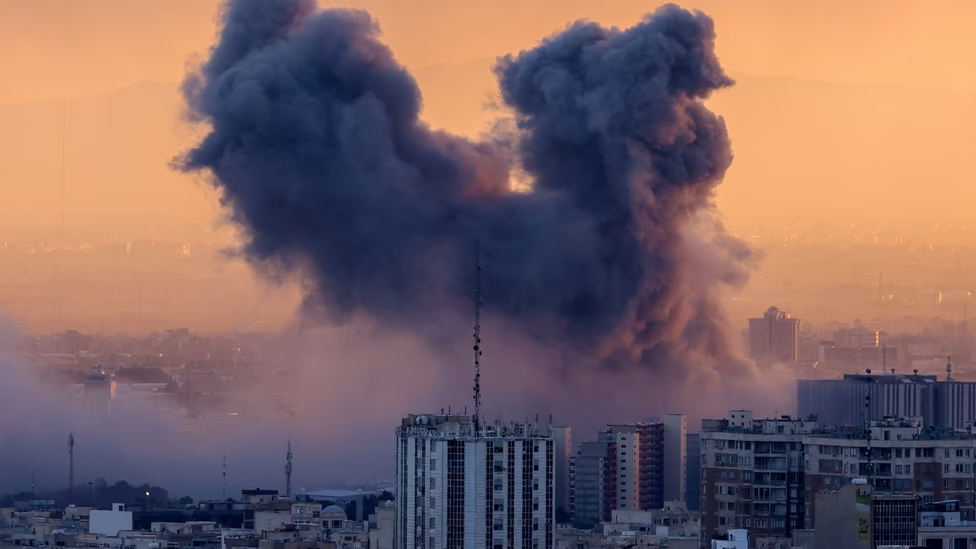
The conflict in Iran extends beyond Iran itself. It involves the moment when the crisis of American imperialism, Israel’s stance between security and arrogance, the pragmatic shifts in Middle Eastern alliances, and the resurgence of energy as a key factor in global geopolitics all converge. If it is viewed only as a campaign against Iran’s nuclear program, it is misunderstood. Instead, if seen as the culmination of long-standing regional, imperial, and identity-based tensions, then the conflict reveals its true nature: not a temporary disruption, but a phase shift within an order that can no longer sustain stability.
A conflict that had been smoldering for a long time
Iran did not start the war from a position of strength. It was already an opaque country, dealing with economic crises, social unrest, repression, a legitimacy crisis, and growing difficulties within the system to maintain consent, fear, and sovereignty. However, that fragility did not necessarily mean a willingness to collapse. Instead, it revealed a dual dynamic: internal vulnerability and the potential to turn external pressure into a narrative about national survival. This is the paradox of regimes under stress: they may appear close to breaking under siege, but sometimes that very pressure helps them rebuild.
The regional situation was already overwhelmed before. Since October 7, the Middle East has been a multi-front powder keg where Gaza isn’t a separate stage but the key that connects almost every other issue: Syria, Yemen, Iraq, Lebanon, the crisis of Arab nationhood, Iranian dominance, the stability of Egypt and Jordan, and major Gulf projects. In this way, the Middle East isn’t a collection of separate crises but a network of interconnected crises. The Iranian war doesn’t arise from this situation; it intensifies it.
Added to this is a deeper shift in regional alliances. In peace initiatives and negotiations, the key point is that the Middle East no longer operates based on rigid ideological blocs but on shifting interests. Interests, more than ideologies, influence new understandings, rivalries, and realignments. This doesn’t mean identities have vanished; it means they are increasingly shaped by the logic of national interest. Within this new framework, the conflict with Tehran must also be understood as not a clash of civilizations, but as a struggle to determine who can still organize the regional space and at what cost.
The reading error: striking the government does not mean bending the regime
A decisive strategic consequence emerges. If the IRGC is the core, then the conflict can no longer be seen as a simple campaign targeting nuclear sites or political leaders. Instead, it becomes a campaign against a dispersed, territorial, logistical system rooted in internal security and retaliatory capability. The main challenge for the United States and Israel is not just intercepting a single attack but identifying and dismantling the logistical network supporting dispersed forces, missiles, drones, and resistance capabilities. Therefore, the war shifts from a vertical approach of decapitation to a horizontal one.
Iranian military doctrine is specifically designed to prevent strategic annihilation. It does not pursue a quick conventional victory; instead, it aims to deny the enemy a decisive win at an acceptable cost. Underground structures, decentralized command, drones, missiles, proxies, information warfare, and sabotage of regional connectivity all serve the same purpose: turning the enemy’s technological advantage into a prolonged, costly, and regionally destabilizing conflict. This is the core of protracted war: not to defeat the stronger power directly but to ensure it pays a too-high price.
Mosaic defense is, in this context, the most effective strategy. The Iranian plan grants local commanders significant autonomy, includes multiple succession lines at each command level, and allows units to operate based on general instructions even after major losses at the top. This doesn’t make Iran all-powerful; however, it makes it more resilient than a strictly airpower-focused view of the war would suggest. Decapitation can cause chaos but not necessarily bring everything to a halt. In this way, a war meant to be short can quickly become a war of attrition.
Hormuz: the point from which the Middle East destabilizes markets
The key location in this conflict isn’t just Tehran, Natanz, or other points of the nuclear program. It’s Hormuz. That’s where the war will mainly be decided because that’s where the Iranian crisis stops being solely a security issue and becomes a matter of global political economy. For Washington, the limit of the campaign isn’t just operational; it’s rooted in internal politics. War has a time limit: it must end before the cost of living rises too much. For Iran, this means it doesn’t need to win in a traditional sense; it only needs to turn prices into a political issue.
Iran’s strategy is specifically aimed at weakening energy, maritime, and financial systems at a key chokepoint. Knowing it cannot survive a direct clash with the U.S. Navy, Tehran plans to use mines, missiles, drones, and coastal guerrilla tactics to prevent full navigation recovery and disrupt the economic infrastructure of regional rivals. Its goal isn’t to entirely shut down the strait but to turn it into a sporadic, costly, and destabilizing threat. Even a partially navigable route can become politically dangerous if it is seen as too risky.
Furthermore, Hormuz’s significance must be linked to the broader American goal of weakening Iran’s core without causing an uncontrollable collapse. The most serious dilemma of the war emerges here: Washington seeks to weaken the regime enough to create a new regional balance, without going so far as to trigger uncontrollable state disintegration. However, the realities on the ground push toward escalation. The more efforts made to bend Iran, the higher the risk of causing serious damage. The more Iran is severely damaged, the more the Gulf, the Levant, and Central Asia face a prolonged period of instability.
Israel, security, and the temptation to redesign its surroundings
To understand why this war is taking such a form, one must also consider Israel’s stance, not just as a tactical ally of the United States but as an actor with its own strategic goals and influence. What we observe is not only self-defense but also a deliberate or developing effort to achieve four long-term objectives. The first is demographic: reducing or neutralizing the Palestinian presence in key areas. The second is territorial: gaining greater strategic depth. The third is regional: weakening or wearing down potential hostile neighbors. The fourth is systemic: maintaining and strengthening structural dependence on the United States, ensuring U.S. presence, support, aid, and strategic alignment.
This framework encourages viewing Iran not just as an isolated threat but as a vital part of a larger system that Israel seeks to weaken, making it less coordinated, less hostile, and less capable of concentrating force. Iran is more than an ideological or nuclear adversary; it is the central point of a pressure belt spanning Lebanon and the Levant to Iraq and the Gulf. In this context, striking Iran for Israel involves trying to change the very structure of the surrounding region. It is not a new order yet, but it already represents an effort to prevent the reemergence of the old hostile order.
But this is exactly where the paradox arises: the pursuit of security often turns into hybris. Not because the threats are imaginary, but because security ceases to be a boundary and becomes an all-encompassing standard. Continued occupation, territorial expansion, the fragmentation of neighboring states, and an almost symbiotic alliance with the dominant global power can lead to a potentially self-destructive path. Israel remains both a state that feels existentially threatened and a regional power trying to shape its surroundings. The contradiction persists and grows stronger.
The Middle East wants a weaker Iran, not an Iran in pieces
The region, however, does not align with the Israeli perspective. Turkey, Saudi Arabia, and other actors see an advantage in Iran’s weakness, but they remain very cautious about a chaotic Iranian collapse. In its geostrategy, Washington needs two regional pillars — Turkey and Saudi Arabia — working together with Israel. However, Israel’s involvement in the war effort complicates the United States’ broader plans. For regional allies, the gap between American and Israeli goals is clear: the US favors strict yet manageable containment, while Israel seeks radical disintegration that surpasses regime change.
Turkey’s stance provides a clear example here. Ankara prefers an Iran that is weak enough not to project power into the Arab world or tighten its grip on Syria, Iraq, and the Levant. Yet, it shouldn’t be so weak as to cause an uncontrollable crisis on the Kurdish front or along the Caucasian border. Turkey and Iran are two non-Arab powers located on the edges of the Levant, separated by a sensitive Caucasian and Mesopotamian frontier; they remain key players in regional dynamics. When their competition becomes too unbalanced, it doesn’t create order but rather new fault lines.
The rest of the region also takes a cautious and interested stance. Past peace efforts show how Saudi Arabia, the Emirates, Egypt, and others had already shifted their policies toward pragmatism, development, intra-Arab competition, and the pursuit of functional stability. The Saudi-Iranian rapprochement, though fragile and incomplete, was driven by the need to reduce the costs of peripheral conflicts and to safeguard internal modernization projects. A war that destabilizes Iran too much, therefore, risks undermining the interests of these very actors, who still aim to contain it.
On a deeper level, the historical and structural reality is that the modern Middle East remains in a power vacuum and within a state system shaped and maintained from outside after the fall of the empires. From this perspective, the region has never truly stopped being a space where local and external powers compete to shape the balance. The war in Iran illustrates this ongoing issue: Who controls the space? Who bears the costs? Who faces the consequences?
The United States, Israel, and the erosion of hegemony
If the Middle East remains the theater, the United States continues to be the systemic problem. American power has not disappeared, but its form has declined. Cohesion has become a geopolitical variable. A fragmented society can still generate wealth, technology, and military strength; it struggles much more to maintain strategic continuity. When vertical and horizontal trust weaken, the outside world turns into a form of identity therapy, and foreign policy becomes more transactional, reactive, and susceptible to internal culture wars.
Here, Israel acts as a multiplier. The Israeli dossier condenses three levels now intertwined in the United States: foreign policy as internal civil war, culture war as domestic foreign policy, and the crisis of representation as persistent suspicion toward every “system” decision. When a superpower uses foreign dossiers to assess internal moral alignment, strategy has already shifted into identity. When strategy becomes identity, managing the costs of war becomes significantly more challenging.
The war against Iran is less a sign of America’s commanding power and more evidence of its decline. The “third Gulf war” expands the scope of the “Great War,” while America seems increasingly less like an arbiter and more like a force caught in a logic it cannot fully control. Washington appears to act more in line with Israel’s view of a perpetual war against eternal enemies, within a framework where American authority no longer clearly explains why the war is fought or what its political goal is. The hegemon does not command: it congests.
Therefore, the real trap. For the United States, Iran is both a challenge to deterrence and a financial burden. Not striking after raising the threshold hurts credibility; striking too hard damages unity, raises energy costs, worsens relations with allies, and increases the risk of entanglement. A superpower can survive tactical errors, but it cannot manage a legitimacy crisis without its external actions becoming inconsistent, sporadic, and vulnerable to the “strategy of stress” used by its opponents. Iran, with its doctrine of sustained war, appears nearly built to exploit that inconsistency.
Not a local war, but a test of order
The conclusion is more serious than traditional views suggest. The war in Iran isn’t just a minor incident or a simple counterproliferation effort; it acts as a test of order. It evaluates the ability of the United States to turn military advantage into political success. It assesses Israel’s ability to maintain security independently of the coercive reshaping of regional influence. It also considers whether Arab and Turkish allies can coexist with a weakened Iran without causing its complete collapse. Finally, it examines the endurance of an Islamic Republic that may be less stable than it claims and more resilient than its opponents expect.
For this reason, the conflict should not be viewed solely in terms of victory or defeat. Instead, it should be understood through factors like duration, threshold, cost, decomposition, and staying power. The key question isn’t who strikes harder, but who can endure longer under the combined pressures of logistics, costs, internal fractures, regional instability, and loss of legitimacy. In this sense, Iran is not just a front; it reflects the historical passage we have entered: a nation with much power but little governability, many weapons but limited ability to end wars, and many actors but no real arbiter. That’s why the war in Iran now affects the world far more than Iran itself.






Leave a Reply