

'/%3E%3Cpath%20fill='%23b2b2b2'%20d='M241%20382q0%2016%2017%2026%2017%2011%2042%2011t42-11q16-11%2017-26V269H241'/%3E%3Cpath%20fill='%239f7e00'%20d='M241%20379q0%2014%208%2023%209%209%2021%209%2014%200%2021-9%209-9%209-23V269h-59'/%3E%3Cpath%20d='M241%20339v-70h59v110q0%2014-9%2023l-6%205v-68h-15v72q-8%200-14-4v-68zm59%2040c0%2022%2015%2032%2029%2032%2021%200%2030-18%2030-32v-40h-59'/%3E%3Cpath%20fill='%239f7e00'%20d='M266%20277v5h2v12h-3v-5h2v-5h-9v5h2v5h-4v9h3v18h-5v10h34v-10h-5v-18h3v-9h-4v-5h2v-5h-9v5h2v5h-3v-12h2v-5zm42%20101q0%2010%206%2017%206%206%2015%207%2010-1%2016-7%206-7%206-17v-29h-43'/%3E%3Ccircle%20fill='%230044ad'%20cx='329.5'%20cy='372'%20r='6'/%3E%3Cellipse%20fill='%230044ad'%20cx='300'%20cy='340'%20rx='16'%20ry='21'/%3E%3C/svg%3E)
America’s trap: credibility abroad, the cost of consent at home
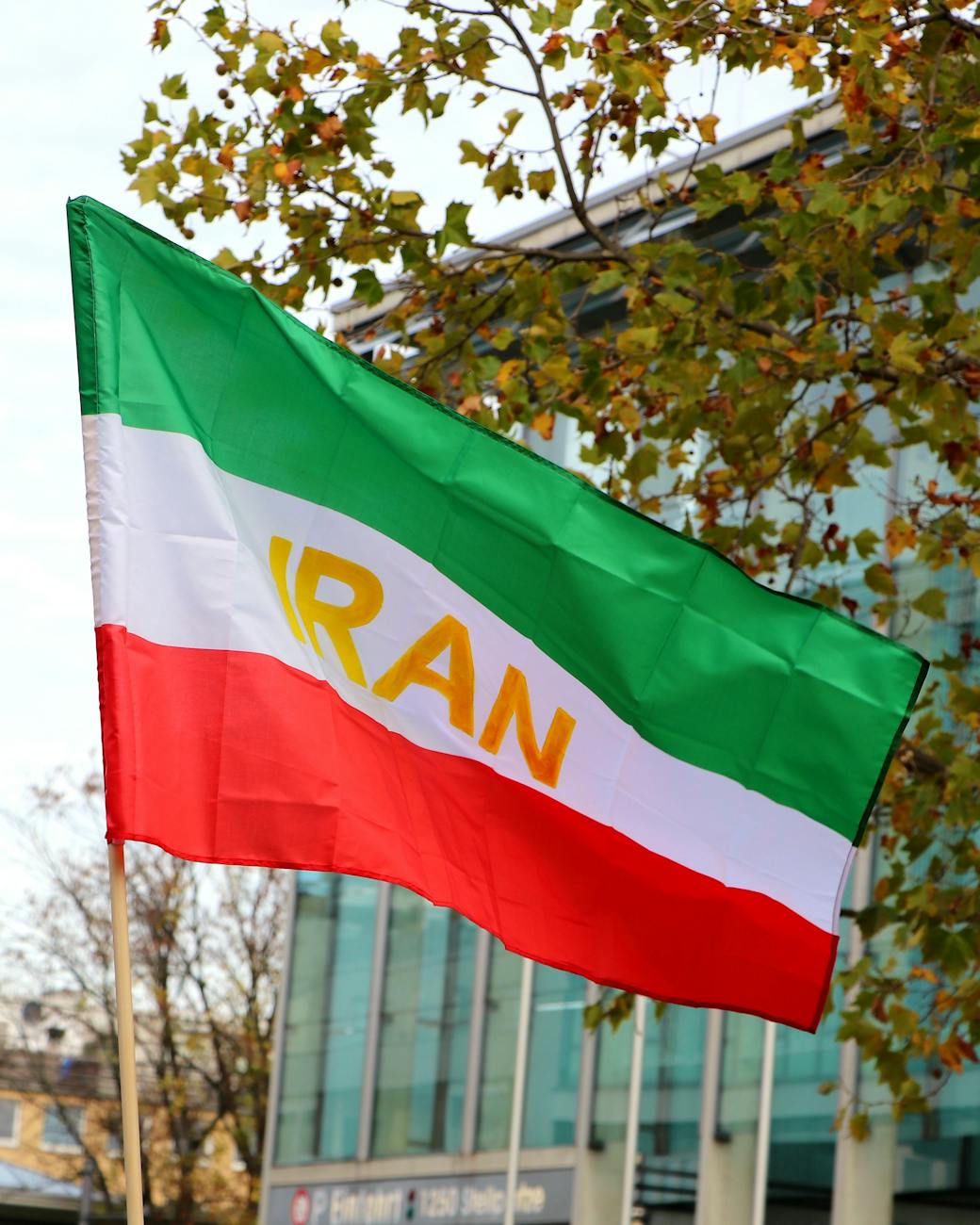
In February 2026, Iran remains “opaque”: an internal crisis you can’t fully see, which makes it easier to narrate and manipulate. In my January 25 piece, the key point was already clear: when a society enters a rupture, the internal fracture becomes a geopolitical lever. The US–Israel tag team tends to treat Iran not as a dossier to manage but as a State to wear down until it becomes replaceable, or at least wrecked, meaning permanently ungovernable. [1]
Since then, events have not altered this interpretation; they have made it more legible. Western pressure on Iran produces blackouts and repression; the threat of war becomes a negotiating lever; the Gulf fears destabilization more than it fears Iran; Israel pushes the threshold higher and demands that Tehran renounce not only its nuclear leverage but also its missile leverage; Washington discovers it has no truly decisive “good options.” But the real update is another: the United States has slipped into a trap with no exit, a geometry of costs in which any move entails a loss of credibility abroad or of consent at home.
1) The blackout as visible sovereignty: shutting down the network to govern the crisis
A blackout is not “just” censorship: it is a visible exercise of sovereignty, the contemporary form of a curfew. It is intended to disrupt coordination, testimony, and accountability, and to make violence more manageable by making it less verifiable. Amnesty International and Human Rights Watch have described the shutdown as an integral part of repression, not a collateral accident, thereby stripping the crisis of its evidentiary basis. [2] The moment the conflict loses real-time images, the narrative reverts to the state’s monopoly.
When external interference in an internal uprising becomes credible — even if only as a story, though in this case Israeli and US services were there fanning the flames — the regime can recode protest as a war of sovereignty. Not “the regime against the people,” but “the state against aggression.” This is the most paradoxical effect produced by the US–Israel tag team: not the regime’s overthrow, but its justification. The more Iran appears besieged, the more repression can be sold as defense; the more repression is framed as defense, the more the blackout becomes “necessity”; the more the blackout is necessity, the more the crisis becomes opaque. Opacity is a multiplier of duration for those who rule and of powerlessness for those who watch.
2) America’s trap: if you don’t strike, you lose credibility; if you do, you lose consent
The trap we referred to stems from a simple fact: Washington has already paid the costs. The military deployment, posture, statements, and the theatrics of visible deterrence: all of this raises the threshold and feeds expectations. If, after raising its voice and moving assets, America does not strike, it appears indecisive and weak. Not so much to adversaries, who are used to theater, as to allies and partners: credibility is not “strength,” but predictability. And predictability, once you have promised a gesture, depends on delivering that gesture.
But if the United States strikes, it pays the bill at home. And it pays it at the worst moment: when affordability is the decisive electoral variable, because inflation is not a macro indicator but a daily experience. Eight months before the midterm elections, the White House cannot afford to turn the price at the pump into a permanent referendum. Here, geopolitics immediately becomes domestic economics: closing Hormuz means routes insured at higher premiums, more expensive logistics, risk-loaded insurance, a higher oil price, and the gasoline–inflation–consent chain. [3] And so the trap becomes double: it is not only “strike or don’t strike.” It is external credibility versus the domestic cost of consent. If you don’t strike, you lose deterrence; if you do strike, you lose voters, markets, and narrative stability. Strategy becomes a domestic budget problem.
3) Why a “surgical” strike won’t achieve objectives: the illusion of rapid victory
The trap also lies in the tools. It is not a question of the ability to strike but of the ability to control what comes after. A “surgical” strike can destroy a site, hit a node, or generate a video. It can produce visible sovereignty, but it rarely achieves a stable strategic objective.
If the goal is to stop the nuclear program, a single blow is not enough: it creates dispersed programs, redundancies, reconstitution capacity, and incentives to sprint faster. If the goal is to “punish,” the punishment is domestic politics, not foreign policy: it serves to display command, not to change the structure. If the goal is regime change, a strike is, by definition, insufficient: regimes do not fall from a detonation but from a crisis of control; and a crisis of control, almost always, requires manpower, time, territory, and risk.
A rapid blow — a “victory” without war — is a promise that satisfies public opinion for a news cycle but exposes the next cycle to retaliation, subthreshold escalation, rearmament, nuclear acceleration, and regime consolidation. Iran’s deterrence is not to defeat America but to render the strike sterile and the aftermath costly.
4) The military point: why an attack carries a high risk of failure
The military option is not only “costly.” It is intrinsically risky, with a high likelihood of producing an ambiguous outcome: a large operational spectacle with a small strategic effect.
The first reason is geography. Iran is not a “concentrated” target: it is characterized by depth, dispersion, mountains, underground infrastructure, and redundancies. In 2025, the symbolic node was Fordow: an enrichment facility carved into rock, long considered beyond the reach of an autonomous Israeli action and widely regarded by analysts as an objective requiring specific capabilities and a complex operational package. [4] Here, geography is not context: it is defense.
The second reason concerns the nature of the target. If the target is “nuclear,” you must not strike only buildings; you must strike a system: knowledge, stockpiles, restoration chains, and the potential for concealment. Even assuming severe damage, the problem of “residual capability” remains: how much material is recoverable, how much has been moved, how much can be rebuilt, and on what timeline. Some recent analyses underscore precisely this: the difference between destroying an infrastructure and eliminating a capability. [5]
The third reason is defense and retaliation. An effective attack on hardened sites is not an isolated event; it tends to escalate into a campaign. Reuters reported that the Pentagon is preparing options that could last weeks, not hours, because Iran has a missile arsenal capable of retaliating and making the attack costly. [6] This is key: in a campaign, vulnerability shifts from Iranian targets to American and Israeli assets.
The fourth reason is the regional posture. The United States does not fight in a vacuum: it relies on bases, logistical hubs, radars, depots, runways, and exposed personnel. Reuters reported that US officials expect Iranian retaliation and that Tehran’s arsenal could strike multiple countries and locations, risking American casualties and regionalizing the crisis. [7] This is not an abstract risk: during the June 2025 crisis, Tehran struck the Al Udeid base in Qatar with ballistic missiles, a crucial node in the US posture; the Pentagon confirmed damage to sensitive infrastructure. [8] This is the point that makes the military option politically toxic: “clean” war does not exist if the adversary can bring the war back to you, in real time, onto your bases.
The fifth reason is Israel. Israel is a small, densely populated territory with a high concentration of critical infrastructure: by definition, it is vulnerable to saturation logic. The 12-day war in June 2025 demonstrated this not because Israel’s defenses failed, but because missile defense is consumptive, and consumption becomes strategy. An EUISS brief reconstructs the impact of that conflict and the fragility of the “informal ceasefire,” precisely because no hotline and no guarantor truly reduce the risk of repetition. [9] In addition, an FPRI analysis, together with a Wall Street Journal reconstruction, highlighted a crucial element: the war burned through interceptor stocks and exposed inventory and sustainability constraints, underscoring the difference between protecting a city for one night and protecting a country for weeks. [10]
Here, the trap in its military version becomes clear: even if the strike lands, Iran can respond with missiles and drones; Israel can intercept many, but it cannot “cancel” attrition over time without paying an economic, psychological, and political price. And when time becomes a factor, war stops being a gesture and becomes a wear-down.
Finally, there is a politico-military data point that serves as an alarm bell: according to the Washington Post, the Chairman of the Joint Chiefs, General Dan Caine, reportedly voiced concerns about the risks of an operation against Iran, citing — among other things — munitions and allied support, which bear on the material and political sustainability of a campaign. [11] Whether the White House minimizes or denies it, the point remains: if even within the apparatus signals of caution emerge, it is because the military threshold is not a switch you can activate with a click.
5) If you get bogged down, you waste resources and hand China a strategic advantage
The other way out of the trap — a long war — is the worst option. It burns the scarcest resource of hegemony in an interregnum: duration. A prolonged war consumes munitions, logistics, and readiness; increases exposure of US assets in the region; forces the protection of corridors and bases; multiplies the hybrid dimension; and above all, becomes a domestic tax: spending, inflation, and polarization.
This is where system competition comes in. If America sticks to Iran, it detaches from the Pacific. Beijing benefits if Washington remains pinned to a costly and politically toxic theater, as it reduces attention and the capacity to prioritize. Simultaneity becomes a weapon against America: you don’t need to defeat it; you only need to saturate it. In that sense, a long war is the perfect saturator.
Moreover, a long war fuels domestic dissent even within the pro-Trump coalition, because the American right is not a bloc but a constellation. The “order and governability” right fears inflation and disorder; the populist right fears the “swamp”; libertarian components view intervention as an anti-system betrayal; the security right views it as a necessity; and isolationist fringes view it as a waste. War does not unite: it selects and splits. When war splits, foreign policy becomes a proxy for the internal cold civil war. This is where the trap closes: the more you fight outside, the more you fight inside; the more you fight inside, the less you can sustain the fight outside.
6) The boomerang effect: rallying the Iranian regime and raising the regional threshold
There is also an effect — already mentioned — that Western debate always treats as a mere “possibility” but is nearly a rule: an attack tends to rally. Not all of society, not forever. But enough to give the regime a survival narrative: the state under attack. This is the logic of besieged sovereignty: instead of opening, the internal fracture can close. And a regime — especially an imperial one like Iran’s — that closes in the name of war becomes harder, more paranoid, and more willing to sacrifice the economy and welfare for deterrence.
At the same time, an attack raises the regional threshold. Iran can strike Israel; it can strike US assets; it can move the war onto proxies and corridors; it can turn Hormuz into a systemic risk. Iranian deterrence is cost-based, and the Strait is the most effective lever because it links the theater of conflict to everyday American life through oil and inflation. In other words: Iran does not have to “close” Hormuz; it only has to make the threat credible. The threshold becomes the market.
7) The fracture with the Gulf: allies who brake, bases that become negotiation
Finally, there is the allied cost. The Gulf does not want Iran dismantled; it wants Iran contained. An Iranian collapse does not produce stability but rather exportable chaos — militias, refugees, energy shocks — and turns the region into a risk multiplier. This fear has moved beyond rhetoric into concrete constraints: Reuters reported that Saudi Arabia would not allow the use of its airspace or territory for military actions against Tehran. [12]
This changes the grammar of the American presence. If partners deny access, deterrence must be redesigned. Indeed, current developments show a more “visible” and active posture in Israel: The Wall Street Journal reported the deployment of F-22s as a readiness signal at a moment when other spaces are denied or politically costly. [13] It is a historic shift: Israel is no longer only an ally but also a basing platform. Yet an Israeli platform also carries a political price: it makes America more closely identified with Israel in the theater and, as a result, more contestable in the region and in the Global South.
8) Nuclear and negotiation: a window that won’t close, pressure that won’t resolve
On the nuclear file, the trap lies in the background. The Geneva talks ended without a final agreement but with signs of progress and a promise of further technical rounds. [14] This is the typical interregnum outcome: no solution, only threshold management. The problem is that when domestic politics demands visible sovereignty, threshold management looks like weakness. Thus, diplomacy itself loses credibility.
Meanwhile, the internal Iranian context remains harsh. The United Nations, through the High Commissioner for Human Rights, warned of the risk of executions linked to the protests, underscoring the repressive nature of the crisis. [15] This also heightens the moral dimension of the dossier in the West, increasing political pressure on the White House.
9) A power that pays the threshold, not an adversary that wins
This is why the United States is in a trap with no painless exit. If it does not strike after moving assets and raising its voice, it pays in credibility and deterrence. If it strikes, it pays in domestic consent, oil prices, inflation, fractures with allies, the Iranian regime’s rallying, and the risk of being bogged down. If it opts for a strike, it fails to achieve its objectives; if it slides into war, it burns resources and hands China time. In both cases, Iran does not need to win: it only needs to make crossing the threshold prohibitively costly.
The Iranian crisis is a device for wearing down America’s “form.” Not America-as-power, but America-as-capacity-to-endure. When endurance grows scarce, hegemony does not collapse: it becomes intermittent. That is how an interregnum becomes a system.
Notes
[1] Massimo Scattarreggia, “Iran: the uprising, the blackout and the ‘tag team’,” Substack, January 25, 2026. For the interpretive key: opacity as leverage, besieged sovereignty, the limits of a strike, and Gulf fears.
[2] Amnesty International; Human Rights Watch (January 2026). For the blackout as a device of repression and concealment, not simple censorship.
[3] Reuters (February 2026), Coverage of war risk and implications for oil/markets. For the chain “geopolitical premium → barrel → inflation → cost of consent.”
[4] Center for Strategic and International Studies (CSIS), “Options for Targeting Iran’s Fordow Nuclear Facility” (June 18, 2025); The Guardian, Explanation of Fordow and Israel’s operational limits (June 2025). For geography as defense, and the difficulty of “closing” Fordow with a single gesture.
[5] Bloomberg (February 2026), Analysis of stockpiles and site protection. For the distinction between infrastructure damage and residual capability (material/reconstitution/concealment).
[6] Reuters (February 2026), Planning for potentially “weeks-long” operations and the risk of missile retaliation. For the idea that a strike tends to become a campaign.
[7] Reuters (February 2026), Expectation of Iranian retaliation and risk of casualties/regional spread. For the vulnerability of US assets in the theater.
[8] ABC News (June 2025) and CSIS (February 2026), Reconstructions of Al Udeid/Qatar being hit by Iranian missiles in response to US strikes. For an empirical demonstration of base vulnerability.
[9] EUISS, “Israel and Iran on the brink: Preventing the next war” (October 3, 2025). For the reconstruction of the 12-day war and the fragility of the “pause” without a guarantor.
[10] Wall Street Journal, “Israel’s 12-Day War Revealed Alarming Gap in America’s Missile Stockpile” (July 24, 2025); Foreign Policy Research Institute (FPRI) (October 2025) on defenses and interceptor consumption. For the “consumptive defense” thesis and inventory constraints as a strategic factor over time.
[11] Washington Post (February 23, 2026) and related coverage. For General Dan Caine’s warning (Joint Chiefs) about risks and the material/allied sustainability of an operation.
[12] Reuters, Saudi statements barring the use of airspace/territory for actions against Tehran (January 27, 2026). For the allied constraint that reduces operational options and signals fear of chaos.
[13] Wall Street Journal (February 2026). For the deployment of F-22s in Israel as a visible deterrence and the redefinition of regional basing.
[14] Reuters, Geneva talks (February 26, 2026). For the state of negotiations: no final agreement, declared progress, and technical continuation.
[15] Reuters/UN (February 27, 2026). For the repressive context and the international politicization of Iran’s internal crisis.


Leave a Reply