

'/%3E%3Cpath%20fill='%23b2b2b2'%20d='M241%20382q0%2016%2017%2026%2017%2011%2042%2011t42-11q16-11%2017-26V269H241'/%3E%3Cpath%20fill='%239f7e00'%20d='M241%20379q0%2014%208%2023%209%209%2021%209%2014%200%2021-9%209-9%209-23V269h-59'/%3E%3Cpath%20d='M241%20339v-70h59v110q0%2014-9%2023l-6%205v-68h-15v72q-8%200-14-4v-68zm59%2040c0%2022%2015%2032%2029%2032%2021%200%2030-18%2030-32v-40h-59'/%3E%3Cpath%20fill='%239f7e00'%20d='M266%20277v5h2v12h-3v-5h2v-5h-9v5h2v5h-4v9h3v18h-5v10h34v-10h-5v-18h3v-9h-4v-5h2v-5h-9v5h2v5h-3v-12h2v-5zm42%20101q0%2010%206%2017%206%206%2015%207%2010-1%2016-7%206-7%206-17v-29h-43'/%3E%3Ccircle%20fill='%230044ad'%20cx='329.5'%20cy='372'%20r='6'/%3E%3Cellipse%20fill='%230044ad'%20cx='300'%20cy='340'%20rx='16'%20ry='21'/%3E%3C/svg%3E)
When Politics Becomes a Global Marketplace
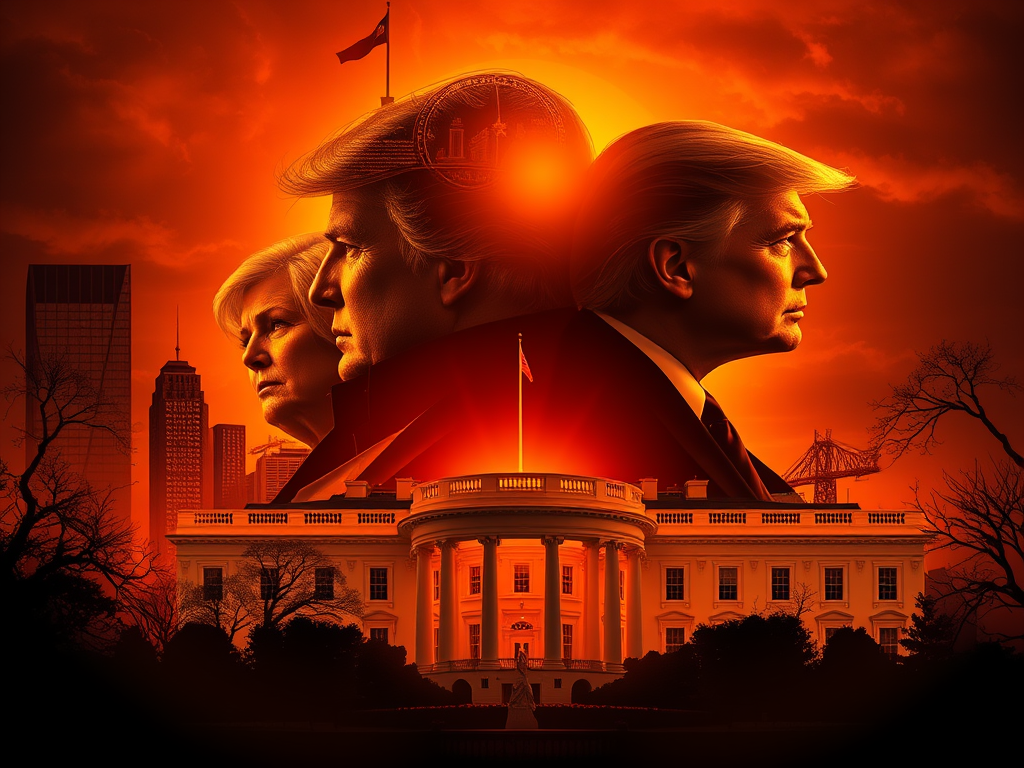
In the United States, a hybrid model is taking shape, one we have seen elsewhere but never on this scale or with this degree of systemic centrality: the state as a platform for private rent and politics as an extraction tool. As the state becomes a conquest zone for tech magnates, the presidential family enriches itself and prepares for a dynastic succession; at the center is Donald Trump Jr., heir to the Trump Corporation’s throne and perhaps its successor in politics as well.
We are no longer in the old pattern: “the leader governs, the family cashes in later.” On the contrary, the family is part of the governing apparatus. As the state becomes contested terrain for new magnates — especially in tech — Trump Inc. continues to operate as a global brand, multiplying opportunities, rents, and channels of influence.
In the first year of Trump’s second administration, several journalistic reconstructions estimated that total flows attributable to the family’s circuit — across real estate, licensing, fundraising, stakes, and cryptocurrencies — reached unprecedented levels for a presidential family (with estimates approaching two billion dollars). The point, however, is not the figure itself: it is the normalization of converting access into rent.
This is not only a domestic American story. It is geopolitics because how Washington manages (or fails to manage) conflicts of interest signals to allies and rivals, and because access to the president, when openly “priced,” becomes a commodity that can be purchased abroad, where politics has long been transactional.
Kleptocracy as a network, not a vice
Twenty-first-century autocracy is no longer a “bad man at the top” surrounded by yes-men. It is a network: opaque financial structures, professional intermediaries, security apparatuses, propaganda, technology, and accommodating jurisdictions that enable money to flow and accountability to evaporate. This is not ideology; it is the infrastructure for “capturing” the State.
This is not “theft.” It is about occupying the state and shaping the rules so that stealing becomes legal — or at least non-prosecutable — and about building channels that convert political power into private rent. The new corruption is not an accident: it is the system. The question is not only how much money flows in but also how much public trust flows out.
The White House as a holding company: power as rent, rent as language
The point is not to demonize “business.” In America, the boundary between power and money has always been permeable. The point is the normalization of conflicts of interest as a method of governance: the idea that the president can be, at the same time, both regulator and beneficiary; that the family can be a protagonist in economic operations and, simultaneously, a political interlocutor. In this framework, old ethical barriers become décor, affirmed in words, irrelevant in practice.
The geopolitical effect is immediate: if power is “negotiable,” access to it becomes an investment. And the investors are not only Americans.
The map of financial entanglements: channels, vehicles, counterparties
If contemporary kleptocracy is a network, it should be described as such: not only “who takes what,” but also which corridors convert access into rent. In Trump’s case, the corridors are at least five — real estate and clubs, global licensing, public equity, funds and advisory, and crypto and tokenization — each with its own geography of counterparties, from the Gulf to the circuits of tech finance.
The point is not that every flow is, by itself, illegal: many channels are formally lawful, and precisely for that reason, they work. The “gift” is not the envelope; it is liquidity that arrives without being labeled a gift — a stake, a fee, a membership, a token — and that, once perceived as a bridge to the political apex, becomes an incentive to pay.
Figure – Network map of financial entanglements – conceptual schema

This map does not “prove” a crime; it describes a structure. In geopolitics, the signal matters most. When access to the president is mediated through monetizable vehicles, foreign interlocutors learn that the relationship with Washington can be conducted through private channels, and domestic interlocutors learn that politics is an asset multiplier.

1789 Capital: the dynastic hinge between venture, defense, and the state-as-contract
If contemporary kleptocracy is a network, it is worth identifying its “switchyards”: places where capital buys not only returns but also proximity, information, and preferential lanes. In this framework, Donald Trump Jr.’s role is no longer merely that of a brand custodian but already that of the operator who translates access into financial architecture.
Don Jr.’s decision to collaborate with 1789 Capital — a fund that positions itself as anti-ESG and as an investor in the conservative “parallel economy” — is a key step because it makes what would otherwise remain episodic into a structural arrangement. This is not only about raising capital: it is about creating a contact point among the political ecosystem, donors, financiers (such as Peter Thiel via Founders Fund, Mark Andreessen via his American Dynamism and Silver Lake funds), platforms (such as Oracle and OpenAI), and the defense and dual-use industry (such as SpaceX, Palantir, and Anduril) at a moment when national security is returning as an industrial policy issue.
It is no accident that, in this galaxy, the “natural winners” are precisely these firms operating in procurement and security: autonomous defense, space, data analytics, and critical infrastructure. This is the new America, where the federal contract market is the primary market and the boundary between private industry and public function is narrowing. When foreign capital enters this perimeter — sovereign funds (such as Emirati MGX or Saudi PIF) seeking protection, reputation, and access — geopolitics becomes a valuation accelerator.
The mechanism is simple and therefore effective. On one side, a presidential family signals to the market that it is permeable; on the other, a vehicle (such as 1789 Capital) invests in or co-invests in companies that rely on public contracts, regulation, and strategic infrastructure. When industrial policy — especially defense industrial policy — runs through outsourcing, the line between “national interest” and “the network’s interest” blurs.
This is where the privatization of the state changes the quality: it is no longer only about the presence of private actors in public services but about the idea that sovereignty — data, cloud, defense, supply chains — can be managed like a portfolio. In this sense, 1789 Capital is significant: it is a system indicator, suggesting that dynastic succession is built not only at rallies but also in cap tables.
The outside world as a portfolio: the Middle East and beyond
One of the most revealing traits of the Trump dynasty is its persistence in international business precisely where geopolitical stakes are highest: the Gulf, the wider Mediterranean, and globalized financial and real estate hubs.
Qatar, in particular, offers an almost didactic example: the announcement of the first major Trump-branded real estate project in the country — an international golf course and a villa complex integrated into the Simaisma coastal mega-development — demonstrates how the presidential brand inserts itself directly into the geography of sovereign funds and Gulf diversification strategies. This is not only a deal. It is a political signal, turning the bilateral relationship into an ecosystem of rents: from real estate projects to financial and investment circuits, up to the most sensitive dimension, where “big gifts” and big contracts become access tools.
Reuters, for example, reported on the expansion in Saudi Arabia of Trump-branded projects linked to Dar Global, with an announced investment plan on the order of billions and a presence that aligns with Saudi ambitions for transformation and national rebranding.
In parallel, deals and announcements tied to Gulf and regional partners are multiplying, carrying an implicit message: doing business with the Trump brand means entering the radius of power.
Here, kleptocracy is not “briefcase and bribe.” It is far more elegant and far more effective: real estate, resorts, licensing, fund management, and crypto. It is the transformation of the president into an asset and the presidency into a platform.
The useful precedent: the Washington hotel and states’ “toll”
To understand the logic, it is worth recalling a paradigmatic episode: the use of Trump-linked venues (first and foremost the Washington hotel) as spending destinations for foreign actors, with the explicit or implicit understanding that such spending was a way to cultivate favor or attention.
A House Oversight report documented substantial spending by foreign governments at Trump properties during the first term, providing a concrete picture of how “hospitality” can serve as an influence channel.
According to that documentation, delegations and representatives from multiple countries — including Saudi Arabia, the United Arab Emirates, Qatar, Turkey, China, and Malaysia — spent hundreds of thousands of dollars at the Washington hotel during politically sensitive periods. It is a perfect example of a “gift without a gift”: a formally commercial payment that, in the donor’s perception, takes on the value of a bet on favor.
The pattern did not remain confined to the first season. In the second term, the acceptance — or even the public negotiation — of a state “gift,” such as a Boeing 747-8 offered by Qatar to be converted into a provisional Air Force One (which, at the end of the presidential term, will become property of the Trump Foundation), pushes this logic to a symbolic extreme: the superpower normalizes the idea that an asset of sovereignty (the presidential aircraft) can enter the circuit of favors. Here again, the point is not only a possible violation of rules; it is the message. If even the state’s symbols become giftable, everything else becomes negotiable.
The lesson for foreign observers is simple: if there is a faucet, someone will eventually turn it on. And if the faucet is “legal” or tolerated, it becomes standard.
Kushner, sovereign funds, and privatized diplomacy
The most geopolitical node — because it links money, power, and the Middle East — runs through Jared Kushner and Affinity Partners. Here, we are not in the hotel’s gray zone. We are in the zone where finance and foreign policy meet.
A letter by Ron Wyden and Jamie Raskin (Senate Finance Committee, 2024) describes a landscape in which Affinity Partners manages largely non-U.S. capital and highlights, among key elements, Saudi Arabia’s PIF ($2 billion in committed capital). The same documentation mentions a 1.25% annual management fee on the PIF commitment — a flow that alone amounts to tens of millions of dollars each year — and cites a filed Form ADV reporting nearly $3 billion in Assets Under Management attributable to non-U.S. parties. The political issue is not only “how much.” It is the underlying question the senators ask: whether a former decision-maker who managed Middle East dossiers can immediately afterward move within the same network of capital and relationships, leveraging regulatory gray areas (including the Foreign Agents Registration Act, or FARA) without a clear separation between influence and business.
The geopolitical core is therefore not only a matter of “how much.” It is the “how”: a former decision-maker and family adviser who, outside the office, remains embedded in diplomatic networks and regional financial channels. That is the operational definition of a network: no clear demarcation line, only continuity of relationships.
Crypto: the perfect shortcut to buying favor
If real estate is the long route, crypto is the short route. It is the ideal infrastructure for converting political favor into a “technical” purchase disguised as an investment.
World Liberty Financial, a crypto platform launched in 2024 and promoted by Trump’s sons in partnership with external partners and with Binance’s technological support, is the purest laboratory of the economy of access: rent no longer flows through bricks but through tokens. According to Reuters reconstructions of the revenue-split structure, the Trump family is entitled to a very large share of net proceeds from token sales, and 2025 financial disclosures reported sales-linked income of about $57.35 million, alongside ownership of an enormous allocation of governance tokens.
The geopolitical signal is not only the amount but also the audience: the token can be purchased worldwide and serve as a symbolic “ticket.” Justin Sun, founder of Tron and a major figure in the sector, said he spent at least $75 million on World Liberty–linked tokens; in the same period, the SEC (U.S. Securities and Exchange Commission) told the court it was exploring a possible resolution of the ongoing civil proceeding against Sun.
The system then tends to close the loop between tech finance and state relationships: Reuters reported that World Liberty’s USD1 stablecoin was selected to settle a $2 billion investment by Emirati MGX in Binance, and that World Liberty’s ecosystem attracted attention and investment from various Gulf actors. In early 2026, according to the Financial Times and the Washington Post, a nearly 49% stake in the company was sold to investors linked to the United Arab Emirates, fueling questions about conflicts of interest and the overlap between policy and business.
In parallel, the regulatory landscape is shifting rapidly: in 2025, under the Trump administration, the SEC filed papers to drop its case against Coinbase and closed other actions, even “forgiving” major operators, including Changpeng Zhao, founder and former CEO of Binance, who had already been jailed after being convicted of money laundering. Meanwhile, the crypto industry, through PACs and super PACs, invested large sums to support candidates and pro-innovation agendas. Here, too, the key is market perception: if political backing is read as regulatory protection, the incentive to “pay for access” grows.
The entanglement is almost didactic: fintech offers a channel where transparency is optional, and the boundary between advocacy, lobbying, and the purchase of benevolence blurs. There is no need to prove an explicit pact; it is enough that part of the market believes financial support can translate into protection or preferential treatment. This is a form of “political rent” grounded in the signal’s credibility.
Ellison and other tech oligarchs: delegated sovereignty
Among the many actors on the front line, the axis centered on Larry Ellison is particularly instructive: it links infrastructure (cloud), data (platforms), AI (industrial capex), and, indirectly, media (the ability to shape the agenda and reputation). Here, politics is no longer a mediator; it is an accelerator and a multiplier of scale.
The emblematic case is the race for AI infrastructure. The announcement of the Stargate project — with Oracle among the partners — made explicit a point that often remains implicit: in the new technology cycle, the U.S. can no longer do without private operators who control data centers, networks, cloud, and supply chains. The problem is that this dependence creates enormous bargaining power, which tends to translate into regulatory influence.
In parallel, the expansion of contracts and framework agreements with the federal government shows that the AI cycle has a “double balance sheet”: a private one of markets and a public one of power. Those who control cloud and data centers do not merely sell services; they sell state capacity and, consequently, accumulate veto or priority power over agencies’ operational choices.
The same applies to the TikTok fight. Building a majority-American “USA” entity, with Oracle on the perimeter, is presented as a national security solution to protect data and infrastructure from China’s shadow. But structurally, it is also a form of delegated sovereignty: data security becomes a contract with a key vendor; digital border policy rests on a corporate architecture; and digital geopolitics is resolved — at least formally — through corporate governance engineering.
Other tech magnates also figure among the protagonists of this state mutation. The 2025 presidential inauguration and subsequent events are the founding scene of a new alliance: Zuckerberg, Bezos, Musk, Cook, Altman, Luckey, and Thiel (the latter two close to 1789 Capital), along with other tech leaders, in symbolically central positions amid donations, meetings, negotiations, and pending regulatory interests.
This is not social theater. It is a snapshot of a politics that has returned to operating through personalized transactions: antitrust, federal contracts, investigations, regulation, and protection. It is the new American oligarchy, shaped by the direct relationship between the president and the economic elite.
The technology trust becomes a parallel ministry. Tech magnates are no longer simple donors; they are co-governors. Elon Musk becomes a figure of enormous influence over agencies that regulate or subsidize his companies; the result: cuts and interventions affecting institutions investigating Tesla, SpaceX, and Neuralink; pressure for Starlink adoption; and impacts on U.S. external projection, with cuts to USAID and international broadcasters that reduce soft power and indirectly benefit friendly competitors. Here, kleptocracy meets geopolitics in an almost “Chinese” way, yet with private actors: power is no longer only the state disciplining capital; capital disciplines the state and then uses it to reorient the international space in which it operates.
The result is a double circuit: on one side, populism as a mass language; on the other, oligarchy as a governing technique. The base feeds on symbols; major interests feed on access.
From Mar-a-Lago to the Arctic Circle: when geopolitics becomes venture
The Greenland case is useful because it combines three elements: territorial ambition, strategic resources, and techno-libertarian ideology.
Investors and figures in the tech ecosystem promote the idea of a low-regulation “freedom city” there. Among these figures, Peter Thiel and Marc Andreessen stand out, while Ken Howery (linked to Thiel and close to Musk) helps define the boundaries of the discussion.
Here, geopolitics is no longer only “national security.” It becomes sovereign urban planning, a regulatory laboratory, and rent extraction on new frontiers (AI, energy, infrastructure, minerals). This is exactly the kind of “hybrid network” model: politics, technology, money, and power lean on one another until you can no longer tell where the state ends and the consortium begins.
At this point, the dynasty becomes doctrine because succession is not only familial but also systemic. If America grows accustomed to seeing power as rent, the world grows accustomed to treating it as a court. And a court, by definition, is composed of sons, favorites, emissaries, dealmakers, and intermediaries: Eric, even nineteen-year-old Baron Trump, David Sacks, Steve Witkoff, Miriam Adelson, Tucker Carlson, Nayib Bukele, Javier Milei, Mohammed bin Salman, Tahnoon bin Mohammed Al Nahyan, and Masayoshi Son are just a few among the many not previously mentioned. Politics becomes spectacle, “efficient” authoritarianism becomes the model, and opaque finance becomes the fuel.
Kleptocracy as a signal: what allies and rivals understand
The final point is the most geopolitical: what does America communicate to the world when the president and his family become visible participants in an economy of access?
It shows that foreign policy can be influenced not only by national interests but also by patrimonial interests; those dossiers (sanctions, exports, export controls, antitrust, defense, energy, the Middle East) can become more permeable to those with the means to invest in “favors.” Above all, it shows that the liberal order is not only contested from the outside but also recalibrated from within through opaque network logics.
From this perspective, kleptocracy threatens democracy not because of corrupt individuals but because the mechanism hollows out popular sovereignty and turns trust into a market. In a transactional world already crisscrossed by transnational autocratic networks, this convergence is a gift: if the superpower normalizes transactions, everyone else learns the lesson.
References and sources
Anne Applebaum, Autocracy, Inc. and related editorial/critical materials (Penguin Random House); Applebaum in The Atlantic with “Kleptocracy, Inc.” (The Atlantic); The Atlantic on the new tech-oligarchic alliance and the consolidation of the Trump–Silicon Valley relationship (The Atlantic); House Committee on Oversight and Reform/House Oversight: documents and reports on spending by foreign governments at the Trump International Hotel in Washington (2017–2021) and “emoluments” profiles; CREW, Trump likely benefited from payments from foreign governments during his presidency (September 2024) and related filings; documentation and letters from the Senate Finance Committee (Wyden/Raskin 2024) on Jared Kushner and Affinity Partners; Reuters on the expansion of Trump-branded real-estate projects in the Gulf (Dar Global) and on the geography of Trump Organization revenues in Florida; Reuters on the transfer of the Trump Media & Technology Group (DJT) stake into a revocable trust (December 2024); Reuters on World Liberty Financial (founding, revenue-share structure, USD1 stablecoin, 2025 disclosure, Sun/SEC cases, partnerships and Gulf-linked investments); Reuters on the SEC dropping the Coinbase case (February 2025) and on the SEC’s crypto regulatory repositioning; Brennan Center for Justice and Campaign Legal Center on major-donor flows and the legal structure of inaugural committees (2025 inauguration); Financial Times and Washington Post on Emirati capital entering World Liberty Financial and the related ethics debate (February 2026); Reuters on Trump Jr and 1789 Capital (entry announcement, November 12, 2024) and Reuters reporting on the fund’s development (September 8, 2025); Reuters on Stargate (OpenAI–SoftBank–Oracle, January 21, 2025); GSA (OneGov agreement with Oracle, July 7, 2025) and sources on federal cloud contracts; Reuters on the TikTok USA joint venture (January 23, 2026) and the role of Oracle/Silver Lake/MGX; Financial Times, Wall Street Journal and Washington Post on Emirati-linked capital (Sheikh Tahnoon/MGX) in World Liberty Financial (January–February 2026); Reuters on the first Trump-branded project in Qatar (Qatari Diar/Dar Global, April 29, 2025); Defense News and congressional records on the Qatari Boeing offered for a provisional Air Force One (2025–2026); Giuseppe de Ruvo, “La dinastia di Trump: soldi, figli e potere,” Limes podcast, January 29, 2026.


Leave a Reply