


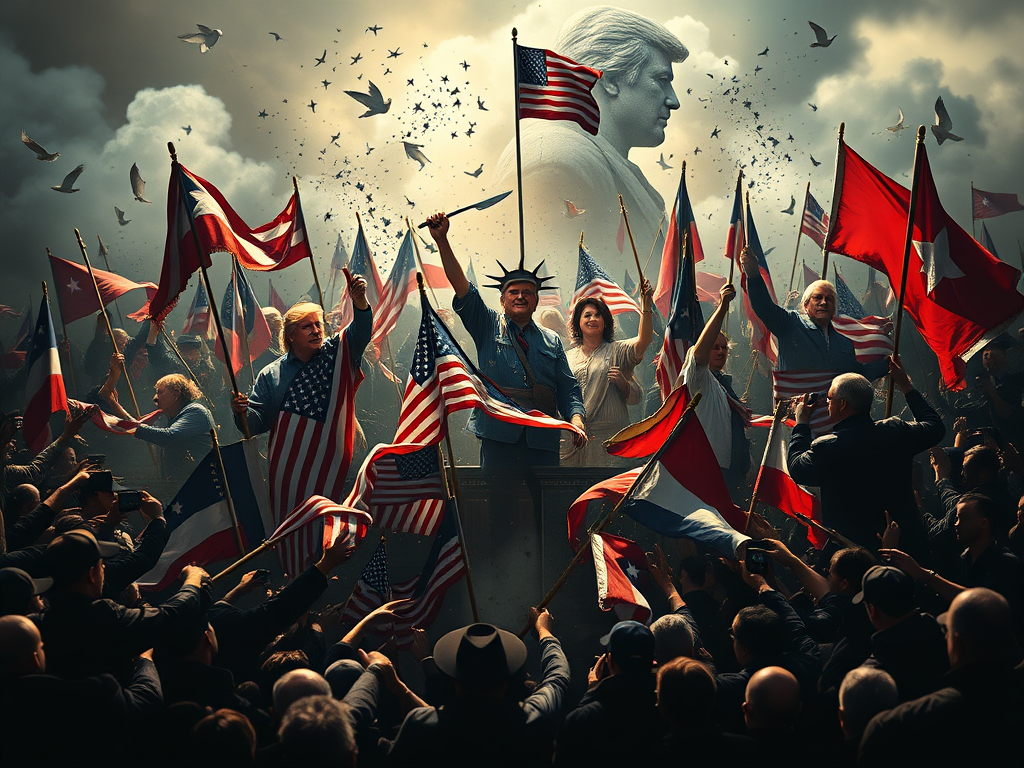
There is an invisible threshold beyond which a democracy stops debating “what to do” and begins debating “who we are.” When public debate shifts from administration to definition, when the state is no longer merely a regulator but becomes a totem, and when institutions are no longer referees but are perceived as parties to the conflict, we are no longer in the realm of programs: we are in the realm of ideology. Trumpism is born here, in a crisis that is as geopolitical as it is intimate: the United States remains immensely powerful, yet a growing share of the country senses that this power no longer produces form. Wealth no longer becomes security, globalization no longer becomes a promise, and military victory no longer becomes order. Material power remains; symbolic cohesion breaks.
For this reason, Trumpism is not merely protest populism. It is a strategy of recomposition: to recompose social fractures, to recompose a dispersed national identity, and to recompose an idea of sovereignty in a world where value chains, migration, finance, and media ecosystems cross borders faster than politics can. It is an American response to a problem Polanyi described elsewhere and in another century: when a “disembedded” economy produces insecurity and a loss of status, society generates a countermove to re-embed the market and social life within a political order.1 Trumpism is a countermove with an American grammar: more plebiscitary than corporatist, more moral than administrative, more theatrical than planned. In the pages that follow, I reconstruct the Trumpian doctrine — absolute sovereignty (“absolute” in its etymological meaning, “loosened from” any constraint) as a promise — and analyze why, today, this doctrine is producing a political revolution whose outcomes remain uncertain, but whose direction is already visible.
The founding act of Trumpism is a religious formula. In the 2017 inaugural address, Trump says: “From this day forward… it’s going to be only America first, America first.”2 He is not simply announcing a line of foreign policy: he is offering a principle of selection that organizes the world, a frame in the Goffmanian sense.3 From that moment on, everything can be reduced to a single question: who benefits? If it doesn’t benefit “us,” it is suspect. If a treaty, an alliance, a climate regulation, a trade deal, a military mission, or an immigration policy “benefits others,” it is a trap, a shakedown, or a fraud. And this reduction is not a flaw: it is a political technique because it makes the world legible to a voter exhausted by complexity.
There is, in this, a dimension of civil religion in Bellah’s sense: America as a wounded moral community to be repaired, not merely an administration of interests.4 Trumpism asks not only to win but also to restore. And restoration always requires two things: a border and an enemy.
The frontier as sacrament: when immigration becomes sovereignty
If “America First” is the theology, the border is the liturgy. Trumpism grasps something both banal and decisive in political sociology: sovereignty must be seen, not merely proclaimed. The border is perfect because it is the only place where the state can demonstrate, through an elemental gesture, that it “commands”: it blocks, selects, and expels. Sovereignty is reduced to a physical act.
The origins of this liturgy trace back to 2015. In the speech launching his candidacy, Trump turns an administrative issue — the flows from the South — into a political myth. He speaks of crime, a violated border, and invasion; precision does not matter here, but the gesture does: naming an enemy and pointing to a breach.5 In an America where trust in elites is corroded, transgression becomes a credential. If institutional language is perceived as elite, then breaking it becomes a sign of authenticity.
From that moment on, immigration is “securitized” in Buzan’s definition6 and in Wæver’s theory7: no longer an administrative matter but an existential threat. When something is framed as a threat to the survival of the political body, the state gains a license to adopt exceptional measures. The border then becomes more than a line: a moral criterion, a way to distinguish insiders from outsiders, the deserving from the undeserving. It is what Lamont would call boundary work: a society that feels it is losing form redraws moral borders to rebuild hierarchies and certainties.8
The 2024 Republican platform presents this liturgy as if it were a catechism: “seal the border” and “carry out the largest deportation operation in American history.”9 Here, the word “largest” matters more than the operational detail: it signifies a promise of verticality. Deportation is not sold as one public policy among others but as an act of refounding the state.
It is proof that order can return. In this logic, the border also becomes the key to reinterpreting everything else: drugs, fentanyl, gangs, urban disorder, and even pressure on welfare are tied to control of the frontier. It is a form of “metanarrative” that simplifies chaos: there is a door, and someone left it open. Trumpism promises to close it again.
From the border to the factory: sovereignty descends into the economy
But a coalition cannot live on liturgy alone. For Trumpism to become a majority, it must offer a material translation of sovereignty. This is where economic nationalism comes in. In an America that has endured decades of offshoring, precarization, and the loss of industrial status, the global economy is no longer presented as an opportunity: it is presented as plunder. Globalization is no longer “modernization”; it is “humiliation.”
The inaugural act of this “translation” is withdrawal from the TPP. The January 23, 2017 memorandum orders the withdrawal and justifies it by protecting workers and wages, offering the bilateral route as a “fairer” alternative.10 It is a gesture of geopolitical value because it rejects an architecture also designed to contain China, but above all it has domestic value: it signals that America stops signing “big deals” perceived as elite devices.
Then comes China, the total antagonist. The 2018 USTR Section 301 report on Chinese practices related to technology transfer and intellectual property provides the technical foundation for a trade war that Trump turns into a moral war.11 In Trumpism, trade becomes the arena where power is measured: if technology is sovereignty, then import dependence means losing freedom. The tariff becomes the economic equivalent of the wall.
It is significant that in 2025, a Congressional Research Service document notes that the 2018 tariffs “remain in effect.”12 This detail is more geopolitically important than many speeches: it indicates that Trumpism is not merely a rhetorical parenthesis but a political infrastructure that tends to normalize. When the exception becomes routine, the ideology has won.
Sociologically, the decisive theme here is not only wages but also recognition. The promised factory is a promise of restored status. It is a way of telling working-class sectors: “you are not the scraps of history; you are the heart of the nation.” When an economic policy becomes a politics of status, it is no longer judged solely on efficiency; it is judged on dignity as well. It is a profound transformation: redistribution is no longer only about income; it is about prestige.
The contradiction that holds: protectionism and pro-business in the same body
At this point, the apparent contradiction that many observers have mistaken for incoherence becomes clear: how can protectionism coexist with deregulation, and how can the defense of the factory coexist with an alliance with big capital? The answer is sociological, not doctrinal. Trumpian ideology is not a logical system: it is a system of minimal compatibility among different social blocs.
The Trump of the Tax Cuts and Jobs Act speaks to the business world with absolute clarity: cutting the federal corporate rate from 35% to 21% is a clear signal, a bridge to donors and corporate management, and to a segment of American capitalism that sees in Trumpism a guarantee against the progressive agenda.13
In parallel, deregulation is presented as an aesthetic of governance. Executive Order 13771 (“two-for-one”) establishes an accounting principle: for every new regulation, eliminate at least two.14 It is not only a technical principle. It is a symbol: the state stops “suffocating” productive America. It is the promise “drain the swamp”, translated into the language of the economy.
Trumpism, in fact, does not shrink the state: it makes it selective. Here, Wacquant helps explain the phenomenon: the state can be permissive toward the market and punitive toward the margins at the same time — light when imposing costs on business and extremely harsh when imposing order and belonging.15 Trumpism does exactly this: deregulate above, discipline below; free up business, harden borders and order. Not less state, but a state with different targets.
Energy: sovereignty that gushes from the subsoil
If the border represents geographic sovereignty and the tariff represents economic sovereignty, energy represents material sovereignty. It is the pillar that turns “America First” into tangible power: extract, produce, export. The 2017 Executive Order, “Promoting Energy Independence and Economic Growth,” declares that developing energy resources is in the national interest and an essential component of geopolitical security, and it frames environmental regulation as a burden that weakens America.16
The most symbolic gesture is withdrawal from the Paris Agreement.17 In the June 1, 2017 speech, Trump presents it as a reappropriation of sovereignty, pitting American voters’ interests against constraints that, in his narrative, would favor other countries. The climate issue is thus reframed as a war over self-government: not science versus denial, but nation versus constraint. It is a powerful twist because it shifts the debate from true/false to loyal/hostile.
In 2024, this energy liturgy re-emerges as a mass slogan, “drill, baby, drill”, and the idea of an “energy-dominant” America capable of powering the world.18 The drill becomes a national symbol. It is a simple object: it promises wealth, jobs, and autonomy. Above all, it promises a hierarchical order: whoever controls energy controls others. Geopolitics enters the oil barrel.
In 2025, a CRS report cites the executive order that formally initiates the U.S. exit from the Paris Agreement and its related obligations.19 Here, once again, what matters is repetition: an ideological pillar does not rest on a single act but on a ritual that renews itself.
Law & order: the strong state at home
The energy pillar promises power; “law & order” promises form. A country can be rich and well-armed yet feel vulnerable. Trumpism recognizes that insecurity is not only statistical: it is an experience. In the 2017 inaugural address, Trump paints a devastated America and delivers the line that becomes a brand: “This American carnage stops right here and stops right now.”20
Here, Durkheim is useful for understanding the phenomenon: when a society perceives that rules no longer protect, anomie emerges.21 Trumpism presents itself as the solution to anomie: the restoration of order, hierarchy, and the return of the visible state. It is a deeply modern need: the demand that someone recompose what appears to be coming apart.
In 2025, the inaugural address promises to restore “law and order” in cities and ties that promise to a broader vision that also denounces the “weaponization” of institutions and the idea of a “merit-based” society.22 Here, public order is part of a package: a strong state against urban chaos, but also a state “purified” of hostile elites and bureaucracies.
Garland would speak of a “culture of control”: security policy as a symbolic response to diffuse anxieties.23 In Trumpism, this culture also becomes one of loyalty: whoever asks for order is a “patriot”; whoever questions order is suspected of siding with chaos.
Culture War: the fight over reality
At a certain point, however, the promise of order is not enough. Anomie is not only crime; it is also cultural disorientation. This is where Trumpism makes the decisive leap: it turns politics into a war over normality. The 2024 Republican program speaks of identity and a threatened “way of life” and proposes a nation founded on “Truth” and “Common Sense.”24 It is the lexicon of the culture war: no longer debating policy but debating what is real and what can be said.
James Davison Hunter describes the culture war as a conflict over the moral authority that defines the good.25 In Trumpism, this battle condenses into symbolic arenas: school, family, sports, university, and the media. These arenas are where the America of tomorrow will be decided. The 2024 platform explicitly places the fight against CRT (Critical Race Theory) and “radical gender ideology” among the priorities of the national agenda.
In 2025, the culture war also becomes administration: the inaugural address promises the end of “social engineering” based on race and gender and declares, as official policy, that there are only two genders.26 Here, Foucault’s theories are pertinent: governing also means producing categories, defining normality, and administering bodies.27 Culture enters the state as a norm.
This pillar has an indirect yet crucial geopolitical function: rebuilding internal cohesion through moral simplification. In the Trumpian vision, power requires an “aligned” people; alignment is produced by defining cultural enemies. It is an ancient mechanism: the moral frontier as a substitute for political mediation.
Anti-establishment: the swamp, weaponization, and the construction of the internal enemy
If the culture war is the glue, anti-establishment is the fuel. It is what allows Trumpism to remain a movement even when it governs: the promise is not to govern better but to liberate. In the 2025 inaugural address, Trump speaks of a crisis of trust and a “corrupt” establishment that supposedly stripped citizens of power and wealth, leaving the pillars of society “broken.”28 It is his interpretation of recent history: decline is not an accident; it is the product of elites.
The keyword is “weaponization.” The 2024 platform promises to end the weaponization of government against the people.29 In 2025, that promise becomes foundational: Trump enacts the end of the Department of Justice’s weaponization.30 Here, Weber is useful: when impersonal legality is perceived as partisan, authority shifts toward charisma.31 Trust no longer goes to procedures but to the leader who says: “I give you back the state.”
According to Becker, this is also moral entrepreneurship: defining an evil as “the swamp” and authorizing its purification.32 It is no surprise that “drain the swamp” remains a totemic slogan in the movement’s political memory. The sociological point is that the slogan creates a “we” and a “they” without requiring details. It generates belonging.
Here, a fundamental geopolitical trait emerges: Trumpism tends to turn foreign policy into a projection of internal conflict. If elites “sold” the country, treaties and alliances become suspect; multilateral institutions become instruments through which “they” discipline “us”; distant wars become traps. The external becomes a chapter in the domestic battle.
Alliances as contracts: NATO between accounting and deterrence
This shift is most evident in the relationship with alliances. In the 2017 inaugural address, Trump says the US has “subsidized the armies of other countries” and defended others’ borders while refusing to defend its own. It is a line that moralizes the alliance: no longer a common good but a wrong suffered.
In 2018, speaking with Stoltenberg, Trump described NATO contributions as “delinquent,” as if the Alliance were a debt.33 This characterization is conceptually misleading: 2% is a national spending target, not a “fee” paid to the US.34 In Trumpism, however, rhetoric matters more than the actual accounting because it produces discipline: 2% — now 5% — becomes a tribute for the defense of the empire. It is geopolitics reduced to a domestic language.
The 2017 NSS includes “unfair burden-sharing with our allies” among the factors that would have produced danger.35 It institutionalizes the frame: the alliance is not denied but renegotiated as insurance. Not a strategic community, but a contract. In 2024, the famous line about “encouraging Russia” to “do whatever it wants” toward those who do not pay triggers immediate reactions because it undermines deterrence.36
In 2025, the NSS openly speaks of “Burden-Sharing” and “Burden-Shifting” and invokes the image of America-Atlas, which can no longer hold up the world order.37 It is Trumpism translated into doctrine: the liberal order is no longer a mission but a cost. Geopolitically, the wager is clear and risky: to secure more contributions and obedience through the implicit threat of disengagement, while accepting the price in terms of credibility.
Here, Walter Russell Mead captures the “Jacksonian” vein: a political culture that distrusts permanent commitments and measures foreign policy by respect, reciprocity, and punishment.38 Trumpism is not total isolation; it is hard selection and transaction.
Judges and institutions: conquering the long run
So far, we have described a movement rooted in theater and conflict. But Trumpism becomes a “bloc” only over the long run. The judicial pillar serves this purpose: transforming an emotional majority into infrastructure. The three Trump appointments to the Supreme Court, as recorded in the Senate’s official timelines, are: Gorsuch (2017), Kavanaugh (2018), and Barrett (2020).39
The Dobbs40 decision of 2022 is the symbolic outcome of these nominations: the Court holds that the Constitution does not confer a right to abortion and overturns Roe and Casey41, returning regulation to the states. Sociologically, it is the institutionalization of a contest: what for decades was movement and mobilization becomes a ruling. Politics is transformed into a norm.
And yet, even here, Trumpian logic creates friction. Trump — and part of MAGA — does not want only conservative judges; it wants “aligned” judges, less autonomous. The rift between MAGA and the Federalist Society highlights this tension: doctrine is not enough; loyalty is required.42 This detail reveals the deepest trait of Trumpism: sovereignty is not only ideological but also a demand for control over citizens and intermediary federal bodies.
“Nationalized” welfare: social protection as a border
The welfare pillar is often misunderstood as a mere tactical softening or as a contradiction of the pro-business stance. In reality, it is the component that allows Trumpism to present itself not only as a punishment of elites but also as a protection of insiders. The 2024 Republican program insists on defending Social Security and Medicare, claiming them as rights won by “our own”.43 It is a nationalized welfare: not an abstract universalism but a selective protection tied to citizenship, work, merit, and belonging. Here, sovereignty becomes concrete again: the state owes little to others but owes something to the “ours”, and it owes it in a visible, politically usable way.
Here, Trumpism departs from a certain Reaganism: it does not promise welfare cuts but protection. Yet it does so by turning welfare into belonging: promises to insiders, suspicion of outsiders. The platform links the defense of Medicare to an immigration narrative, casting irregular immigration as a threat to financial sustainability. It is welfare chauvinism: social protection as a privilege of “us.” The border, once again, enters domestic politics; this time not as a customs gate but as a criterion of belonging and merit.
Geopolitically, this pillar matters: in a country that perceives relative decline, social protection becomes an infrastructure of cohesion. Trumpism promises first to secure the domestic order, then to manage the world. It is the social version of America First.
Electoral integrity: legitimacy as a frontier
Finally, the most spiritual and destabilizing pillar: electoral legitimacy. The 2024 platform insists on “secure our elections,” proposing measures such as “voter identification, paper ballots, proof of citizenship.” Here again, the frame is that of the border: who belongs to the demos? Who can decide? The election becomes a moral frontier. And when legitimacy becomes a permanent theme, politics shifts from a dispute over programs to a dispute over the referee.
In the 2025 inaugural address, Trump presents the election as a mandate for restoration and promises to restore integrity and trust, linking that theme to the end of weaponization. It is a form of inverted civil religion: not trust in institutions, but cohesion through suspicion. Durkheim would say that ritual produces solidarity;44 here, solidarity arises from the conviction of betrayal.
For a superpower, this is geopolitically costly: a country that compromises its internal legitimacy undermines its external credibility and its capacity to develop a coherent strategy. But for a movement, it is fuel: it turns every political battle into an existential one, and therefore into total mobilization.
The synthesis: absolute sovereignty, a selective state, war over form
At this point, the deep coherence of Trumpism becomes clear. It is not doctrinal coherence but functional coherence. Trumpism takes a complex world and reduces it to a single question: who decides? It then answers by reducing sovereignty to visible symbols: wall, tariff, drill, police, judge, ballot.
Its State is selective: light on business, hard on borders and order; protective toward insiders, punitive toward anything that threatens cohesion. Its foreign policy is transactional: alliances as contracts, reciprocity as morality, and credibility as leverage. Its domestic policy is a war over form: culture, legitimacy, and institutions become battlefields.
Ultimately, Trumpism is a doctrine of absolute sovereignty, aiming to bring every sphere — borders, trade, energy, order, culture, courts, welfare, elections, alliances — under the same imperative: restore command. In an era when the liberal order seems to be a machine that distributes costs without producing consent, Trumpism offers a simple countermove: rebuild the political dimension as decision-making power. The price is moral simplification and permanent conflict; the gain is emotional cohesion.
That is why some in America experience it as a threat and others as liberation. It is not only a change in policies: it is a change in political ontology. It is an attempt to remake the country by making visible again what many believe has been lost: the power to say “no.” But when a movement turns that “no” into a method of government, the question is no longer only what the state will do: it is what it will become.
From Doctrine to Revolution: Trumpism as a Transformation of the Regime
Up to this point, Trumpism has appeared as a doctrine: a grammar that reduces the world to the question “who decides?” and, to answer it, constructs a liturgy of symbols: the wall, the tariff, the drill, the police, the judge, the ballot. But a doctrine becomes history only when it turns symbols into institutions. In the second term, the issue shifts from agenda to process: absolute sovereignty tries to build a new, suitable container for the State. It therefore becomes a revolution.
What is happening in the United States is precisely a “political revolution,” understood as the attempt to systematically dismantle constraints on presidential power and to capture the machinery of the federal government to use it against the president’s enemies. The formula matters because it shifts the focus from policy content to the command device: what began as tactical norm-breaking becomes a system-level transformation, qualitatively different from ordinary partisan hardball or normal executive overreach.
The connection to absolute sovereignty is direct. If the problem is that the state is perceived as a party (captured by bureaucracies, courts, the media, universities, the establishment), then the promise to restore command cannot be limited to changing laws: it must change the brakes. The revolution, in this sense, is not the abolition of democracy but its reinterpretation in an autocratic, plebiscitary key: legitimacy no longer comes from checks and balances but from the vote as a personal mandate, an authorization to bend intermediary bodies. This project is also a “restoration”: a necessary purge of a system deemed already corrupt and weaponized, and therefore illegitimate.
The administration has accordingly begun politicizing the state: purges of career officials for political reasons; removal of inspectors general, ethical watchdogs, and the leadership of independent agencies; and, above all, the transformation of “power ministries”— first and foremost the Department of Justice and the FBI — into political arms of the White House, after decades of relative autonomy built in reaction to Watergate. Media outlets, law firms, and universities also enter the command intent perimeter through investigations, litigation, and threats intended to secure compliance.
Norms and checks, guaranteed by the courts, Congress, independent agencies, the press, and the legal profession, are eroding. Many actions are concentrated precisely in these areas, and most have already produced results: in several cases, even when a move is challenged, its strategic purpose is achieved before a ruling because the chilling effect on newsrooms and law firms occurs regardless of the outcome.
This is politics as an economy of fear: the cost of opposition rises, and the mere need to pay it changes behavior. Media and technology companies prefer paying millions to settle even “winnable” disputes; financial executives stay silent, and collective actors choose caution because the alternative is exposure. Order is no longer only “law and order”: it becomes “order as obedience,” an order built for internal deterrence.
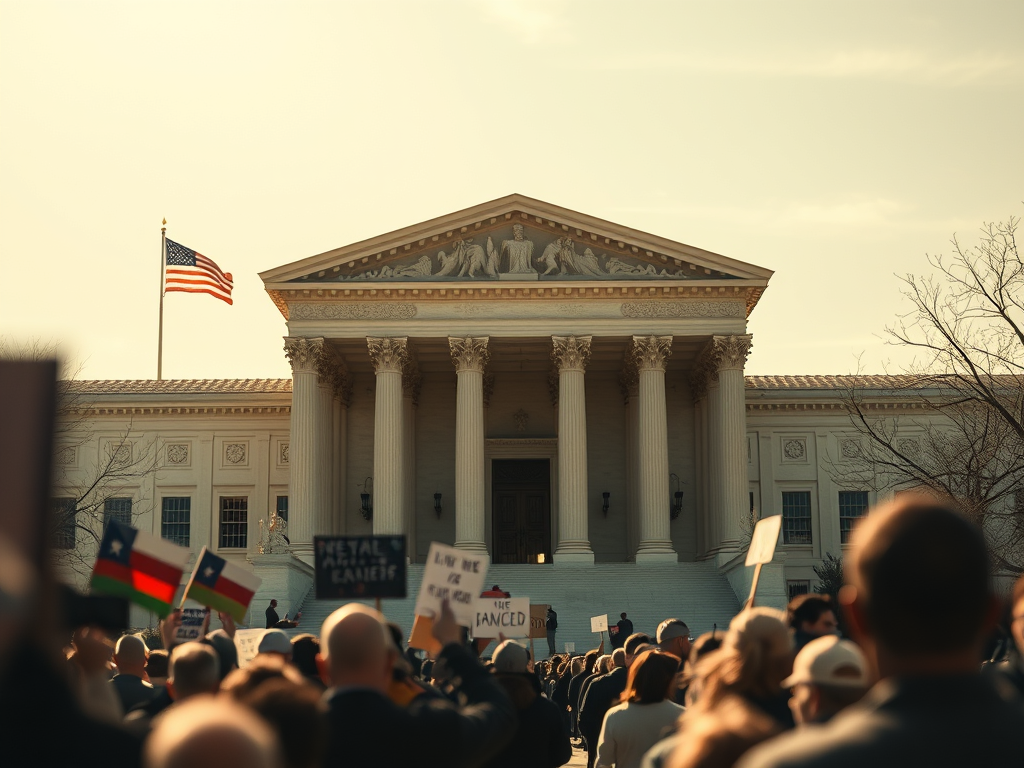
At this point, the Supreme Court of the United States becomes decisive. Even while losing several battles in lower courts, the administration has often exploited timing and loopholes in a legal system that cannot keep pace with the executive’s speed. The Court — one of the most powerful checks — has, on more than one occasion, accommodated the revolutionary push, in part because the conservative majority appears receptive to a maximalist conception of presidential power, the so-called Unitary Executive Theory.45 Here, the revolution is not only a matter of political will: it is also a matter of institutional architecture and constitutional interpretation.
From this perspective, many political-science categories about democratic erosion cease to be abstract. Steven Levitsky and Daniel Ziblatt called “guardrails” the informal norms that prevent competition from degenerating into institutional warfare; when they break, the system remains formally intact but deforms.46 Nancy Bermeo showed that modern backsliding rarely proceeds via coups and more often through the gradual capture of institutions and processes.47 Reality shows exactly such a sequence: not the interruption of voting, but the rewriting of the conditions under which voting produces alternation.
That is why the direction is already clear, even if the outcome remains uncertain. In 2026, an increase in “risk acceptance” is likely: with the prospect of unfavorable midterms and a narrowing window, Donald J. Trump and his circle will be incentivized to intensify the use of the federal machine against opponents: investigations of Democratic fundraising platforms, donors, officials, and candidates; regulatory retaliation against companies that employ critics; and threats to foundations through litigation over their tax status. The expected and already unfolding result is to make criticism and organizing more expensive.
The media dimension is an integral part of the device. Further pressure through lawsuits and regulatory threats is likely, but so is co-optation: investors aligned with Trump obtaining political approvals to acquire platforms in exchange for favorable coverage, with the prospect of a concentration of legacy media and social platforms in pro-Trump hands. In a mass democracy, controlling the attention ecosystem means controlling the boundary of what can be said: it is a way of producing reality without having to argue for it.
The most delicate point — because it touches the last check —I s the electoral terrain. I previously defined legitimacy as a frontier: here, the frontier becomes engineering. Many moves aim to tilt the playing field: an unprecedented push for mid-decade redistricting; pardons for the 2020 fake electors; the weakening of the Cybersecurity and Infrastructure Security Agency, which helps states defend elections; and the presence of an election denier at the helm of election security within the Department of Homeland Security. If the vote remains, but the referee and the field are under pressure, competition remains “competitive” yet becomes less “fair”: a typical trajectory of hybrid regimes.48
Why, then, do outcomes remain uncertain? Because real frictions persist. Grand juries, trial juries, and independent judges make it difficult to turn political pressure into automatic convictions; and a Democratic victory in Congress would increase the likelihood that the revolution fails by adding friction and legitimizing resistance. Coalitions can also crack: internal fissures within MAGA and the president’s impulsiveness could sabotage the project. The point, however, is that even failure does not roll things back: it leaves behind precedents, expanded powers, and weakened counterweights.
This is where Guillermo O’Donnell becomes useful: in “delegative democracies,” the elected leader interprets the vote as total delegation and views intermediary bodies as obstacles.49 Trumpism radicalizes this tendency within a superpower: domestic politics becomes a test of sovereignty, and sovereignty becomes — literally — the capacity to impose costs. When this scheme enters the federal administration, the transformation concerns not only ideology but also the state’s capacity and shape.
And indeed, a collateral effect of the revolution is the erosion of competence: as loyalists replace experts, state capacity weakens; data collection and crisis-response capabilities shrink; pressure is applied to the nodes of statistical and administrative production. Today’s America begins to resemble the final phase of the Mikhail Gorbachev era: a system moving toward the unknown, with a society that accepts revolutionary uncertainty because the certainty of decline amid perceived failure is intolerable.
The deterioration is not only technical but also moral and cognitive. Media consolidation can degrade the information environment and fracture the “shared reality” necessary for deliberation; corruption becomes more explicit, and political violence continues to expand, with threats against election officials, judges, and politicians. Pardons for those responsible for January 6 send a clear message: rule-breakers aligned with Trump can count on executive protection.
In this frame, the Trumpian revolution is geopolitical even when it appears domestic. Instability “radiates” outward: tariff threats used as leverage, alliances that shift with presidential mood, erosion of soft power and coalition capacity, and further retreat from multilateral cooperation. And what happens in America does not stay there: U.S. regression becomes an accelerant for other regressions.
The conclusion, then, is not a prophecy but a criterion. Trumpism sparks a political revolution because it seeks to transform absolute sovereignty from a matter of language into a regime, shifting the center of gravity from the balance of powers to executive supremacy and from the idea of institutions-as-referees to institutions-as-weapons. The outcomes are indeterminate and will remain so for years, but the direction is already clear: not a return to the past but a conflictual refounding of command, with internal and external costs that, in a superpower, become global costs.
NOTES
- K. Polanyi, The Great Transformation: The Political and Economic Origins of Our Time, Rinehart, New York 1944 (It. ed. La grande trasformazione, Einaudi, Turin 1974): for the idea of “disembedding” and society’s reaction to the self-regulating market.
- Donald J. Trump, Inaugural Address, January 20, 2017, The American Presidency Project (UCSB): for the formula “America First” and the symbolic architecture of the inauguration.
- E. Goffman, Frame Analysis: An Essay on the Organization of Experience, Harvard University Press, Cambridge (MA) 1974: on framing as an interpretive structure of social reality.
- R.N. Bellah, “Civil Religion in America”, Daedalus, vol. 96, no. 1, 1967, pp. 1–21: for the concept of civil religion as a national moral grammar.
- Donald J. Trump, Remarks Announcing Candidacy for President in the 2016 Election, June 16, 2015, The American Presidency Project (UCSB): for the initial securitarian framing of immigration (the quote “When Mexico sends its people…”).
- Barry Buzan, Ole Wæver, Jaap de Wilde, Security: A New Framework for Analysis, Lynne Rienner, Boulder 1998: for securitization theory (the transformation of an issue into a security question).
- Ole Wæver, “Securitization and Desecuritization”, in R. Lipschutz (ed.), On Security, Columbia University Press, New York 1995.
- Michèle Lamont, Money, Morals, and Manners, University of Chicago Press, Chicago 1992; and The Dignity of Working Men, Harvard University Press, Cambridge (MA) 2000: for “symbolic boundaries” and the moral dimension of social distinction.
- Republican National Committee, 2024 Republican Party Platform (“Make America Great Again!”), text circulated in 2024: for language on the border, deportations, and “way of life”.
- Presidential Memorandum, “Withdrawal of the United States from the Trans-Pacific Partnership Negotiations and Agreement”, January 23, 2017 (White House Presidential Actions).
- Office of the United States Trade Representative (USTR), Findings of the Investigation into China’s Acts, Policies, and Practices Related to Technology Transfer, Intellectual Property, and Innovation Under Section 301 of the Trade Act of 1974, March 22, 2018.
- Congressional Research Service, “Section 301 Tariffs on U.S. Imports from China”, updates 2024–2025: on the continuity of the 2018 tariffs and their status in USTR reviews.
- Tax Cuts and Jobs Act (TCJA), December 22, 2017: for the tax reform and the cut of the federal corporate rate to 21%.
- Executive Order 13771, “Reducing Regulation and Controlling Regulatory Costs”, January 30, 2017 (Federal Register): for the “two-for-one” rule and the anti-regulatory approach.
- Loïc Wacquant, Punishing the Poor: The Neoliberal Government of Social Insecurity, Duke University Press, Durham 2009: on the coexistence of economic deregulation and selective punitive hyper-regulation.
- Executive Order 13783, “Promoting Energy Independence and Economic Growth”, March 28, 2017 (Federal Register): for the “energy dominance” framework and the review of environmental regulations.
- Donald J. Trump, Remarks/Statement on the Paris Climate Accord, June 1, 2017, The American Presidency Project / White House archives: for the U.S. withdrawal.
- RNC, 2024 Republican Party Platform: lexical recurrences and energy slogans (“Drill, Baby, Drill”, “Energy Dominance”).
- Congressional Research Service, “The Paris Agreement on Climate Change: U.S. Withdrawal and Reentry”, 2025 update; and Executive Order 14162, “Putting America First in International Environmental Agreements”, January 20, 2025 (White House Presidential Actions).
- Donald J. Trump, Inaugural Address, January 20, 2017, The American Presidency Project (UCSB): for the phrase “American carnage”.
- Émile Durkheim, Le suicide: Étude de sociologie, Félix Alcan, Paris 1897: for the concept of anomie.
- Donald J. Trump, Second Inaugural Address, January 20, 2025, official transcript (U.S. Embassy transcripts/AP): for “law and order”, “weaponization”, and “merit-based”.
- David Garland, The Culture of Control: Crime and Social Order in Contemporary Society, University of Chicago Press, Chicago 2001: for reading “law & order” as the political-cultural management of insecurity.
- RNC, 2024 Republican Party Platform: for the lexicon of “truth”, “common sense”, and the depiction of “way of life”.
- James Davison Hunter, Culture Wars: The Struggle to Define America, Basic Books, New York 1991: for the theory of culture wars.
- Donald J. Trump, Second Inaugural Address, January 20, 2025 (official transcript/AP): for the reference to “only two genders”.
- Michel Foucault, Surveiller et punir: Naissance de la prison, Gallimard, Paris 1975; and Histoire de la sexualité I: La volonté de savoir, Gallimard, Paris 1976.
- Donald J. Trump, Second Inaugural Address, January 20, 2025 (official transcript/AP): for the anti-establishment narrative and the diagnosis of “broken pillars”.
- RNC, 2024 Republican Party Platform: for the promise to end the “weaponization of government”.
- Donald J. Trump, Second Inaugural Address, January 20, 2025 (official transcript/AP): the commitment to end the “weaponization” of the Department of Justice.
- Max Weber, Wirtschaft und Gesellschaft, 1922; and Politik als Beruf, 1919: on legitimacy, charisma, and bureaucracy.
- Howard S. Becker, Outsiders: Studies in the Sociology of Deviance, Free Press, New York 1963: for “moral entrepreneurs”.
- White House archives, “President Trump Participates in a Bilateral Breakfast with the Secretary General of NATO” (July 12, 2018): for the rhetoric of “delinquent” contributions.
- NATO, Wales Summit Declaration, September 5, 2014: for the Defense Investment Pledge and the 2% of GDP target as a national target.
- The White House, National Security Strategy of the United States of America, December 18, 2017 (Trump White House Archives).
- Statements by Donald J. Trump in the 2024 campaign on NATO and “delinquent allies” (Reuters/AP, February 2024): for the line about “encouraging Russia” to do “whatever the hell they want”.
- The White House, 2025 National Security Strategy, December 2025 (official text): for “burden-sharing/burden-shifting” and the transactional framing of alliances.
- Walter Russell Mead, Special Providence: American Foreign Policy and How It Changed the World, Knopf, New York 2001; and “The Jacksonian Revolt”, Foreign Affairs, 2017.
- U.S. Senate, Supreme Court nominations: Neil Gorsuch (2017), Brett M. Kavanaugh (2018), Amy Coney Barrett (2020).
- Supreme Court of the United States, Dobbs v. Jackson Women’s Health Organization, 597 U.S. (2022).
- Supreme Court of the United States, Roe v. Wade, 410 U.S. 113 (1973), and Planned Parenthood v. Casey, 505 U.S. 833 (1992).
- On the MAGA–Federalist Society clash and the figure of Leonard Leo: Politico (May 30, 2025), “Inside the split between MAGA and the Federalist Society”; and Associated Press, January 20, 2025, on Trump’s attacks on Leonard Leo.
- Republican National Committee, 2024 Republican Party Platform (“Make America Great Again!”), 2024: language on Social Security and Medicare (“fight for and protect social security and Medicare”).
- Cf. É. Durkheim, Le suicide, cit.: on anomie, crisis of integration, and the concept of interpretive application.
- Steven G. Calabresi; Christopher S. Yoo, The Unitary Executive: Presidential Power from Washington to Bush, Yale University Press, New Haven 2008: on the unitary executive theory as an interpretation of Article II and as an expansion of presidential prerogative.
- Steven Levitsky; Daniel Ziblatt, How Democracies Die, Crown, New York 2018: for the concept of guardrails and the centrality of informal norms in containing political competition.
- Nancy Bermeo, “On Democratic Backsliding”, Journal of Democracy, vol. 27, no. 1, 2016, pp. 5–19: on the gradual and institutional forms of backsliding (capture of institutions, distortion of the rules of competition).
- Steven Levitsky; Lucan A. Way, Competitive Authoritarianism: Hybrid Regimes after the Cold War, Cambridge University Press, Cambridge 2010: on the notion of competitive elections on a tilted playing field and the idea of hybrid regimes.
- Guillermo O’Donnell, “Delegative Democracy”, Journal of Democracy, vol. 5, no. 1, 1994, pp. 55–69: on the personal mandate as total delegation and the marginalization of intermediary bodies.


Leave a Reply