


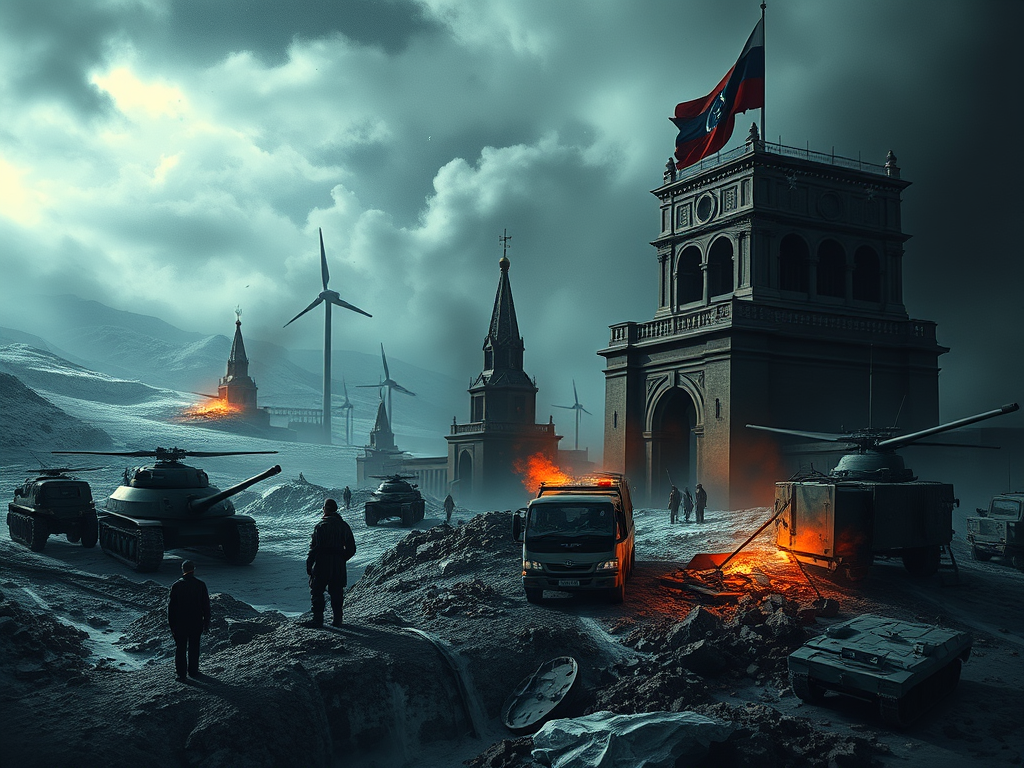
Strategic depth, long war, and “siberianization”
Russia enters this phase of hegemonic transition not as a fully-fledged superpower but as an incomplete great power demanding imperial recognition, while no longer possessing the economic, technological, and demographic base to sustain that status on a stable footing. This is the paradox running through Putin’s entire trajectory: Moscow refuses to accept the outcome of 1991 as settled, yet lacks the means to overturn it “positively,” that is, without turning its external strategy into a permanent strain on the state and society. In this article’s interpretive framework, today’s Russia is a wounded revisionist power: it seeks to reopen the security architecture in the post-Soviet space (particularly in Eastern Europe), but fears sliding into a subordinate fate to the east, as an energy rear area and raw materials warehouse for a China-dominated Asia.
This double bind — pressure from the West and the risk of subordination to the East — explains why the war in Ukraine, conceived as a quick adjustment and a demonstration of control over the “Russian world,” has turned into its opposite: a grinding war of attrition that deepens dependencies, exposes vulnerabilities, forces tragic guns-versus-butter choices, and compels Russia to renegotiate its social contract in real time, without being able to acknowledge the political cost of conversion.
And yet that is precisely the point: for Moscow, war is not an accident of history but a function of geography and memory. In the Russian grammar of power, “peace” does not equate to reconciliation; often the realistic fork in the road is between war and truce, and the plausible outcome is not a return to the cooperative illusion but a new, durable separation between Russia and the West.
1. Geopolitics as a sentence: space, vulnerability, depth
To understand Russia, we must start with what does not change: its structural vulnerability as a land power. The western frontier has historically been the weak point: the great European plain — a corridor for invasions and military penetration — runs “right up against” Russia’s core. For this reason, in Moscow’s logic, security has never been a line but a depth: the goal is to push the front outward, widen the distance between the vital center and the adversary, or build buffer zones when expansion is not possible.
This geographic reality intertwines with human and infrastructural elements. Much of Russian territory lies in harsh latitudinal bands; agriculture and population density concentrate in the southwest and in European Russia; and the decisive centers — government, industry, logistics hubs — remain relatively close to Europe and thus exposed. Russia compensates for internal fragmentation and the difficulty of connections through rail links that become not just infrastructure but an architecture of power: in many respects, Russia is a “rails” power, reinforcing the centrality of its western and southern parts.
From this standpoint, Ukraine is not just any country: it is the hinge of strategic depth to the west. Russia’s national priority is Ukraine’s status as a buffer zone; its minimum objective is military neutrality, because an integrated Ukraine within the Western apparatus compresses Russia’s room for maneuver and brings pressure closer to the core.
This necessity — depth and a protective belt — does not erase other imperatives. Russia also faces an incomplete maritime condition: access to global waters is constrained by choke points and bottlenecks (including the Bosporus in the Black Sea), and the loss or degradation of key ports reduces naval and commercial capacity. This is another reason the Black Sea–Sea of Azov corridor and the theme of “warm-water ports” recur in Moscow’s strategic discourse.
2. From 1991 to today: the empire’s wound and structural distrust
Russian revisionism is not new. It is the product of a trajectory in which the Soviet dissolution is experienced as a loss of status and a geopolitical amputation, while the West is perceived as a power that converted victory into institutional expansion (NATO/EU) up to the thresholds of the “near abroad.” In this reading, the absolute security sought by the West after 1991 produced, in post-imperial Russia, a threat of total insecurity: a “security dilemma” that generates escalation, not stability.
This brings us to a decisive point: Russian distrust is not only political; it is also anthropological. Here, the mental sequence structuring Moscow’s strategic narrative emerges: Munich, February 2007, as a public announcement of the break with Western Europe; Bucharest, April 2008, as the proclamation of the red line (a veto on Ukraine and Georgia in NATO); August 2008, Georgia as the lesson (invasion and a “protectorate” over Abkhazia and South Ossetia); March 2014, Crimea as action (military occupation and annexation). In this framework, the Kremlin treats Crimea’s annexation and the war in Donbas not as whims but as a “necessary recalibration” against alleged Western interference in the post-Soviet space. From that point on, Ukraine ceases to be a regional dossier and becomes an indirect conflict with the West, fueled by a deeper and more toxic trust deficit than that of the Cold War.
The result is that Russia, while unable to afford an all-out war with NATO, convinces itself it must resort to force to avoid losing its entire sphere of influence: better “a piece” than “nothing,” because nothing would mean the definitive encroachment of Western pressure on Russia’s core.
3. The Ukraine objective: not only territory, but architecture
If we take Moscow’s geopolitical grammar seriously, the objective is not limited to a few oblasts or a corridor. The heart of the problem is the claim to reopen Europe’s security architecture and reassert an imperial principle: there are zones in which the sovereignty of neighboring states is conditioned by the security of the adjacent great power. This is not a detail; it is the question: “Who decides the political and military boundaries of the post-Soviet space?”
Russia does not want a direct clash with the US/NATO; it therefore aims for a negotiated outcome (formal or informal) that establishes Ukraine’s status as a buffer. To obtain this result, it employs relatively low-cost tools — limited interventions, covert operations, information war — and seeks to turn external theaters into negotiating leverage.
From this perspective, the 2015 intervention in Syria also becomes legible as more than “just” the Middle East. It served to reshape perceptions of Russian power and improve Moscow’s bargaining position with Washington on the Ukraine dossier; once the “goal” was reached, the Kremlin signaled a reduced commitment and refocused on priorities in Europe.
But 2022 altered the balance between symbol and substance. After years of a “global disruption strategy” (Syria, Venezuela, North Korea as instruments of disruption and exchange), Russia pivoted and invaded Ukraine, a choice that produced the opposite of what was intended, because it revitalized NATO and the transatlantic relationship, intensified Western presence on the eastern flank, and isolated Russia more harshly economically.
Yet precisely because the objective is architectural, “winning” on the battlefield does not automatically solve the problem: Russia can seize territory, but unless it secures Ukraine’s durable neutralization and a redesign or a freeze of the relationship between NATO and the post-Soviet space, its insecurity remains. For this reason, the war tends to become a permanent fixture: no longer an operation to close a dossier, but a means to prevent the dossier from being closed against Moscow.
4. Long war: when external strategy becomes a social contract
War is not only a front line; it is a resource-allocation regime that redraws the social contract. As long as the state can pay wages, pensions, and the military-industrial complex, consensus can remain “passive”; but the longer the war lasts, the more Russia resembles a country forced to choose what to sacrifice, without being able to acknowledge it politically.
The problem is that the war in Ukraine has not been fought exclusively on Ukrainian territory: from the beginning, it has also been an economic war. The conflict deprived Russia of direct oil and gas sales to Europe, its historically large buyer. Moscow initially overestimated Europe’s energy dependence as a lever to split the continent and force it to the table; the Western response — sanctions and energy adaptation — reduced available rents and forced Russia to reconfigure its routes and partners.
Hence, the other transformation: Russia divides the world into “friends” and “unfriendly” states and tries to build an alternative trading system to keep a resource-based economy afloat, with Asia and Africa essential but not sufficient. Meanwhile, fiscal stimulus, parallel imports, and reserve use cushion the impact, and some indicators remain positive. However, in the medium term, the balance may not sustain the costs of welfare, war, and support for firms hit by sanctions at the same time.
This tension points to a crucial issue: the “energy threat” is a fragile tool. Gas, due to infrastructure rigidity, is less suited to prolonged muscular policies; when international stability erodes, consumers (Europe, in particular) seek diversification, while producers cannot sustain prolonged revenue losses without harming themselves. Energy coercion is powerful as a signal but unstable as a structural strategy.
It is within this knot — long war, rent erosion, industrial conversion — that Russia faces the classic dilemma of every revisionist power: to secure external security, it must militarize, but militarization shrinks the space for internal modernization. The more modernization stalls, the more external security depends on force rather than competitiveness.
5. Power as fortress: siloviki, technocrats, oligarchs, and the shadow of succession
Russian domestic politics is not simply “authoritarianism”: it is an architecture of stability built around a personal center and a balance among coercive agencies and economic management. The regime depends on security services, the distribution of incentives to selected elites, and popular acquiescence; as the economy deteriorates, signals of concern about internal stability intensify.
In this sense, the creation of tools such as a National Guard directly accountable to the president can be read as an indicator of control anxiety, not necessarily because the regime is about to fall, but because the leadership fears elite unpredictability and the social costs of a complex economic phase.
Inside the power machine, the “Putin pyramid” is visible: siloviki rooted in the Security Council and coercive apparatuses; technocrats charged with keeping finance and administration afloat; oligarchs oscillating between adaptation and unease; and hybrid figures — such as Kadyrov and Prigozhin (when he was alive) — who turn foreign policy into “war diplomacy” and domestic politics into a theater of competitive loyalty.
But war introduces a rupture: it produces a “war elite,” less globalized and more dependent on the state, and therefore more disciplined; and at the same time it makes the transition more opaque, because personalized power works well for mobilization but poorly for succession. Admitting a strategic mistake would undermine the source of legitimacy and invite removal.
Hence, the symbolic importance of the Wagner coup attempt of June 24, 2023: on that day, Russia ceased to appear as a monolithic bloc and reemerged as a conglomerate of factions, loyalties, and fears, held together by “personalized” stability rather than institutionalized stability. Russia became “unstable stability”: a system able to pass through crises without dissolving, yet unable to transform without shocks.
Since then, the ideological dimension has hardened. Authoritarian tightening and normative production follow as responses to the perception of external attack (regime change as a Western objective), with the 2020 constitutional reform as a key node and the defense of “traditional values” as legitimizing language. In this frame, history is militarized and repurposed as a cohesion tool: memory and security fuse, and the siloviki apparatus enters directly into the management of the national narrative.
6. Rodina, Prostranstvo, Gosudarstvo, Derzhava, Russkiy mir: when geography becomes identity
Russia should not be read as a simple “rational” actor in the Western sense: in Russia, space and identity are inseparable. The terms “Rodina” (homeland), “prostranstvo” (space), and “gosudarstvo” (state) are not abstract; they evoke a lived geography rich in emotional and historical resonance. The vastness of Russian space symbolizes toughness and moral depth; the threat of territorial loss is therefore felt not only strategically but also existentially, fueling narratives of encirclement and cultural siege.
This explains why the obsession with strategic depth is not a technical detail. It is the mental form of a power that has internalized invasions, collapses, and resurgences and has turned “distance” into a political religion: more space equals more time to react, more margin to absorb shock, and greater ability to negotiate from a non-desperate position. At the same time, however, that religion creates a permanent temptation: if security depends on depth, depth tends to become infinite, and defensive logic can mutate into an expansionist appetite, especially when the leadership believes the adversary will never grant “equal” security.
This is where the ideas of derzhava (power) and russkiy mir (Russian world) come into play. The Kremlin seeks to project an international message of Russia’s “uniqueness” in opposition to the West, presenting Russia as the “true and just Europe” and linking the war to a mission to recover lands whose inhabitants “feel spiritually Russian.” The point is not the concept’s historical truth but its political utility: turning a security conflict into a civilizational one, thereby generating greater mobilization and making compromise harder without losing face.
7. Russia–China: asymmetric partnership and “Siberianization”
If pressure from the West pushes Moscow toward militarization, pressure from the East exposes it to a subtler risk: subordination. After the break with the West and the decision to isolate Russia economically, Moscow has had to rely more than before on Beijing as a market and geopolitical partner. However, this dependence has not automatically translated into political dependence, and China does not “command” the timing of war or peace in Ukraine.
Yet the relationship remains asymmetric, and that asymmetry is most visible where Russia is most fragile: investment, technology, and the capacity to hold vast spaces without an adequate demographic base. Chinese economic presence in Siberia and the Arctic has grown partly by filling gaps left by Western companies, but direct investment remains modest, and the physical presence of Chinese citizens is minimal. This does not eliminate risk but shifts it to the long term, raising the question of who will structure development in those regions and through which value chains.
From here emerges the doctrine of “Siberianization”: defensive closure in the west to freeze an acceptable line and a gradual shift eastward toward Siberia, the Pacific, and the Arctic, in an effort to transform Russian geography from a periphery into a bridge. It is a compensatory strategy: if Europe becomes hostile, Russia must survive as a Eurasian power, but to do so, it must avoid becoming a simple province of Asia.
Siberianization also has a cultural and identity dimension. It presents itself as a “new civilizational platform,” rejects failed Western liberalism, embraces a multiethnic Russian spiritual identity, and proposes a Siberian future that revives a service mission that outweighs Western consumerism. Its supporters include think tanks (such as the Izborsky Club), civilizational-state thinkers, Eurasianist elites, and policy intellectuals close to the Kremlin.
The problem is that, precisely in the region where Russia would like to project power — Central Asia — China has advanced further. Beijing has significantly expanded its influence and presence in the region, and Central Asian states pursue a “multi-vector” foreign policy that loosens historical ties with Moscow and attracts investment and attention from many powers (the EU, the US, Turkey, the Gulf, India, Iran, and South Korea). In this context, even the Eurasian Economic Union and the Collective Security Treaty Organization are insufficient to ensure that Central Asia remains within Russia’s sphere of influence today.
This is strategically corrosive: the Russian empire, by tradition, does not live only off territory; it lives off borderlands, the near abroad, buffers, and corridors. If the western buffer ignites and the southern-eastern buffer pluralizes, Russia risks becoming what it fears: a large but “isolated” power, forced to militarize to avoid retreat and to sell resources to finance that militarization.
8. Unstable peripheries: the Caucasus, Central Asia
The war in Ukraine absorbs resources and attention, but it does not erase peripheral vulnerabilities. Regardless of the outcome in Ukraine, Russia will tend to militarize because its insecurity will persist: the growth of NATO’s presence in the Baltic, rising European military spending, uncertainty about a decisive outcome in Ukraine, and, above all, vulnerability along the belt regions, from the Caucasus to the Black Sea.
The same logic appears in regional analyses: Central Asia is a crossroads region where external developments (China, as well as Afghanistan, Tajikistan, Kazakhstan, Kyrgyzstan, Turkmenistan, Uzbekistan) weigh more than internal strategies; borders drawn by the USSR, state fragilities, ethnic tensions, and competition over resources — from water to energy — create an environment that can produce spillover into Russia and its routes.
In other words, Russia is condemned to manage multiple theaters simultaneously, but today it lacks the economic and demographic margin to do so with the same imperial elasticity as in the past. For this reason, Moscow often seeks “minimum stabilization” solutions: freezing conflicts, maintaining levers, and preventing others from filling the void. It is a defensive-aggressive strategy typical of powers in relative decline that refuse to accept their decline.
9. Dirty peace: the most likely outcome is an armed freeze
If war has become a regime, the question is not “when does it end,” but “how does it stabilize?” Here, the diagnosis returns: the realistic fork is often between war and truce, and the plausible outcome is a durable separation between Russia and the West, or, more likely, between Russia and Europe.
The depth of distrust and the transformation of the conflict constitute a systemic test: not only a territorial contest but also a test of the governability of disorder, that is, the ability of powers and alliances to contain extremisms, industrial automatisms, commercial hypocrisies, and fear of the abyss. Genuine détente is difficult because the trust deficit is structural and because Moscow interprets Western interference in the post-Soviet space as permanent.
That is why, even if a ceasefire is reached, Russia is unlikely to truly demilitarize: militarization is more likely regardless of the outcome, because the Kremlin would interpret any slowdown as a strategic error amid NATO pressure and peripheral instability.
In this frame, “peace” does not mean normalization. It means an armed freeze, temporary redrawings of lines, economic reorganization in a selectively autarkic direction, and, above all, narrative repositioning: Russia must present the truce as a defensive victory, not a limit, and must do so to keep the internal fortress cohesive.
Conclusion: Russia as a negative pivot of stability
“Russia or not Russia” is not only an identity question; it is a systemic one. Russia remains a negative pivot for global stability because it represents the extreme limit. If it collapses, a space is not “freed”; a nuclear and imperial problem opens. If it holds, it continues to generate friction and revisionism. If it transforms, it will do so according to its historical law of unstable stability: torsion more than linear reform, crisis as an adaptation method, and centralization as a defensive reflex.
Within hegemonic transition and global disorder, this Russia cannot be reduced to a caricature: it is not omnipotent, but neither is it irrelevant; it is not an economic superpower, yet it remains a nuclear power capable of setting the agenda; it cannot impose order, but it can sabotage it; and above all, it cannot afford to lose strategic depth without losing itself.
The geopolitical point, then, is stark: the war in Ukraine is not only a regional tragedy; it is a mechanism that redraws Eurasia’s structure, forces Europe and the United States to redefine deterrence and industry, pushes Russia to reinvent its economic model, and hands China a long-term advantage, as each year of Russian attrition deepens partnership asymmetry and makes it harder for Moscow to avoid the fate it fears: leaving Europe only to become a mere province of Asia.



Leave a Reply