

'/%3E%3Cpath%20fill='%23b2b2b2'%20d='M241%20382q0%2016%2017%2026%2017%2011%2042%2011t42-11q16-11%2017-26V269H241'/%3E%3Cpath%20fill='%239f7e00'%20d='M241%20379q0%2014%208%2023%209%209%2021%209%2014%200%2021-9%209-9%209-23V269h-59'/%3E%3Cpath%20d='M241%20339v-70h59v110q0%2014-9%2023l-6%205v-68h-15v72q-8%200-14-4v-68zm59%2040c0%2022%2015%2032%2029%2032%2021%200%2030-18%2030-32v-40h-59'/%3E%3Cpath%20fill='%239f7e00'%20d='M266%20277v5h2v12h-3v-5h2v-5h-9v5h2v5h-4v9h3v18h-5v10h34v-10h-5v-18h3v-9h-4v-5h2v-5h-9v5h2v5h-3v-12h2v-5zm42%20101q0%2010%206%2017%206%206%2015%207%2010-1%2016-7%206-7%206-17v-29h-43'/%3E%3Ccircle%20fill='%230044ad'%20cx='329.5'%20cy='372'%20r='6'/%3E%3Cellipse%20fill='%230044ad'%20cx='300'%20cy='340'%20rx='16'%20ry='21'/%3E%3C/svg%3E)
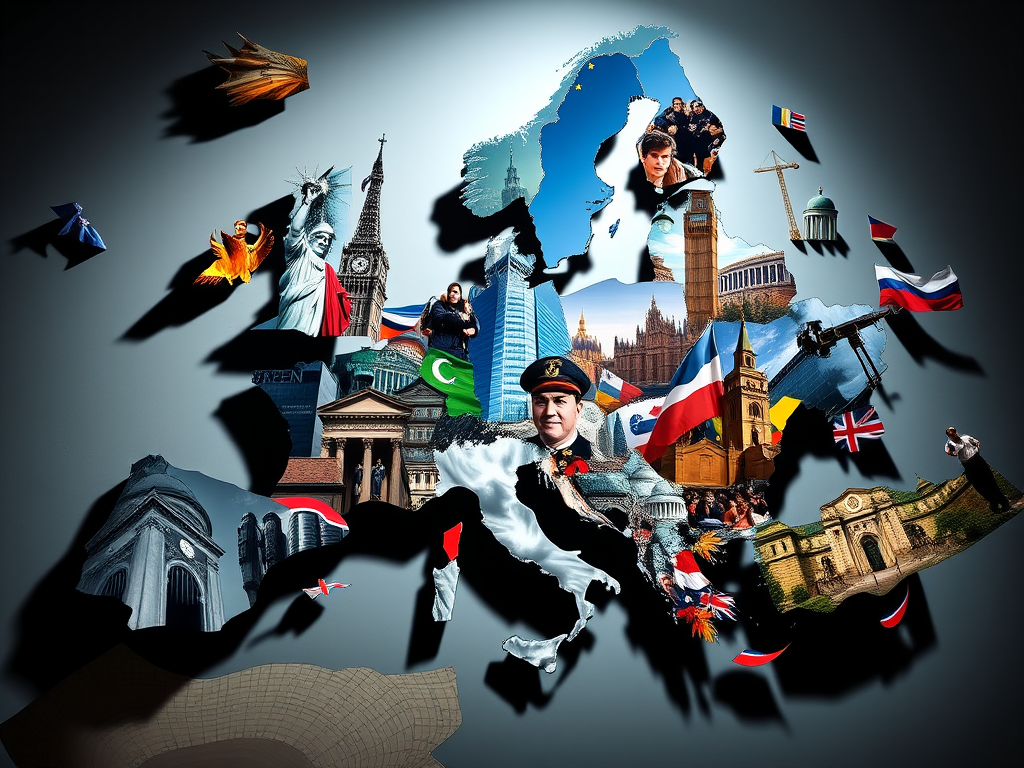
Europe in the Interregnum: The United Kingdom and Continental Powers Between the Return of Geography, a Long War, and a Crisis of Cohesion
The phase we are living through no longer resembles the post–Cold War era, and it is not even a simple “return” to the Cold War. It is a hegemonic transition that, rather than quickly producing a new order, generates a denser disorder: more tables, more dossiers, more variable combinations, more transactional exchanges, more informal conflicts, and, above all, a growing weight of information as a domain of power. The ability to represent war, the enemy, and domestic reality becomes a strategic factor, on par with munitions and finance.
In this world, Europe is where the interregnum is most visible, because here the “normative” and “post-historical” architecture built after 1989 collides with a context that has once again become tragic: deterrence, rearmament, borders, logistics, the vulnerability of dual-use infrastructure, competition over sea routes, and chokepoints. Even the old distinction between domestic and foreign policy weakens: the outside comes home in the form of energy, migration, value chains, sabotage, disinformation, and polarization.
For Europe, the point is not merely “spending more” or “making more Europe.” The reality is harsher: an effective foreign policy requires internal cohesion, and today cohesion is the most contested resource on a continent marked by inflation, implicit or explicit austerity, identity fractures, institutional distrust, and a permanent political conflict over Ukraine, Gaza, and the relationship with the United States. In several countries, populist movements thrive in this polarized climate and, at times, adopt conciliatory postures toward Moscow that erode European unity.
The European Peninsula: Fragmented Wealth and Structural Vulnerability
To understand Europe’s powers, you must start from the ground: Europe is a great peninsula of Eurasia, stretched between the Atlantic and the Mediterranean, connected by rivers, seas, and trade corridors that have made it one of the wealthiest regions on the planet. But that wealth stems from a geography that favors plurality and fragmentation: many centers, capitals, histories, and fault lines. “Integration” long masked the underlying reality: nations with diverging interests, different economic and political constraints, and geopolitical priorities that do not always overlap.
Within this peninsula, at least two structural tensions are returning to the forefront. The first is the friction between the peninsula and the Eurasian “mainland” dominated by Russia: a long-duration conflict that revolves around buffer zones, the “borderlands” from the Baltic to the Black Sea, and Europe’s attempt to extend influence and institutions eastward into a space Moscow perceives as its strategic rear area.
The second is the internal friction among European regions living in different geopolitical environments. The continental North and the North European Plain favor trade and manufacturing but expose the region to invasion and pressure; the Mediterranean South is more mountainous and fragmented, harder to integrate, and more sensitive to destabilization from the southern neighborhood; the East is frontier and vanguard, more inclined to think in terms of the Russian threat and deterrence; the West is often a rear area, more inclined to think in terms of economic equilibrium and the management of consent.
These different environments produce distinct strategic psychologies. This is where Europe, by nature, is a continent that is hard to govern “with a single voice”: in reality, it is living through multiple wars and fears at the same time. The East fears Russia; the South fears Mediterranean destabilization and migratory pressure; industry fears trade war and decoupling; societies fear the loss of economic and identity security.
The EU and NATO: Potential Power, Dispersed Sovereignty, Outsourced Deterrence
In its original design, the European Union was a machine for prosperity and for preventing intra-European conflict. Geopolitically, for decades, it functioned as a device of “shock absorption”: it neutralized historical rivalries, integrated economies, and made war among the major European states less likely. But its contradiction is now evident: the EU is big enough to be a target of others’ power politics and rich enough to be contested, yet often too disunited to act as a full power. For this reason, it tends to be more “space” than “actor”: a market, standards, and sanctions; but also slow decision-making, permanent compromise, and difficulty turning urgency into command.
At the same time, NATO has returned as the cornerstone of European security, but in a more problematic form: the American umbrella remains decisive, while the perception grows that Washington increasingly selects its priorities and reduces its willingness to shoulder regional crises directly. The idea emerges of an America that maintains global primacy while doing so “at the lowest possible cost,” supporting allies with equipment and training rather than massive interventions. This pushes Europe to talk about greater self-sufficiency, but often only on the condition of American endorsement.
The knot, therefore, is not whether Europe can “detach” from the United States. It is whether Europe can stop treating deterrence as an external service and turn it into an internal social and industrial capability. Rearmament is not a budget line: it is culture, recruitment, munitions, interoperability, industrial supply chains, and the resilience of critical infrastructure. And before all that, it is legitimation: the ability to explain to tired societies why costs, sacrifices, and discipline are needed in a time that offers no certainty.
United Kingdom: Autonomy Does Not Cancel Geography
The United Kingdom chose the sharpest break with the continent: leaving the Union to regain room to maneuver. But maneuver, when you live on an island in front of the European peninsula, does not erase geography: it rereads it. London remains a maritime and intelligence power; it retains a more “global” strategic culture than many continental partners; and it tends to maximize influence by presenting itself as the most reliable European partner of the United States, precisely because the transatlantic relationship is the security structure that enables it to project.
The British Strategic Defence Review codifies a trajectory of rearmament and NATO leadership, with spending targets (2.5% by 2027 and the ambition of 3% in the following legislature) and the idea of making defense a “growth engine” as well. This is a key point: London tries to convert geopolitical necessity into industrial policy and into an economic narrative.
British grand strategy today is a triangulation. One side is hard Atlantism: intelligence, deterrence, interoperability, naval posture. A second side is extra-European projection, especially in the Indo-Pacific, to demonstrate that the United Kingdom remains a global node rather than a mere regional power. The third side is the management of the continent: cooperating selectively with the EU without rejoining it, because the continent remains a market, a rear area, and a structural problem. The United Kingdom needs political distance to build a symbolic autonomy, but it cannot afford permanent hostility toward Europe without paying an economic and logistical price.
The fragility here is internal. A country that wants to play the role of a power must first be “a country,” and British unity is less self-evident than it looks on the map. Territorial tensions, fractures between London, a world-city, and the peripheries, the politicization of immigration, and the post-Brexit cycle of political instability make it harder to turn external posture into a coherent strategy. In the interregnum, foreign policy cannot be a performance: it must be an architecture sustained by consent.
Germany: Zeitenwende as Cultural Trauma
Germany is the center of gravity of continental Europe and, at the same time, its most sensitive point. Its position on the North European Plain, without decisive natural barriers, has historically made it vulnerable to pressures from the east and the west. For this reason, in the “classic” reading, German grand strategy revolves around four objectives: unity and sovereignty; dominance or control of the plain and the buffer zones; internal stability; and limiting the influence of external powers over the plain itself. Postwar Germany pursued these objectives mainly through non-military means, economically and politically integrating rivals through the EU and NATO, reducing the French threat, and pushing eastward into buffer zones through the enlargement of European institutions.
But this strategy works only if the EU remains cohesive and the external environment is relatively stable. When the EU fragments and war returns to Europe, Germany finds that geoeconomic power alone is insufficient to guarantee its security. This is where Zeitenwende becomes, more than a military turn, a cultural trauma: the return of war as a concrete possibility, the end of peace as a “fact of nature,” and the need to “shake the population” with a language that had been repressed until then.
Germany is a work in progress — an unstable form, a historically uneasy identity — favored by the absence of natural borders and by a history that makes it difficult to “geometrize” the nation as France or Italy can.
Zeitenwende, however, is a work in progress “in slow motion”: investments, special funds, promises to bring debt over 2% of GDP, purchases of F-35s to strengthen nuclear sharing and interoperability, but also difficulty spending quickly, bureaucratic slowness, and domestic resistance. In the meantime, the turn has materialized first on the geoeconomic level rather than the military one: cutting energy dependence on Russia and reducing vulnerability to coercion. In contrast, the complete rebuilding of military capabilities is proceeding slowly.
Here, the German contradiction is twofold. On the one hand, the German economy is structurally export-led: its internal stability depends on access to external markets and on the resilience of a Europe that cannot depreciate and remains a large market for German industry. In the strategic reading, the EU and the eurozone are not only ideals to share: they are devices for internal social stability, because full employment and consent flow from the capacity to export.
On the other hand, German society is marked by identity and generational fractures that directly shape strategic posture. The rise of the AfD in the East and its ability to attract even young people who demand “history” and identity; the competition between Westbindung and the temptation of Mittellage; and the idea of balancing East and West against Rhineland political culture: all of this is not only domestic politics but also a debate about Germany’s international positioning.
Added to this is a theme often underestimated: the capacity for recruitment and society’s willingness to use force. There are German difficulties in making the Bundeswehr “kriegstüchtig,” the need for accounting maneuvers to meet spending targets, and, above all, a recruitment crisis: young people do not want the uniform, and the debate returns to compulsory service and even “Scandinavian” models.
Germany, in other words, is strong yet exposed. In the interregnum, exposure becomes a strategic vulnerability, forcing choices amid reduced internal cohesion.
France: Full Sovereignty and Social Fracture as a Strategic Constraint
France is the European exception closest to the classic strategist state: presidentialism, a power culture, nuclear deterrence, a habit of projecting power in the Mediterranean and Africa, and a tradition of autonomy even while integrated into the West. In a Europe that is often rule-bound, Paris more readily thinks in terms of full sovereignty and, consequently, of architectures: command, deterrence, projection, and industry.
The problem is that sovereignty, to be credible, must rest on governable societies. Contemporary France lives in a permanent tension between the state’s verticality and the horizontality of a fractured society: identity conflicts, cycles of protest, electoral polarization, and center–periphery conflict. In the interregnum, this internal fracture compromises strategic continuity: France can think big, but it must also devote energy to managing its domestic “cold civil war.”
Moreover, the erosion of French influence in some African theaters and growing competition from external actors make projection a more costly and contested enterprise, especially at the narrative level. Today, in a world where alliances and legitimacy are modular and transactional, France must translate its power tradition into a new language of partnership without relying on either colonial rents or automatic prestige.
Italy: Maritime Power as an Imperative, the Internal Constraint as an Existential Risk
Italy is the European power that most clearly embodies the contradiction between geography and structure. Geography assigns it a Mediterranean vocation: routes, ports, energy, cables, and neighborhood stabilization. Yet the internal structure — debt, weak growth, political instability, institutional fragmentation — makes it challenging to translate this vocation into a coherent strategy.
Ports and maritime infrastructure are no longer merely economic assets; they represent power because almost all infrastructure is dual-use. Devolving authority over strategic infrastructure for domestic political calculations is, in practice, strategic recklessness: in an era of the state’s return and competition over routes, the state must retain direct control over maritime and port infrastructure, as it is an existential geopolitical matter.
This is the core of a possible Italian grand strategy: maritime power as a condition of existence, not an ornament. The war in Ukraine is not only a war “in the East”: it widens the fracture between the anti-Russian vanguard and the Western pivots, risks pulling the Mediterranean into the vortex, and turns the Adriatic into a strategic fault line, exposed to sabotage of gas pipelines and undersea cables and to threats to chokepoints such as the Strait of Otranto.
From this follows another implication: Italy cannot afford to think of its security only in terrestrial or “European” terms. Its foreign policy is inevitably a maritime policy: keeping routes open, protecting infrastructure, and — so far as possible — preventing the East–West fault line from becoming an internal rupture within the Euro-Atlantic system, one that would ultimately affect the Mediterranean.
In this framework, the Adriatic dimension becomes a laboratory: the Baltic–Adriatic corridor, Trieste as an asset, the idea of linking the Trimarium, and the building of integrated Adriatic systems with ports and hinterland ports, culminating in imagining co-management of the Adriatic–Balkan space. This is not only logistics: it is stabilization. And it is also a way to stitch Italy’s North–South fracture through a strategy of connection rather than sterile redistribution.
But the internal constraint remains decisive. Institutional reforms, if conceived as a tactical response to domestic political conflict rather than as an architecture of power, can become a multiplier of fragility. Uncontrolled devolution risks undermining not only national unity but also Italy’s capacity for strategic survival by weakening state control over dual-use nodes and cyber resilience.
Italy, then, is a country that can be more central than it appears—but only if it turns geography into a project and domestic politics into cohesion. In the interregnum, those who do not govern themselves are governed by others.
Spain: An Amphibious Gate Between the Atlantic and the Mediterranean, with a Problem of Internal Form
Spain is often treated as a “secondary” power. Yet, its position makes it a hinge: access between the Atlantic and the Mediterranean, proximity to North Africa, a role in energy routes and migratory flows, and a historical-cultural relationship with Latin America that can serve as a political and economic channel. Its implicit grand strategy is amphibious: Atlantism as a security anchor and Mediterranean-ness as the operating environment.
The primary constraint is internal: the territorial structure and center–periphery tensions make strategic continuity harder to sustain. In an environment where Europe risks a new migration crisis and must manage instability in the Balkans and its eastern and southern neighborhoods, internal political cohesion becomes a geopolitical asset. Forecasts indicate that the threat of a new migration crisis could be a catalyst for further divisions within Europe, complicating the collective response.
Poland: The Frontier Seeking to Become a Keystone, Between Intermarium and “Super-NATO”
Poland is the European actor that most openly lives geopolitics as destiny. It sits on the contact line between Germany and Russia and, historically, has built its strategic imagination around emancipation from the Russo-German vise. This trajectory is a return of the Jagiellonian idea and the Intermarium: a Polish-led confederation with Baltic appendages and a buffer space, now Americanized through the Three Seas Initiative, which treats infrastructure, energy, and technology as instruments of power.
The interesting point here is not only Polish rearmament or the ambition to become one of Europe’s leading military powers. It is the implicit critique of “Old Europe” and the Franco-German axis, accused of being refractory to war and therefore unreliable as a deterrent pillar. Intermarium, within a NATO that risks hollowing out, is a way to create a European super-alliance capable of carrying more weight, equipped with a military apparatus and the will to use force.
This approach has direct consequences for Europe. First, it shifts the center of gravity toward the Northeast, which deepens the fracture between the anti-Russian vanguard and the Western pivots, a structural risk for the Euro-Atlantic system. Second, it makes the German question even more central: without Germany, there is no European industrial cohesion; with a hesitant Germany, the temptation toward parallel architectures grows. Third, it introduces Turkey as a variable, presenting the Intermarium as a response to Turkey’s growing influence in the Balkans, proof that Europe is not only “Russia yes/no,” but also a system of intersecting competitions.
The Turkish Knot: The Eastern Mediterranean and the Balkans as a Theater of Intra-Western Friction
If Europe wants to think of itself as a strategic subject, it must accept that its Southeast is not a periphery but a frontier. Turkey appears to be a power destined to fill the power vacuums created by the fragmentation of the Middle East and by Europe’s weakness or distraction. Its potential radius includes the Eastern Mediterranean, the Black Sea, the Caucasus, and parts of the Balkans: precisely the areas where European interests (France, Italy, Greece, Spain) and those of the eastern vanguard (Trimarium, security of the Eastern flank) intersect.
For Italy, moreover, Turkey is not only a competitor: it is also a port chain and infrastructure built through acquisitions and concessions that connect Scandinavia, Italy, and North Africa. This is a revealing detail: in the twenty-first century, geopolitics runs through logistics, ports, corridors, and networks, and therefore through choices that appear economic but are, in fact, strategic.
Energy, Industry, Demography: Three Constraints That Compress European Grand Strategy
The war in Ukraine and the energy crisis have shown that sovereignty is not an abstract concept. When Germany relied heavily on Russian gas, its vulnerability was geopolitical rather than economic. When Russo-German energy cooperation becomes unsustainable, civil and industrial energy security becomes a strategic priority, with direct effects on growth and consent.
This intertwines with the industrial question. Part of Europe — Germany above all — is built to export: it produces far more than it consumes and therefore needs open markets, stable routes, and a predictable order. But hegemonic transition realigns power around physical and immaterial nodes — maritime straits, undersea cables, semiconductors, technological standards, and financial platforms — and turns interdependence into a weaponizable asset. In such a world, Europe finds that being hyper-integrated without full sovereignty leaves it exposed.
Finally, there is demography, the great silent variable. Without getting into numbers, the geopolitical point is simple: aging, exhausted societies are less willing to bear costs, more susceptible to propaganda, more polarizable, and therefore less suited to strategic mobilization. Cohesion is the premise of foreign policy: it is the condition that makes deterrence, industrial policy, and even diplomatic continuity sustainable.
Information, Perception, Legitimacy: Cognitive Warfare as a European Field
Europe, more than other regions, is vulnerable to information warfare because it is pluralist and fragmented. Plurality is a strength, but in an age of disinformation, it is also an entry point. If foreign policy becomes a sequence of transactional exchanges across intersecting dossiers, the battle to define “what is happening” becomes an integral part of strategy. The capacity to represent the enemy and domestic social reality is an essential component of power, especially in Europe, where the legitimacy of elites and institutions is often fragile and contested.
The result is that European foreign policy is no longer negotiated solely among states: it is also a struggle for domestic consent. Ukraine, Gaza, the relationship with Washington, and migration: each of these issues divides societies and, consequently, limits governments’ freedom of action. Internal instability must be reconciled with external obligations; otherwise Europe becomes unpredictable and ineffective precisely when it needs continuity.
Three Possible Trajectories: Europe-as-Actor, Europe-as-Space, Europe-as-Mosaic
If we take the framework of a long transition with modular alliances, in which interdependence is a weapon, Europe can take three trajectories.
The first is Europe-as-actor: a Union that, at least partially, transforms the idea of strategic autonomy into capability — building a credible industrial and military pillar — without breaking the Atlantic alliance while reducing asymmetric dependence. It is the most ambitious trajectory and also the most difficult, because it requires centralization and consent, two resources that are missing when domestic politics are polarized and national interests diverge.
The second is Europe-as-space: a rich but fragmented continent that remains a theater of competition among the United States, Russia, China, and regional powers, managing crises reactively without building strategic depth. In this trajectory, deterrence remains outsourced and industrial policy remains partial, risking the loss of productive capacity and technological autonomy. It is no accident that some geopolitical forecasts to 2040 hypothesize an EU that collapses or shrinks into a commercial zone, and a Germany that drops in rank while Poland rises as a regional power. It is an extreme reading, but it signals the structural vulnerability of a system too dependent on exports and external stability.
The third is Europe-as-mosaic: a continent that does not become “one” but organizes itself into functional sub-architectures. A northeastern pillar of deterrence and rearmament; a Mediterranean pillar of stabilization and route control; a Franco-German axis that remains the economic-institutional engine, though with contested legitimacy; a United Kingdom that cooperates selectively as a military multiplier; an Italy that seeks to become a maritime and logistics hub; and a Spain that guards the western threshold and manages migratory pressure. It is a less elegant trajectory, but perhaps more compatible with European reality: not an empire, but a variable geometry.
Closing: European Power as a Problem of Form
In the end, the European question is not whether the continent has resources. The resources exist: technology, industry, human capital, and markets. The question is whether Europe has form, that is, the capacity to manage those resources. And form depends on something geopolitics cannot ignore: internal cohesion.
In the interregnum, cohesion is not a moral virtue; it is a strategic resource. Without cohesion, rearmament remains an accounting exercise; without cohesion, industrial policy remains fragmented; without cohesion, deterrence remains outsourced; without cohesion, Europe remains a space. With at least sufficient cohesion — not unanimity, but minimal consent on dangers and ends — Europe can become, if not an empire, at least an actor capable of choosing. And today, choosing is already a form of power.


Leave a Reply