

'/%3E%3Cpath%20fill='%23b2b2b2'%20d='M241%20382q0%2016%2017%2026%2017%2011%2042%2011t42-11q16-11%2017-26V269H241'/%3E%3Cpath%20fill='%239f7e00'%20d='M241%20379q0%2014%208%2023%209%209%2021%209%2014%200%2021-9%209-9%209-23V269h-59'/%3E%3Cpath%20d='M241%20339v-70h59v110q0%2014-9%2023l-6%205v-68h-15v72q-8%200-14-4v-68zm59%2040c0%2022%2015%2032%2029%2032%2021%200%2030-18%2030-32v-40h-59'/%3E%3Cpath%20fill='%239f7e00'%20d='M266%20277v5h2v12h-3v-5h2v-5h-9v5h2v5h-4v9h3v18h-5v10h34v-10h-5v-18h3v-9h-4v-5h2v-5h-9v5h2v5h-3v-12h2v-5zm42%20101q0%2010%206%2017%206%206%2015%207%2010-1%2016-7%206-7%206-17v-29h-43'/%3E%3Ccircle%20fill='%230044ad'%20cx='329.5'%20cy='372'%20r='6'/%3E%3Cellipse%20fill='%230044ad'%20cx='300'%20cy='340'%20rx='16'%20ry='21'/%3E%3C/svg%3E)
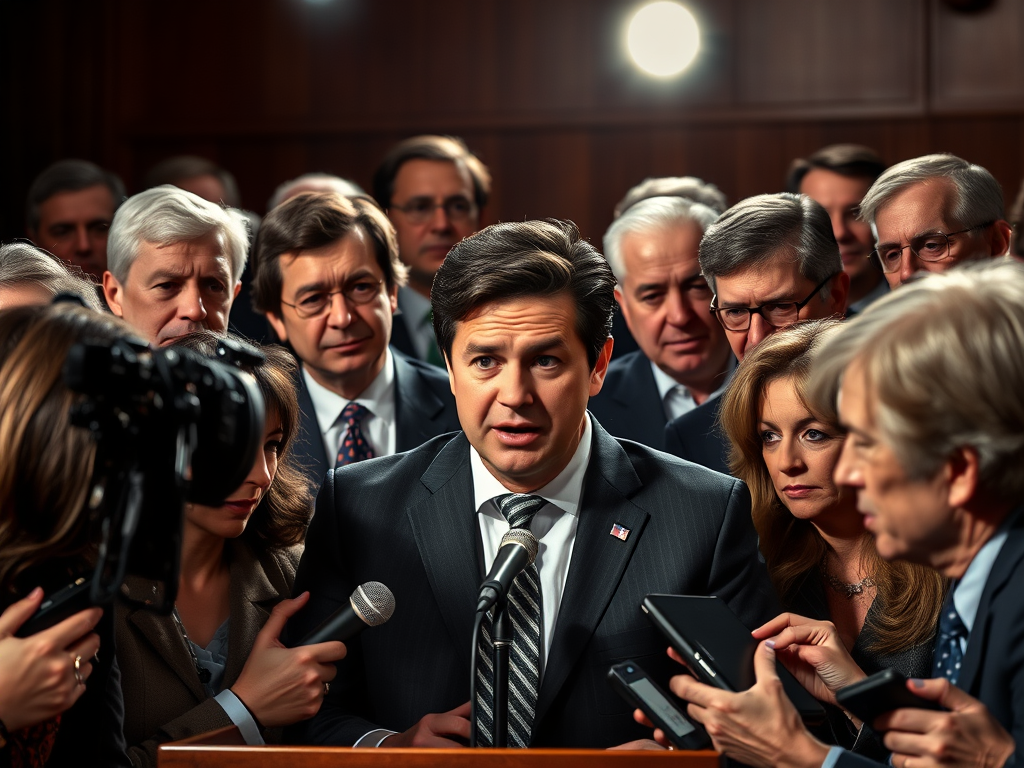
When Tucker Carlson decided to interview Nick Fuentes last October, the initial story seemed straightforward: a prominent broadcaster gives airtime to an extremist; the conservative establishment reacts; the internet ignites the controversy. However, the political significance runs deeper. It was a test — deliberate and opportunistic — to see whether the “new right” could accept a figure long seen as radioactive, and whether the institutions that still support the conservative brand (think tanks, donor networks, elected officials, pro-Israel groups, and legacy media) still have the power to exclude.
The shock spread throughout the entire conservative movement because the American right is no longer a “party” in the traditional sense; instead, it is a complex ecosystem of media outlets, campaign committees, think tanks, donors, influencers, churches, and online communities that debate (and compete over) what conservatism means and who has the right to represent it. In this system, legitimacy is not just about elections; it also depends on reputation and media influence. Within the conservative landscape, Fuentes and the Groyper orbit have acted as a pressure group, turning media attention into internal leverage.
The Groypers are the far-right network linked to Fuentes’ “America First” streaming brand, often associated with antisemitic themes and white-nationalist ideas.
The structural backdrop: a coalition under stress
To understand why the “Fuentes question” repeatedly triggers internal “civil wars,” we need to broaden our view to America’s crisis of cohesion: declining trust, affective polarization, and the collapse of a shared civic space. These forces transform party conflicts into moral-identity battles: strategy becomes a matter of survival, and compromise is viewed as betrayal. In this environment, micro-factions expand, offering certainty, a sense of belonging, and an enemy map.
The broad New Right galaxy is especially vulnerable as it navigates three simultaneous shifts: from Reagan-era conservatism to Trump-era populism; from traditional broadcast media to influencer-driven media; and from a generally pro-institutional stance to one viewing institutions as illegitimate or hostile. This last shift is crucial: when you delegitimize the “referees,” you also delegitimize the mechanisms that once kept marginal actors out of the system.
Nick Fuentes’s role is best understood through concepts from political science, such as “movement entrepreneurship” and “boundary work.” Fuentes has repeatedly sought to turn notoriety into influence by pursuing opportunities where mainstream goals align with the fringe’s desire to gain a voice. The “groyper” approach has historically combined ambush tactics — particularly in Q&A settings like with Eric Trump — online swarming, and narrative warfare.
This matters because the disagreement within conservatism isn’t just moral (antisemitism), but also practical: What are the reputational risks? Which coalitions break apart if the boundary shifts? Which donors withdraw? Which voters drift away? These are questions of real power within a movement that aims to govern.
The pre-Carlson conflict: backlash cycles and containment
Opposition to Fuentes within the broader right has existed for years before Carlson’s interview. It grows stronger whenever Fuentes appears to gain legitimacy, mainly through access to major media outlets and appearances on large platforms or at events featuring established Republican figures. A significant increase occurred after the 2022 Mar-a-Lago dinner with Trump, an event that drew widespread condemnation and caused the respectable right to distance themselves further from Fuentes.
However, containment efforts have never fully resolved the “Groyper issue” for two reasons. First, the conservative media landscape is divided: if one outlet shuts down, others provide access. Second, online political incentives encourage provocation. Extremism becomes a content strategy, and outrage boosts distribution.
In 2024, Fuentes’s orbit launched what even neutral observers called a coordinated digital pressure crusade — known as the “Groyper War” — aimed at influencing the coalition by targeting campaign messaging and intra-right rivalries. Several hostile factions regarded it as an effort to gain concessions (or at least visibility and a voice) through coordinated online tactics.
It was an internal conflict, not just against Democrats or “the left.” Fuentes targeted other right-wing groups — “tech right” currents linked to funding from figures like Peter Thiel or associated with names such as JD Vance and Curtis Yarvin — highlighting a key point: today’s New Right is not a single unified populist movement but a collection of factions working to shape the post-liberal future.
Carlson’s interview: when a platform grants power
Carlson’s interview — and the fire that followed — raised the conflict from “containing the fringe” to shaping the “movement’s identity.” That’s because Carlson is more than a media figure; he’s a symbolic hub for a major part of the post-Trump right. Giving Fuentes that platform legitimizes the Groypers and challenges the new conservative mainstream’s ability to normalize a figure seen as fringe, or even beyond acceptable limits.
The reaction was quick and multifaceted. Heritage Foundation president Kevin Roberts emerged as a key figure after defending Carlson’s decision, sparking an organizational crisis that reveals how institutional conservatives still seek to uphold discipline when their reputations are on the line. Internal pressures, resignations or departures, and the formation of an anti-Semitism task force clearly show that boundaries are being reinforced within the conservative political and cultural system.
Simultaneously, elected Republicans and movement allies face a coordination challenge: condemning Fuentes too lightly risks seeming complicit; condemning him too harshly risks alienating populist voters who view gatekeeping as betrayal and demand unconditional free speech. The extent of the division — including tensions between congressional leaders and Carlson’s America First circle — is significant.
To understand the conflict, it’s helpful to view the new American right as a hegemonic project in which different factions compete for three key assets: narrative authority (who defines conservatism’s moral core); institutional power (who controls think tanks, the policy pipeline, and staffing); mobilization strength (who leads audiences and activists).
Many groups coexist today: establishment conservatives, MAGA populists, national conservatives, libertarians, the religious right, the tech right, and various intellectual or online subcultures — such as the Groypers — that overlap but do not share the same leadership. In this landscape, Fuentes acts as a wedge because antisemitism is a breaking point for at least three central pillars of American conservatism: pro-Israel conservatives (including evangelical segments and donor networks), the Republican establishment (which fears electoral backlash), and policy institutions like Heritage (which need legitimacy to operate in Washington and with allied civil society).
The Groyper strategy, in contrast, often seeks to discredit these pillars as gatekeepers who are compromised by failed conservatism, turning moral stigma into proof of authenticity: “they hate us because we tell the truth.”
Florida as an amplifier
Florida matters not because the Groypers are “typically” Floridian, but because Florida has become a strategic and symbolic hub for Trumpist conservatism: Mar-a-Lago functions as a political command center, a gathering place for donors, and a focal point for media outlets. It’s where populist rebellion and elite coordination meet; it is a complex landscape of alliances and conflicts. Florida also plays a role in the post-Carlson era through political reactions: figures such as Florida state lawmaker Randy Fine, who criticized Carlson’s decision, demonstrate how the debate over moral boundaries directly influences the electoral and reputational calculations of “red” power centers.
The Groyper subculture: ideals and aesthetics
One reason the Groypers “haunt” conservative politics is that they are not just carriers of “ideas.” They embody a youth subculture with its own hierarchies, rituals, and aesthetics (e.g., the looksmaxxers). They aim to appear both serious and subversive: young men in suits, hotel ballroom settings, and a disciplined aesthetic that signals this is not merely trolling but an emerging alternative elite. There is also a religious-cultural shift — specifically the appeal of traditionalist Catholic identity in much of this milieu — and hostility toward Christian Zionism, which explains why they often oppose Israel or even use antisemitic rhetoric, making it a recurring fault line in conservative coalitions.
The Groyper movement is highly influenced by digital communication: it develops through group chats, streaming routines, and the intimacy of parasocial relationships with leadership. The “leader” is always online or on their phone; politics becomes a way of fostering belonging. That’s why figures like Carlson are so significant to Groypers: they act as links between online subcultures and broader audiences.
Then there is the internal psychology. This youthful attitude often appears as countercultural, cynical toward institutions, and craving hierarchy. It seeks meaning in “order”: sometimes through religion, sometimes through nationalism, and sometimes in a stylized masculinity that views liberal modernity as decadence. Analytically, it is the psychopolitics of anxiety: a society filled with distrust transforming politics into identity therapy, with the most radical factions offering the most substantial emotional relief.
Antisemitism as a power struggle
The debate over antisemitism within American conservatism isn’t just about issues like taxes or the cost of living; it’s about identity. What’s really at stake is who gets to define the movement’s moral boundaries.
For institutional conservatives, the line is clear: Fuentes is politically toxic and morally disqualifying. For parts of the media-populist sphere, the line becomes conditional: the real enemy is the establishment, and accusations of antisemitism can be dismissed as weaponized stigma. For the Groypers’ ultra-right, by contrast, the antisemitic frame is “pure” and the ultimate theory — an ideological shortcut to undermining the elite in power, that is, the presumed gatekeepers — which remains emotionally “sticky” even when it becomes strategically costly.
The reconstruction of internal dynamics — such as group chats, language, and normalization — uncovers a key fact: younger conservative subcultures aren’t just consuming ideas; they’re negotiating permission and access, testing the limits of what can be said, who can say it, and what the consequences might be. This negotiation is the real battleground of hegemony.
Consequences and scenarios
The consequences are fourfold. First, coordination costs increase: you can win an election with a loose coalition, but governing requires discipline. Every public rupture over Fuentes forces institutions and candidates to spend political capital on damage control. Second, it accelerates the development of parallel institutions: if mainstream venues reject the Groypers, they double down on alternative platforms, conferences, and intellectual ecosystems, which reduces any central authority’s ability to enforce moderation. Third, it raises the security dilemma in American politics: when polarization becomes emotional, and the opponent is seen as a traitor, the fringes find it easier to engage in intimidation and episodic violence, even if most participants never actually do so. Fourth, it diminishes America’s strategic “bandwidth”: internal consensus is crucial; internal “civil wars” — within and between parties — undermine the ability to sustain a consistent foreign policy.
From there, four scenarios unfold. The first is boundary restoration: institutions like Heritage, prominent elected officials, and pro-Israel networks reaffirm red lines, treating Fuentes as a permanent pariah and punishing those who normalize him. Backlash, task forces, and resignations indicate this trend. The second is selective normalization: not full acceptance, but a pattern where major media and political figures continue to engage with the fringe to win votes or capture audience attention, thereby making boundaries more porous and causing recurring crises rather than resolving them. The third is schism driven by foreign policy and religion: a more apparent divide between pro-Israel coalitions (often evangelical) and a younger post-liberal right (usually Christian) that combines nationalism, traditionalism, and skepticism toward Israel. The fourth is “Floridaization”: the established right continues to deepen its control over Florida-style hubs — where influencers, donors, media, and political staging converge — but factional conflicts become more costly as they occur within these centers that produce conservative talent and shape conservative agendas and priorities.
Conclusion
Ultimately, the ongoing conflict over Fuentes revolves around the New Right movement’s internal sovereignty: who defines its identity, enemies, and moral boundaries. Antisemitism is a major concern because it forces the coalition to choose between maximizing mobilization and preserving long-term legitimacy. In a time marked by institutional distrust and collective anxiety, fringe groups will continue pushing boundaries, while the conservative core works to maintain control through stigma and exclusion. The question isn’t whether the conflict will resurface; it’s whether the movement will find a stable way to resolve it or if conservative politics will remain a constant battle between gatekeepers and insurgents, fought in real time across Florida command centers, Washington institutions, and online algorithmic battlegrounds.


Leave a Reply