


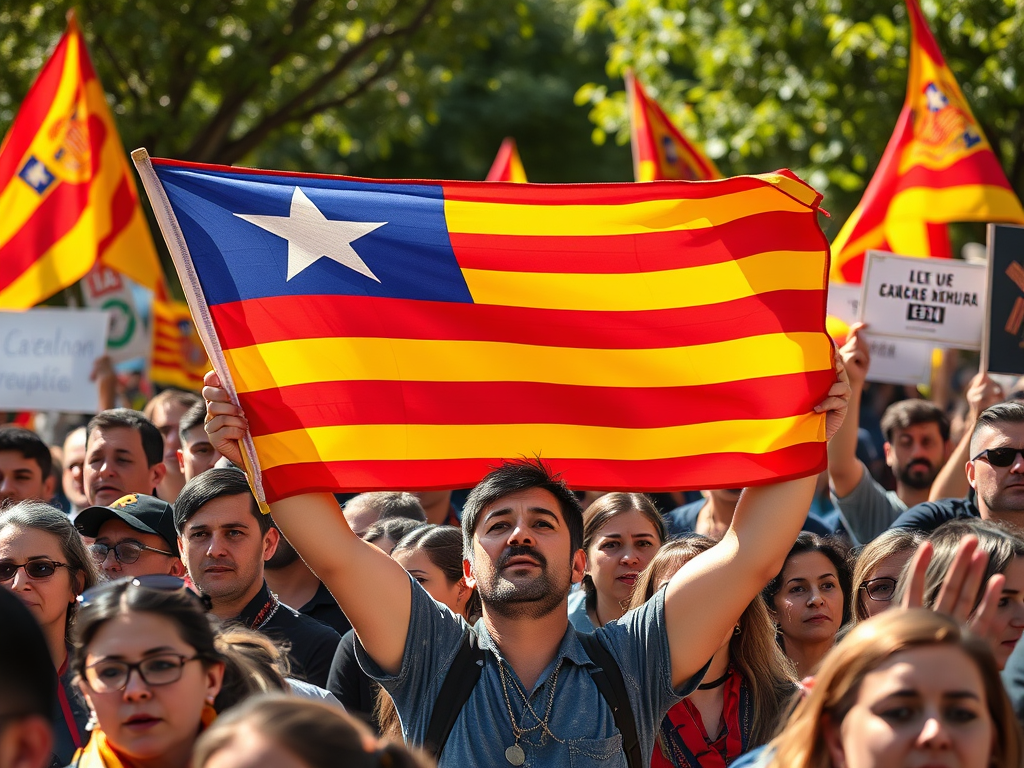
In 2022, Pedro Sánchez, Prime Minister of Spain, announced in Barcelona the approval of an amnesty measure in favor of the nine Catalan independence leaders imprisoned for organizing the 2017 referendum. The choice of amnesty — which extinguishes the offense and vacates the conviction — and not a pardon — which merely remits the sentence imposed —was taken by the government to create the preconditions for national pacification, social concord, and overcoming the clashes — including violent ones — occasioned by independence claims. There were, however, motives of electoral convenience and the need for institutional support.
The amnesty was welcomed by the independence movement, the local clergy, business organizations, and Catalan civil society more broadly. It nevertheless sparked a strong reaction from Spain’s center-right, which lined up against it.
Catalan Independence: Historical Roots and Current Context
The idea of an independent Catalonia has medieval roots and, over the course of the nineteenth century, emerged as a key idea of modern Catalanism: a cultural and political movement that exalted Catalonia’s culture, language, history, and economic peculiarities. It was then that Catalan nationalism consolidated, and the poet Joan Maragall fixed the date of September 11, 1714 — an arguably inapt date — as a symbol of the Renaixença.
During the twentieth century, Catalonia experienced alternating phases: the Second Republic recognized broad autonomy with the 1932 Statute; Franco subsequently smothered the language and self-government; and finally, in 1978, the Spanish Constitution confirmed an autonomous statute based, however, on the “indissoluble unity” of Spain.
The current procés independentista that led to the 2017 referendum arose largely after 2010, when the Constitutional Court, in the name of national unity, struck down parts of the new autonomous Statute approved in 2006, thereby reinforcing among Catalans the perception of Barcelona’s marginality within the Spanish framework.
Political Actors and Institutional Positions
In the Catalan arena, the pro-independence forces include Junts per Catalunya (the party of former president Carles Puigdemont, heir to the old CDC/PDeCAT), Esquerra Republicana de Catalunya (ERC), and the radical left CUP. All support the right to a referendum on independence, although ERC backs negotiations with Madrid while Junts and CUP press rhetorically for more radical paths.
The unionist (or federalist) parties include the PSC (Catalan socialists linked to the national PSOE), the PP, and Ciudadanos (nationalist center-right), which reject secession and instead call for constitutional reforms for greater decentralization. Finally, Vox, a far-right party, rejects any compromise on the question of Catalan independence.
Officially, in defense of the Constitution, the Spanish government recognizes no right to separate self-determination and has deemed any secessionist aspiration illegitimate. However, from 2018 onward, Madrid’s strategy has oscillated between repression—under right-wing governments — and concessions under left-wing governments. Mariano Rajoy (PP) applied Article 155 (suspension of Catalan autonomy), and criminal proceedings were opened against independence leaders. Pedro Sánchez (PSOE) launched a “dialogue table” with Barcelona, negotiated an amnesty for the leaders of the 2017 referendum, and agreed to a new financial pact on Catalan taxation. But the Spanish Supreme Court limited the amnesty, excluding abuses of public funds for which Puigdemont remains under investigation.
The Spanish Crown took an unreserved stand in defense of national unity. In an unprecedented statement on October 4, 2017, King Felipe VI accused the Catalan authorities of “driving a rupture of Spain’s unity” and of “disdaining the feeling of solidarity that unites all Spaniards.” The royal address made no mention of irregularities in the vote or police violence, emphasizing only the safeguarding of the constitutional framework.
The judiciary — from the Constitutional Court to the Supreme Court — has consistently reaffirmed the referendum’s illegality; in 2019, the Supreme Court handed down long prison sentences to the leaders who organized the consultation and the October 2017 Declaration of Independence, accentuating the institutional rift.
Finally, on the international plane, the European Union largely kept out of the dispute, calling it Spain’s “internal matter,” while the Catalan government in exile sought, unsuccessfully, support in other countries.
Main Developments from 2017 to 2025
The October 1 independence referendum was deemed unconstitutional by Madrid. Its development was marked by violent clashes with the Guardia Civil, which shut down polling stations and forced an early end to voting. Despite arrests of officials, the self-proclaimed result was 90 percent “yes” (with only 43 percent turnout). On October 27, the Catalan Parliament unilaterally declared the Catalan Republic, prompting the central government to apply Article 155: the Generalitat was placed under direct rule and new regional elections were called.
In December 2017, in the snap elections (21-D), the pro-independence parties (ERC, Junts, CUP) won a majority of seats (70 out of 135) but not of votes. ERC leader Junqueras and other officials were arrested in the meantime, while Puigdemont took refuge in Belgium. In 2018, the new president, Quim Torra (Junts), continued the strategy of confrontation. In 2019, the Supreme Court (June) issued stiff sentences (up to 13 years) for sedition against various former Catalan ministers. This generated widespread protests, but it did not fuel a new referendum. In Spain, instability led to two general elections (April and November) after the socialists failed to secure the necessary votes in Parliament. Only in January 2020 did a new PSOE–Podemos government take office, in the minority, committed to dialogue on Catalonia.
In 2020–2021, institutional dialogue struggled to take off (also due to the pandemic). In February 2021, new Catalan elections were held: the PSC emerged as the leading party, while the pro-independence coalition remained the majority in the assembly. Pere Aragonès (ERC) became president of the Generalitat in coalition with Junts. Nationally, the Sánchez government opened a negotiating table (the “Taula per la democràcia”), but results were scant.
In 2022, to secure ERC’s parliamentary support, the Spanish executive negotiated several concessions. In December 2022, Parliament approved an amnesty law that shelved proceedings related to the procés (the 2017 referendum, demonstrations, internal votes). That same month, ERC abstained in the prime ministerial vote to enable Sánchez’s investiture, in exchange for promoting an unprecedented pacto fiscal (like the Basque model) for Catalonia.
In May 2023, regional elections were held: the Catalan socialists (PSC) regained leadership in Barcelona, while the independence parties lost some seats but maintained an uncertain parliamentary majority. The count nevertheless left room for political confusion: after months of failed negotiations, in November 2023, Aragonès dissolved the Catalan Parliament and called new elections. Meanwhile, the Spanish government completed the fiscal plan: at year’s end, a framework agreement was approved under which Barcelona acquired extraordinary competencies over tax administration.
Throughout 2024, the situation remained tense. On March 27, 2025, the official institute CEO published the new political Barometer: support for “yes” to independence had fallen to 38 percent (a historic low) while 54 percent were opposed. Among the parties, Junts and CUP still declare their intention to demand another referendum today, but the loss of internal unity (the ERC–Junts split in 2024) weakens the separatist front.
On the Spanish side, the Sánchez administration is precariously supported by small forces (including ERC), and the opposition right (PP, Vox) promises to roll back the concessions if it returns to power. In the European arena, Catalonia is relegated to an “internal matter,” although the PSC’s success in the European elections —evidence of diminished separatist influence — has allowed the Spanish government to change its position, align with the EU’s plan, and recognize Kosovo.
Polls and Public Support for Independence
Today, polling data show a clear decline in popular support for Catalan independence. In 2017, various surveys indicated a situation of parity. For example, an October 2017 barometer from the Catalan government showed 48.7 percent of Catalans in favor of independence and 43.6 percent opposed. A comparable survey from March 2017 instead recorded 44.3 percent “yes” versus 48.5 percent “no.” Overall, by late 2017, roughly half of Catalans said they wanted secession.
This trend changed drastically in subsequent years. The latest CEO barometers show continued declines in “yes.” In the third quarter of 2024, support for separation had dropped to around 40 percent, with 54 percent opposed. In the first 2025 barometer, that gap widened further: only 38 percent of Catalans today would vote for an independent “Catalan State,” while 54 percent would remain opposed.
In parallel, Spain’s population has traditionally lined up by a wide majority against Catalan independence. A national poll from September 2017 showed that 60.3 percent of Spaniards wanted Madrid to prevent the referendum, versus only 29 percent who would have authorized it. There are no similarly recent nationwide studies, but there does not appear to be a reversal: Spanish opinion remains broadly in favor of the country’s unity.
The Economic Motivations Behind Independence
Economic motivations are one of the fundamental pillars of Catalan independence sentiment. The perception of inequitable fiscal treatment by the central Spanish state has fueled discontent and strengthened secessionist aspirations. Catalonia is one of Spain’s economically strongest regions, contributing significantly to the national budget. However, there is a marked imbalance between what the region pays into the central state and what it receives in public spending.
In 2021, Catalonia contributed 19.2 percent of the Spanish government’s total revenues, while receiving only 13.6 percent of total state spending. Excluding transfers linked to social security, the gap widens further: only 9 percent of the state’s discretionary spending was allocated to Catalonia. This imbalance has produced an estimated fiscal deficit of around 10 percent of regional GDP, a figure significantly higher than in economically strong regions of other countries, such as California or New York in the United States, where the fiscal deficit hovers around 4 percent.
Moreover, while regions such as the Basque Country and Navarre enjoy a special fiscal regime that allows them to collect and manage taxes directly, Catalonia is subject to the common regime, whereby tax revenues are centralized and then redistributed. This system has fed the perception of fiscal injustice among many Catalans, who see a significant share of their resources transferred to other regions without an adequate return on investments and services.
Beyond the fiscal deficit, many Catalans lament the chronic underfunding of public investment by the central state. Key sectors such as health care, education, and infrastructure are often cited as examples of this neglect. For example, the regional rail network and road infrastructure have been criticized for insufficient investment, even though Catalonia is one of the country’s leading industrial and tourist regions.
In recent years, the issue of the fiscal deficit and resource management has become central to Catalonia’s political debate. Demands for a new pacto fiscal that would grant Catalonia greater autonomy in tax collection and management have been at the heart of negotiations between the regional and central governments. However, despite some concessions, such as the approval of a new fiscal agreement in 2023, many Catalans consider the measures adopted insufficient and continue to argue for more direct control over the region’s economic resources.
Considering the economic and political tensions, one proposed solution is to adopt a model of asymmetric federalism that recognizes Catalonia’s peculiarities and grants it a higher degree of fiscal and administrative autonomy than other regions.
Prospects and the Spanish Government’s Strategies
Today, the Catalan independence movement appears to be at an impasse. On the one hand, it has achieved neither recognition nor the capacity to act unilaterally, and the decline in the polls weakens its popular legitimacy. On the other hand, the historic independence forces (particularly Junts and CUP) continue to defend a referendum as their bottom line, while ERC prefers to focus on negotiations and autonomous powers. The future scenario will depend on two key factors: the evolution of popular support and Madrid’s response.
Spanish authorities possess three main levers: legal repression, political dialogue, and institutional reform. Looking ahead, the government could push further along this line, encouraging forms of fiscal federalism (in the Basque style) or modest constitutional changes to reduce demand for independence. However, the 1978 Constitution makes it difficult to recognize a referendum or self-determination.
Conversely, Spain’s right-wing opposition calls for a return to the hard line: PP leader Feijóo has already called for repealing the amnesty and restoring full sanctions if he returns to power. If tensions were to reignite (for example, with new unilateral declarations from Barcelona), Madrid could once again invoke the courts and the constitutional veto.
On the international level, Catalonia is unlikely to obtain recognition: the EU has made clear that it would not permit the immediate admission of a “New Catalonia” to the European space, and the major states do not show particular interest in this question. For the European Union, the Catalan situation has had negative repercussions on Spanish foreign policy, initially causing it to misalign with the common line on Kosovo.
Ultimately, it is likely that the Catalan-Spanish affair will continue on slow institutional tracks: on one side, the independence leadership will try to keep alive the project of a legal referendum (including through parliamentary initiatives); on the other, Madrid will seek to shift attention to practical reforms (financial and social) while holding fast to the constitutional line. The substantial decline in support for independence itself suggests that absent new political shocks, support may stabilize at moderate levels. Madrid’s future policies — whether they entail openings (efforts at dialogue, transfers of competencies) or coercive interventions (law, courts) — will shape the actual trajectory of the secessionist movement in the coming years.
Geopolitical Conclusions
In 2017, independence sentiment was not a majority view in Catalonia. The independence elites, aware of the weakness of pro-independence feeling, forced the Spanish state to intervene. The objective was to rouse a population outraged by police crackdowns and the hard line of the right-wing government, which excluded any compromise and even dialogue on Catalan aspirations. It was a tactical maneuver common in such situations, where offense also mobilizes the more moderate — autonomists in this case — to take to the streets alongside the independence movement to rebel — according to the Catalanist narrative — against the abuses of a central state that is violent and closed to dialogue. But this tactic failed. Madrid’s “repression,” from police intervention to direct rule, did not generate enough indignation for a rebellion, only momentary tensions.
Two factors explain this course. A first external factor: no European country — despite Catalonia’s diplomatic efforts before and during the referendum — extended solidarity to Catalonia. And no country made the cause its own, supporting the independence movement financially and materially as is necessary in these historical situations. This was justified on the one hand by concerns over internal independence movements (in Italy, Germany, the United Kingdom) and by the desire not to create problems for Spain.
A second internal factor explains the lack of success: Catalonia’s demographic composition, with a high average age and a post-historical, economistic culture well represented by the Catalan bourgeoisie. For demographic reasons, Catalan society lacks the youthful, violent élan necessary for a clash with the state; moreover, its privileged, well-off condition — in which people have much to lose in such situations — does not justify a leap into the void for a sentiment that is not, in the end, so deep and is also unsupported from outside. The European Union had made it clear from the outset that an independent Catalonia would not be part of the EU and would have to begin the usual lengthy admission process, likely obstructed by Spain.
In conclusion, it is important to clarify that Spain is not a single nation but a collection of regional communities, which are remnants of an empire. The Basque Country and Navarra do not speak an Indo-European language, and Catalunya and the País Valencià have their own language and history. Therefore, Spain, like the United Kingdom and, in certain respects, also Germany, is destined to face these regional centripetal forces. It will be difficult for the dominant ethnic group — the Castilians — to keep the state together even if Madrid has won this battle. Catalonia’s sense of nationhood cannot be erased by an economic accord and is destined to bloom again in the future. Spain lacks external threats or colonial undertakings that might internally re-cohere the state or provide an outlet for violent regional tensions.
Much will also depend on the international role of the United States, which to date has guaranteed peace in Europe, and on rivalries among European countries that could one day return to age-old conflicts; in the future, someone, who knows, might be interested in destabilizing Spain by supporting independence movements.


Leave a Reply