


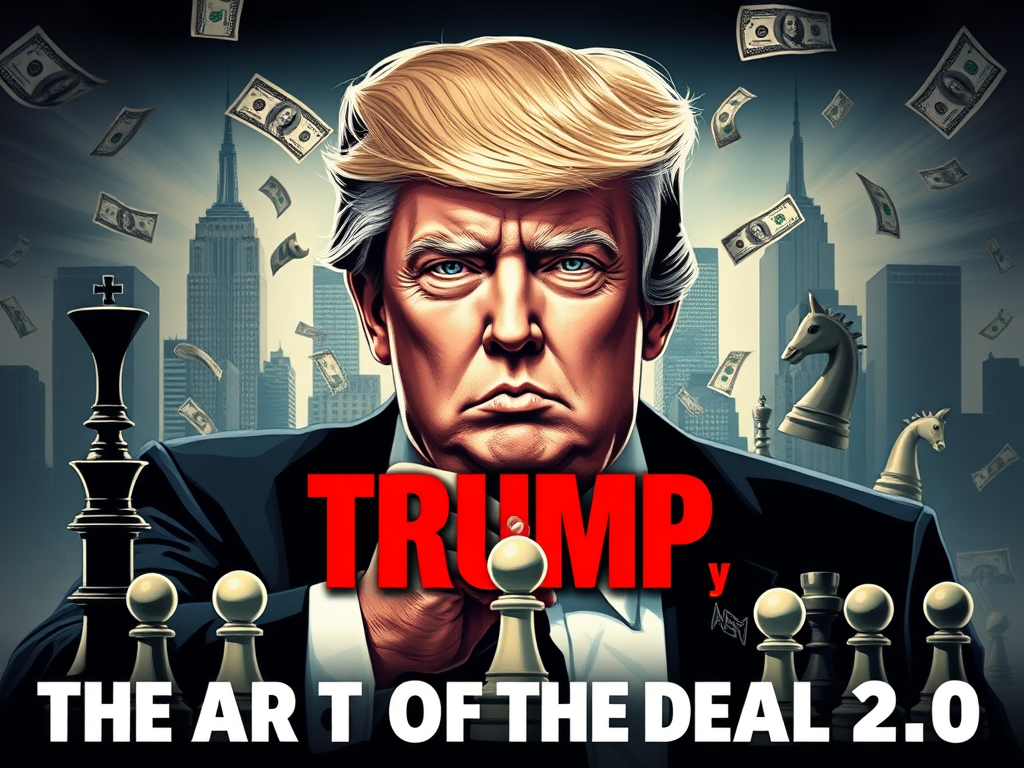
In 1987, Trump co-authored “The Art of the Deal” with journalist Tony Schwartz, a blend of autobiography, business guide, and manifesto that outlines his life and business philosophy. The book depicts his actions as a mix of instinct, aggression, and strategic thinking. The second part, which focuses on deal-making lessons, distills his negotiation philosophy into six core principles: think big, be aggressive and protect yourself, utilize the media to your advantage, negotiate effectively, surround yourself with loyal people, and adjust your stance based on the circumstances.
These aren’t your typical business guidelines; in Trump’s case, they are driven by determination, unpredictability, and even a degree of relational bullying rooted in past experiences, traits that strongly resonate with his political supporters.
Those roots include his father, the Jamaica neighborhood in Queens during the late 1950s (which he observed from his window in Jamaica Estates), his time at NYMA (New York Military Academy), and his early exposure to the corrupt world of real estate and business in 1960s New York.
Let’s analyze the negotiation techniques used by Trump and his administration today. We see a clear continuation of his past modus operandi as a brash and ruthless real estate mogul. His current approach combines calculated risk-taking, unpredictability, threats, and tactics centered around “leverage,” whether financial or otherwise. We’ve broken this down into five key points.
Trump operates under the belief that the stronger party sets the terms
He often tries to create or emphasize leverage before entering negotiations. During his first term, he engaged in trade wars and tariffs. Trump used tariffs as a bargaining tool against China and other trade partners, forcing the renegotiation of agreements such as replacing NAFTA with the USMCA. He pressured European allies by threatening to cut U.S. defense commitments unless they increased military spending. He publicly pressured the Federal Reserve to keep interest rates low, using political influence to advance his economic agenda. By doing so, he forced the other side to react instead of setting the terms.
This strategy is effective when the U.S. holds economic or military advantages, enabling it to renegotiate existing agreements in America’s favor. However, it’s risky; the leverage disappears if the other side calls his bluff. It can also harm long-term relationships with allies and partners. Furthermore, this unpredictability can weaken trust in America’s commitments, as seen with NATO allies who now fear abandonment.
Trump often pushes situations to the breaking point before finalizing a deal
He believes in pushing negotiations to the limit, forcing opponents to make concessions out of fear of worse outcomes. This was clear during the 2018–2020 trade war with China. Trump imposed tariffs on hundreds of billions of dollars’ worth of Chinese goods, fully expecting retaliation. Eventually, China agreed to a trade deal to stabilize relations. He employed the same tactic during the government shutdown, willing to shut down the government to demand funding for the border wall, relying on political pressure to persuade Congress to yield. He repeated this during the 2018 North Korea summit, threatening “fire and fury” against Kim Jong Un, then switching to diplomacy once North Korea showed a willingness to talk.
These tactics push opponents to act rather than delay, create urgency in negotiations, and prevent long-lasting debates. They are often successful in high-stakes business deals, such as mergers and property sales. However, if the other side refuses to yield, escalation can spiral out of control, as seen with China’s retaliatory tariffs. It can also cause unnecessary instability, especially in global markets. Finally, it requires a solid fallback plan; otherwise, it can backfire, as happened with Iran after the U.S. withdrew from the nuclear deal.
Trump intentionally keeps opponents, allies, and even his own administration in a state of uncertainty
His unpredictability forces others to constantly reevaluate his next move. He demonstrated this with North Korea, sometimes threatening war, and at other times proposing a historic deal. A similar pattern was observed in U.S.-China relations, which alternated between friendly diplomacy and escalating trade disputes. With Russia and Ukraine, he was sometimes tough on Russia with sanctions and military aid to Ukraine, yet also questioned NATO commitments and praised Putin.
This keeps foes guessing, making it harder to craft effective counterstrategies. It allows Trump to change positions to serve his goals. It keeps the media and public focus on him, helping control the story. But it also weakens trust; allies and enemies are less likely to take threats seriously. It creates inconsistency, hurting America’s long-term strategic interests. It also risks causing chaos that could unsettle markets and shake investor confidence.
Trump often sees negotiations as a zero-sum game, where one side wins and the other loses
He presents compromises as victories. This was evident with Mexico and the border wall: even though Mexico didn’t pay for it, Trump framed stricter immigration enforcement as a win for the U.S. With the USMCA trade deal, he claimed it was a complete replacement for NAFTA, despite most provisions remaining largely unchanged. He declared victory in the trade war with China, despite China only making minor concessions.
This approach energizes his political base by projecting strength. It creates an illusion of triumph, even when results are mixed. It pressures the other side to concede more out of fear of political backlash. However, it fosters unnecessary hostility in diplomacy and can complicate future negotiations. It also makes it harder to sell necessary compromises and risks, as overpromising can lead to a perception of failure when rhetoric doesn’t match actual results.
Trump personalizes negotiations, often attacking opponents directly to undermine them
He prioritizes personal loyalty over consensus. This has occurred with Angela Merkel and NATO; he criticized Germany’s military spending to pressure for increased contributions. It also happened with Xi Jinping and China; he went from calling Xi a “friend” to blaming him for COVID and trade disputes. It occurred with the Federal Reserve; he publicly attacked Chairman Powell for not lowering interest rates quickly enough.
This approach intimidates weaker opponents, prompting them to concede more rapidly. It keeps negotiations in the public eye, shaping public perception. It bypasses bureaucratic delays, allowing swift and decisive action. However, it also burns bridges, making future cooperation harder. It damages institutional stability and erodes trust in U.S. leadership. It risks turning negotiations into ego battles rather than meaningful policy discussions.
In conclusion, Trump’s negotiation approach has remained largely the same since 1987. It still displays a streak of relational bullying rooted in his early life that emotionally resonates with his supporters. The Art of the Deal is not just a business book but also a revealing glimpse into Trump’s 2.0 political style: aggressive, unfiltered, and centered on shaping his image as a revolutionary predator and ultimate victor.
Bibliography
Axelrod, Robert. The Evolution of Cooperation. New York: Basic Books, 1984.
Bannon, Steve. “Understanding Trump’s Negotiation Style.” Harvard Business Review, July 2020.
Bown, Chad P. “The 2018–2019 Trade War.” Peterson Institute for International Economics Working Paper, 2020.
Bremmer, Ian. Us vs. Them: The Failure of Globalism. New York: Portfolio, 2018.
Crowley, Michael. “Trump’s Brinkmanship Strategy.” The New York Times, September 2019.
Druckman, Daniel. Negotiation and Conflict Management: Essays on Theory and Practice. London: Routledge, 2011.
Fisher, Roger, William Ury, and Bruce Patton. Getting to Yes: Negotiating Agreement Without Giving In. 3rd ed. New York: Penguin, 2011.
Gellman, Barton. “Trump’s Next Coup Has Already Begun.” The Atlantic, December 2021.
Graham, Allison, and Philip Zelikow. Essence of Decision: Explaining the Cuban Missile Crisis. 2nd ed. New York: Longman, 1999.
Mearsheimer, John J. The Tragedy of Great Power Politics. 2nd ed. New York: W.W. Norton, 2014.
Rosenberg, Matthew. “Inside Trump’s Trade War Calculus.” The Washington Post, August 2020.
Schwartz, Tony, and Donald Trump. Trump: The Art of the Deal. New York: Ballantine Books, 1987.
Schelling, Thomas C. The Strategy of Conflict. Cambridge, MA: Harvard University Press, 1960.
Sestanovich, Stephen. Maximalist: America in the World from Truman to Obama. New York: Vintage, 2014.
Stengel, Richard. “Trump’s Zero-Sum Worldview.” Foreign Affairs, November 2020.
Tufekci, Zeynep. Twitter and Tear Gas: The Power and Fragility of Networked Protest. New Haven: Yale University Press, 2017.
U.S. Trade Representative. Economic Impact of the United States–Mexico–Canada Agreement (USMCA). Washington, D.C.: USTR, 2020.
Woodward, Bob. Fear: Trump in the White House. New York: Simon & Schuster, 2018.
Leave a Reply