


What could the United States become under Trump’s current term, and what shape might the new world order take? This was the question we concluded with in our previous article.
After the first 50 days of his “reign,” the new administration is focused domestically on transforming the federal government and strengthening executive power by reorganizing institutions and boosting presidential authority.
One of its main targets is the federal bureaucracy. For this reason, Trump has created the Department of Government Efficiency (DOGE), entrusting it to Elon Musk, with the mandate to eliminate “excessive” environmental and labor regulations.[1] The goal is to reduce the number of federal employees and increase the number of private contractors. It also aims to centralize power in the hands of the executive, diminish the role of Congress and independent agencies, and purge the administration of officials who are not aligned. These initiatives mark a significant shift in the management of the federal government, carrying the risk of eroding the separation of powers and granting private corporations greater influence over public decisions.
At the same time, Trump has initiated a process to grant the president more powers during crises, primarily through the widespread use of executive orders and the declaration of states of emergency.[2] He has restricted the independence of Democratic-led states — California, New York, and Illinois — by attaching conditions to federal funds. Additionally, to control the security agencies, he has replaced hostile officials in the Department of Justice and the Pentagon with loyalists in key roles. Lastly, he is politicizing the judiciary and law enforcement by increasing pressure to make courts more loyal through targeted federal court appointments and expanding the powers of the Department of Homeland Security and the FBI to investigate protests and opposition groups, labeling many demonstrations as “acts of domestic terrorism”.[3]
In terms of economic and social policy, Trump is betting on protectionism and deregulation. He has initiated a plan for forced reindustrialization based on high tariffs, corporate tax cuts, incentives for domestic production, and partial privatization of social programs like Medicare and Medicaid. While these measures may partially revive certain manufacturing sectors, they also risk raising domestic prices, reigniting inflation, slowing economic growth, and restricting international trade.[4]
These efforts may include welfare cuts and privatization of public services. An early example is the gradual reduction of Social Security, Medicare, and Medicaid under the pretense of “modernizing the system.” Another is deregulation in healthcare and education, with incentives for private insurers and private schools. Such policies cause increased social inequality, widening the gap between the rich and the poor.[5]
Finally, it is essential to highlight Trump’s aggressive tax reform plan, encompassing both economic and social policy. This plan includes additional tax cuts for corporations and high-income earners, aiming to lower federal taxes and shift the burden of public spending to the states, which disproportionately affects Democratic-leaning states. This could lead to fiscal crises at the local level, resulting in cuts to essential services.[6]
The final domestic goal is his new policy on immigration and national identity. The first involves stopping migrants and militarizing the border. Trump has declared a national emergency at the Mexican border, deployed the armed forces, fully closed the frontier to asylum seekers, and revoked birthright citizenship for the children of undocumented immigrants.[7] The second involves promoting cultural nationalism and fighting woke ideologies. This includes revising school curricula, restricting free expression in universities and the media, and attacking journalists and digital platforms that do not follow the Trumpian narrative.[8]
On the world stage, Trump seeks to redefine the United States’ role by challenging the existing global order.
His foreign policy, inspired by a sort of unilateralism and fake isolationism, abandons traditional multilateralism in favor of bilateral agreements in which the U.S. dictates the terms.[9] Trade wars and sanctions — now used as geopolitical weapons — have targeted not only hostile states but also many allies. The punitive tariffs on the EU, Canada, and Mexico serve not only to force more favorable trade renegotiations but also to pay tributes for the “wars of the Empire”. Finally, the pressure on U.S. corporations aims to repatriate production and capital that have been invested abroad.[10]
The new administration has withdrawn from international treaties, including pulling out of the World Health Organization, because it is “a corrupt system”.[11] It has also threatened to withdraw from NATO, leaving Europe to handle its own defense, and has cut economic aid to developing countries, focusing resources solely on strategic allies like Israel.
In terms of power politics, Trump is adopting a mixed strategy with China, Russia, and Iran. Meanwhile, with China, he has made the containment policy — inherited from previous administrations — more aggressive, increasing the U.S. military presence in the Pacific and engaging in a full-scale trade war through sanctions and technological restrictions. However, he has also softened his rhetoric and publicly calls Xi Jinping a friend.[12]
With Russia, he continues a double game of cooperation and rivalry. On one hand, he has eased some economic sanctions, encouraging direct relations with Moscow; on the other hand, he aims to reduce Europe’s energy dependence on Russia by promoting American gas exports. He also provides aid to Ukraine while claiming to be a friend of Putin and expressing understanding for Moscow’s territorial claims.[13]
With Iran, Trump is pursuing a maximum-pressure strategy, using economic sanctions and military threats to try to force regime change.[14] He has partnered with Israel and Saudi Arabia to isolate Tehran. Contrary to his claimed principles of reducing military commitments, he does not rule out a targeted military strike to eliminate Iran’s nuclear infrastructure. At the same time, he says his goal is to reach a nuclear deal with Iran, but on terms more favorable than Obama’s Joint Comprehensive Plan of Action.[15]
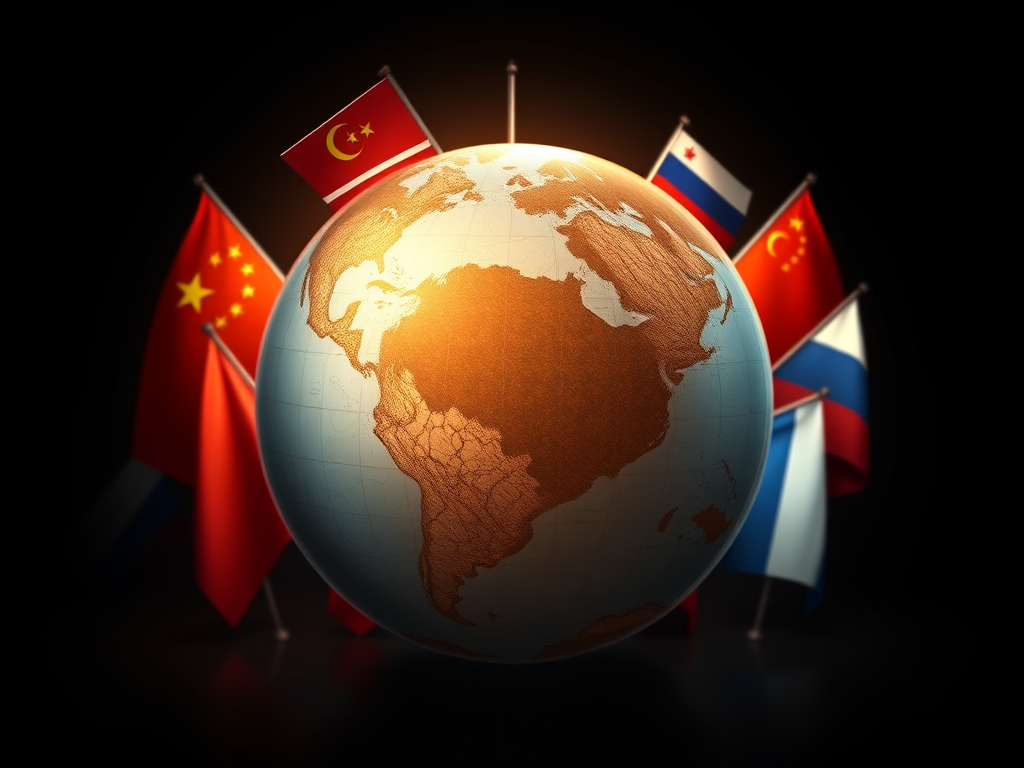
In conclusion, we are moving toward a more authoritarian and conflict-prone America. Trump aims to transform the United States into a more centralized, economically protectionist, and socially conservative nation, while globally he seeks to reshape geopolitical balances unilaterally and aggressively — foreshadowing a world where the three major nuclear powers, the United States, China, and Russia, divide up strategic territories based on their national interests.
His project heightens domestic polarization, risking protests and clashes within institutions, and damages relations with traditional allies, resulting in a more fragmented and unstable world.[16] This could lead to a decline in the United States’ global influence, with China and other nations with imperial ambitions poised to fill the gap left by the Americans.
We are experiencing the years of the “storm” predicted by George Friedman [17], and the future of the United States and the world remains uncertain; the shape of the “calm” that will follow will depend heavily on the ability of American institutions and civil society to contain Trump’s ambitions and revolutionary policies.
Notes
[1] Executive Order creating the Department of Government Efficiency (DOGE), White House Press Release, January 2025.
[2] Federal Register, “Presidential Powers in Emergencies: Expanded Authorities,” February 2025.
[3] Department of Justice Restructuring Plan, Congressional Hearing Record, February 2025.
[4] Brookings Institution, “Economic Impact of Protectionism under Trump 2.0,” March 2025.
[5] OECD, Income Inequality Trends in the United States, 2024.
[6] Tax Policy Center, “Trump’s 2025 Tax Reform and Federalism,” March 2025.
[7] DHS Report, “National Emergency and Border Militarization Measures,” February 2025.
[8] PEN America, “Academic Freedom and Media Pressure under the Trump Administration,” 2025.
[9] Council on Foreign Relations, “U.S. Foreign Policy Unilateralism in the Trump Era,” March 2025.
[10] WTO, “Trade Disputes and Tariffs 2024–2025.”
[11] NATO Secretary General Briefing, January 2025.
[12] CSIS, U.S.–China Strategic Competition, 2025.
[13] European Council on Foreign Relations, “Sanctions and Energy Realignment,” March 2025.
[14] IISS, Iran and the Axis of Resistance: Military Options, 2025.
[15] Arms Control Association, “JCPOA Alternatives under Trump Administration,” February 2025.
[16] International Crisis Group, “Risks of Global Fragmentation,” 2025.
[17] George Friedman, The Storm Before the Calm, Doubleday, 2020.
Leave a Reply