


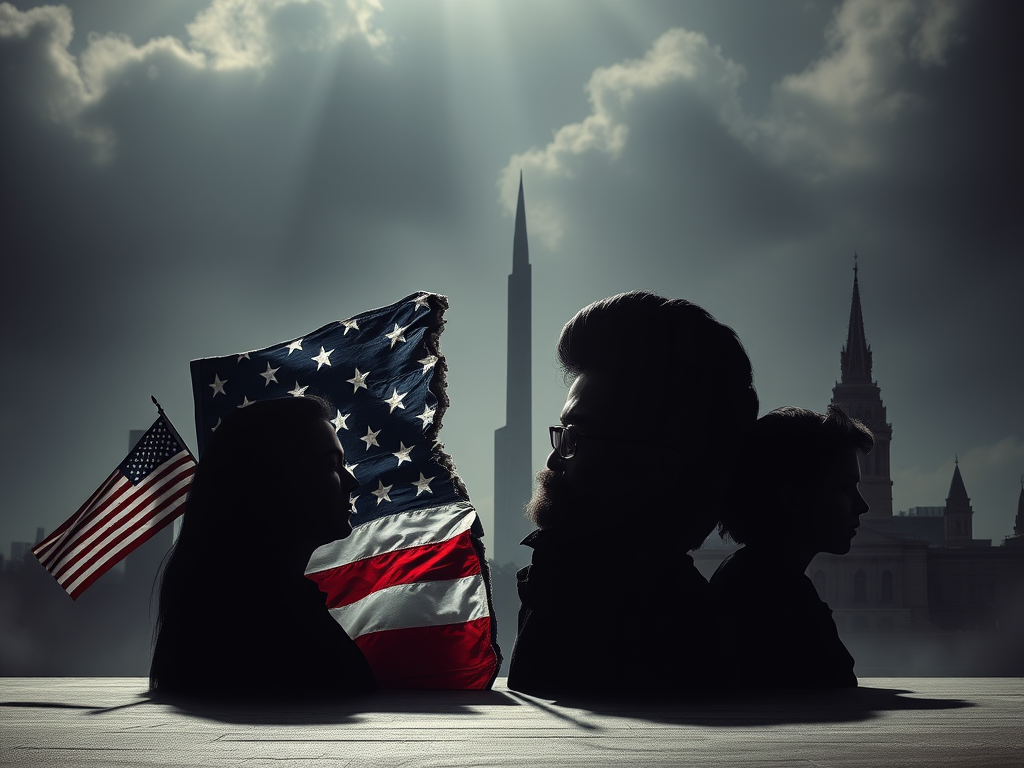
The Internal Enemy
Part I: The Origins
For over a decade, people have been discussing a crisis of American power and hegemony, stemming from internal divisions and cleavages that highlight a growing polarization threatening social cohesion. These divisions reflect rising skepticism toward institutions. In many cases, a lack of trust in state and federal authorities is accompanied by the perception that political and economic elites are disconnected from the concerns of ordinary people. Economic, racial, and identity-based challenges, along with the radicalization of political rhetoric, have created a fragmented social landscape. This instability is amplified by the media and social networks, which often exacerbate polarized opinions.
These internal fractures have deepened over recent decades, fed by historical grievances and new sociopolitical dynamics. But when did this phenomenon begin, and what are the fault lines often cited? Let’s begin by examining the origins.
America’s internal fractures date back to the nation’s founding. The adoption of the Constitution in 1787 — although innovative — established a precarious balance between North and South, particularly on issues of slavery and political representation. Initially, internal conflicts arose around key issues like racial inequality, class division, ideological clashes, and civil rights.
One of the oldest and most significant fault lines was the compromise to allow slavery in the Southern agricultural economy, in opposition to growing abolitionist movements in the North. This tension intensified during westward expansion and culminated in the Civil War (1861–1865). Even after the abolition of slavery, segregation and Jim Crow laws maintained a sharp divide between White and Black Americans, especially in the South.
By the late 19th century, industrialization created a growing class divide between wealthy industrialists and the working class. Labor movements and worker rights struggles led to strikes and social unrest, particularly during the Progressive Era in the early 20th century.
The Great Depression of 1929 and President Franklin D. Roosevelt’s New Deal in the 1930s split public opinion between those supporting greater government intervention and those fearing federal overreach. These ideological tensions intensified during the Cold War, when fear of communism and external threats sharpened the divide between “conservatives” and “liberals.”
The 1950s and ’60s were defined by the Civil Rights Movement, which challenged entrenched racial segregation and demanded equal rights for Black Americans. These decades also saw the rise of feminist, antiwar, and civil rights movements, all of which faced resistance, especially in more conservative regions.
The liberalization of the 1960s led to a conservative backlash in the 1980s with Ronald Reagan’s presidency, which promoted traditional values and rolled back the welfare state. The country became increasingly divided over issues such as abortion, LGBTQ+ rights, and the growing role of religion in politics.
Globalization and subsequent economic crises, such as the 2008 recession, widened economic disparities. Offshoring devastated rural and working-class communities, deepening the political and economic divide between those who see globalization as an opportunity and those who see it as a threat to American workers.
Since the 1990s, figures like Newt Gingrich and his “Contract with America” have further polarized American politics. This divide grew even wider under Donald Trump, who capitalized on identity-based tensions and promoted anti-establishment rhetoric, further deepening America’s social and political fractures.
Part II: The Cleavages
These internal fractures have existed since the nation’s inception and have worsened, surfacing repeatedly depending on historical, economic, and social contexts. These divisions appear to have intensified in recent years, contributing to a more polarized society vulnerable to internal crises and ideological conflicts. But what are these fault lines?
Racial fault line.
Racial divisions are deeply rooted in America’s history of slavery, segregation, and Jim Crow laws. Despite the gains of the Civil Rights Movement, systemic discrimination persists, especially in the justice system, law enforcement, education, and healthcare. Anti-establishment rhetoric has inflamed these tensions, with some factions alleging unfair advantages for minorities and others claiming continued civil rights oppression. The Black Lives Matter movement amplified awareness of racial inequality, particularly in response to police brutality. This has polarized public opinion, with one side demanding radical reforms, including defunding the police, and the other viewing these demands as threats to public safety and order.
Economic fault line.
Economic disparity in the U.S. has been exacerbated by globalization and the neoliberal policies of the 1980s and ’90s, which cut back welfare programs and promoted deregulation, often at the expense of the working class. Populist movements like the Tea Party and the rise of Trump partly respond to these inequities, as many Americans feel abandoned by political and economic elites. The 2008 financial crisis and, more recently, economic inequalities worsened by the COVID-19 pandemic have left large segments of the population struggling. While the elite thrive in sectors like tech and finance, the middle and lower classes face declining purchasing power and growing hardships.
Religious fault line.
While the U.S. was founded on the principle of religious pluralism, tensions have long existed between conservative Protestant groups and secular liberals. Religious conservatives often feel marginalized and see progressive policies as attacks on family and Christian values, while progressives argue that such values should not interfere with individual rights. Increasing secularism and advocacy for LGBTQ+ and reproductive rights have further alienated religious conservatives, who see these shifts as threats to traditional values. Court rulings on issues like abortion and same-sex marriage have intensified cultural conflict.
Political fault line.
Political tribalism has deep roots, but it worsened significantly in the 1990s with increasingly extreme rhetoric and divisive policy agendas — like Gingrich’s “Contract with America.” Today, American political life is fractured into “tribes” supporting conservative, populist, or nationalist worldviews, and others backing progressive, redistributive, or inclusive ones. Some prioritize national identity and security, while others focus on social justice and civil rights. Trump’s presidency accelerated this tribalization with his populist, anti-establishment rhetoric. Allegations of election fraud and institutional distrust have undermined legitimacy and culminated in the January 6, 2021, Capitol riot.
Geographic fault line.
Divisions between coastal and interior regions — and urban and rural areas — have long shaped American culture. Cities and coastal areas are more progressive, while rural and inland regions are typically more conservative. Rural America often values independence and tradition, while urban centers prioritize openness and innovation, intensifying value clashes. The “blue city, red suburb” divide has grown, with urban areas supporting liberal environmental policies, immigration, and civil rights. At the same time, rural regions oppose these initiatives as threats to the American way of life.
Gender fault line.
The struggle for gender equality and LGBTQ+ rights is relatively recent but central to modern American history, with significant gains since the 1960s. Some see gender rights and LGBTQ+ inclusion as essential to social justice; others view them as threats to traditional values. LGBTQ+ rights, gender equality, and the #MeToo movement have sparked backlash, particularly among conservative groups. Women’s rights, including abortion access, remain an intensely polarizing issue.
Identity fault line.
America is a nation of immigrants, yet immigration has always been controversial, especially during times of economic stress. While some Americans see the U.S. as a “white Christian nation” in need of protection, others promote a pluralistic vision embracing cultural diversity. Trump’s anti-immigration rhetoric heightened tensions, with some factions viewing immigration as a threat to security and core American values. Others argue that immigrants are vital, enrich society, and deserve rights and opportunities.
Part III: The Factions
These internal fault lines have fractured the American political, cultural, and social landscape into distinct factions, beyond the conventional progressive–conservative divide and traditional party lines, which are relatively weak in the U.S. Today, values, identities, beliefs, and lifestyles threaten national cohesion. We have identified eight key factions.
Progressive Liberals
This faction represents the political left, partly aligned with the Democratic Party, and is deeply concerned with social justice, civil rights, and economic redistribution. Progressive liberals support active government intervention to address economic and social inequalities. They advocate for higher taxes on the wealthy and strong welfare programs, including universal healthcare, affordable public education, and a higher minimum wage. They champion the rights of ethnic minorities, the LGBTQ+ community, women, and other marginalized groups. They strongly support policies to combat climate change, such as investing in renewable energy and reducing pollution. They also favor more open immigration policies and the inclusion of migrants.
Progressive liberals are ethnically, religiously, and culturally diverse. The group includes white, Black, Hispanic, and other minority elites, as well as young, educated people and LGBTQ+ individuals. Geographically, they are concentrated in major urban centers, coastal regions, and states with strong left-wing political traditions. These areas are more culturally and economically diverse and have higher education levels. Even in traditionally conservative states, urban enclaves and younger, more diverse communities often lean progressive.
Moderate Centrists
Moderates seek a balance between progressive and conservative ideas, often promoting pragmatic solutions and compromise. Politically, they may identify with either the Democratic or Republican Party, though many consider themselves independents and reject extremes on both sides. They favor fiscally responsible policies without drastic tax cuts or spending hikes and generally support a regulated market economy. While they support some progressive social causes like civil rights and economic equity, they do so more accurately and incrementally. They prefer a balanced approach to foreign policy — mixing multilateral diplomacy with strategic interventions.
Moderate centrists are ethnically, religiously, and culturally diverse, and are more geographically spread out than other factions. They often reside between progressive liberals and traditional conservatives on the ideological spectrum. Their values include economic stability, middle-class prosperity, personal responsibility, and social inclusion.
They tend to live in suburban areas around major cities, mid-sized cities, and swing states — especially in the Midwest — where pragmatic politics and economic-social balance are highly valued. These voters often determine the outcome of U.S. elections.
Traditional Conservatives
Traditional conservatives are right-leaning and largely aligned with the Republican Party. They emphasize limited government, free markets, and social institutions like family and religion. They support lower taxes, deregulation, and reduced government involvement in the economy. They uphold the nuclear family model, oppose same-sex marriage, and are typically pro-life. Many are social conservatives and evangelical Christians for whom faith plays a major role in political and social life. They advocate for stricter immigration policies and strong national security.
Traditional conservatives are a cohesive group whose identity centers on family values, economic freedom, personal responsibility, and national defense. While predominantly white, the group is increasingly ethnically diverse, especially among socially conservative Latinos, African Americans, and Asian Americans. Their culture is rooted in preserving tradition and positively viewing American history and institutions.
They are mainly found in rural and suburban areas, particularly in the South, Midwest, Great Plains, and the Rocky Mountain region. Though less present in large cities, they remain a dominant political force in less urbanized, religious areas where tradition, faith, and self-reliance shape daily life and politics.
Populist Nationalists
Aligned with the “America First” ideology and Trump’s movement, this faction emphasizes cultural and economic nationalism. They oppose globalism and mass immigration. Though part of the Republican Party, they diverge from traditional conservatives on several issues. They support economic protectionism, tariffs, and reshoring U.S. industries. They are skeptical of free trade and multinational corporations, focusing on defending American identity and traditional cultural values. They distrust political, economic, and cultural institutions, which they view as controlled by liberal elites. They are also wary of international organizations like the UN and NATO and favor a more isolationist foreign policy.
Populist nationalists are mainly white and evangelical but include some ethnic and religious minorities. Their identity is based on preserving American cultural identity, economic protectionism, and immigration control. They are intensely patriotic, anti-elite, and loyal to traditional family values and national sovereignty. They see themselves as representing “real Americans” in contrast to urban elites and progressive globalists.
They are concentrated in rural areas, former industrial zones like the Rust Belt, and some Southern and Midwestern suburbs — regions that have suffered economically and culturally. Their support is fueled by resentment toward globalization, immigration, and the decline of traditional industries.
Radical Socialists
On the far left, radical socialists advocate for structural transformation of the U.S. economy and society. Though not significantly represented in mainstream parties, they have gained momentum, especially among younger generations. They support democratic socialism, advocating for the nationalization of key sectors such as healthcare, education, energy, and significant wealth redistribution. They aim to eliminate systemic inequalities tied to race, gender, and class through bold policies targeting poverty, racial injustice, and climate change. They view capitalism as the root cause of economic and social inequality and seek to replace it with a more equitable system.
Radical socialist movements are ethnically diverse, secular, and often rooted in resistance to capitalism. Core values include economic equality, social justice, environmental sustainability, and anti-authoritarianism. Their identity is closely tied to solidarity with workers and marginalized communities, and a commitment to structural change.
These movements are concentrated in large urban areas, college towns, and parts of the industrial Midwest and West Coast. They are strongest in places with young, diverse, and highly educated populations where economic justice, climate action, and social equality are key priorities.
Individualist Libertarians
Libertarians advocate for maximum individual freedom and minimal government intervention. Economically, they align more with conservatives, but socially, they often share common ground with progressives. They support free-market capitalism, low taxes, deregulation, and limited government. Socially, they favor civil liberties, drug legalization, and same-sex marriage. They are strongly non-interventionist and oppose U.S. military involvement abroad.
Libertarians are ethnically and culturally diverse, united by a deep belief in personal liberty, economic freedom, and resistance to authoritarianism. Their culture promotes independence, personal responsibility, and individual rights. They oppose both government overreach and moral regulation.
They are most prevalent in the Mountain West, Southwest, and rural and suburban areas of states like Texas, Alaska, and Nevada — places with a strong tradition of personal freedom and self-reliance. Though less prominent in coastal cities, libertarian enclaves can be found in some college towns and entrepreneurial hubs.
White Identitarian Supremacists
This extremist faction promotes white supremacy, nativism, and ethnonationalism. Though a minority, these groups have gained visibility in recent years. They advocate for Aryan supremacy, oppose immigration and multiculturalism, and reject civil rights movements. They believe in ethnic nationalism and reject integration and cosmopolitanism, promoting a society based on white ethnic values. They often claim that global elites are threatening national identity.
White nationalist movements are ethnically homogenous — mostly of Anglo-Saxon or Germanic descent — and obsessed with preserving white racial and cultural dominance. They promote racial separation and resist multiculturalism and immigration. Their identity is built around an existential struggle to protect the white race from external threats and internal “conspiracies.”
They are concentrated in rural regions and predominantly white areas, such as the South, Appalachia, the rural Midwest, the Pacific Northwest, the Great Plains, and parts of the Southwest. These movements often flourish in areas facing economic or demographic shifts, where isolation and virtual communities fuel their ideology.
Religious Social Conservatives
In addition to traditional conservatives, there is a strong religious faction in the U.S., including evangelical Christians, conservative Catholics, Mormons, and some conservative Muslims. These communities defend traditional moral values and religious freedom and oppose abortion and LGBTQ+ rights. They play a key role in politics, especially in the Republican Party and the Tea Party movement, pushing for legislation that reflects their religious convictions.
Religious social conservatives are ethnically diverse but united by shared faith and resistance to progressive social and cultural change. Their culture emphasizes public morality, patriotism, and the preservation of religious and family values. Their worldview revolves around the sanctity of life, traditional sexuality, and religious liberty.
They are mainly located in the South (the Bible Belt), the Great Plains, the Rocky Mountains, and parts of the Midwest and Appalachia — especially in rural and suburban areas where Christianity, especially Evangelicalism and Mormonism, remains central. While present in other regions, these areas are strongholds of religious conservatism and closely linked to politics.
Conclusion
America’s internal fault lines, factional divisions, and the inability of these “tribes” to maintain constructive dialogue are leading to a breakdown of national cohesion. They are weakening the effectiveness of government institutions, eroding public trust, undermining internal security, blocking redistributive economic policy, and exposing the country to external vulnerabilities.
The impact is complex and profoundly negative, fragmenting the United States and weakening its core. These internal dynamics destabilize domestic politics and society, diminishing America’s ability to respond cohesively to crises and maintain its global leadership. Perhaps this lack of internal cohesion — born from these deep-seated domestic fractures — is the actual internal enemy, and the most dangerous one the United States faces.

Leave a Reply